Harris County’s top legal figures announced a program aimed at expanding access to domestic violence protections during a press conference Oct. 2.
About the program
The Protective Order Extended Team, or POET, is made up of trained social workers and administrators who work to support domestic violence survivors countywide and help file protective orders, according to a press release. The civil orders provide legal safeguards for victims of violence or harassment, according to the Texas State Law Library.
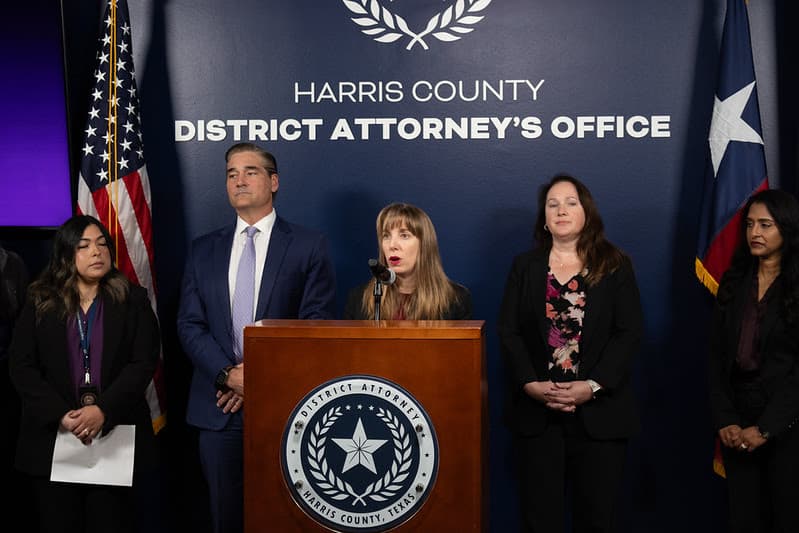
Harris County District Attorney Sean Teare and Harris County Attorney Abbie Kamin announced the initiative at a joint press conference.
Kamin said the county has the state's largest number of domestic violence homicides, and nearly one-third of the county’s homicides are domestic violence-related. A 2025 report from the Texas Council on Family Violence found 26 people were killed in intimate partner violence cases in Harris County.
“More people can now have access to counseling, resources and legal protection as we move them towards safety and stability,” Kamin said.
The nine-member POET team will work at locations throughout the county to help survivors with relocation, jobs, financial assistance and protective orders, Teare said.
“Instead of just going through this process downtown, forcing survivors to come downtown to get resources that we had and need, we’re going out into the community and meeting people where they are,” Teare said. “We are starting this very intentionally and plan to grow it over the next few years to be able to service every single community in this vast county.”
The program launched two days into Domestic Violence Awareness Month, which is observed throughout October. The announcement also coincided with the start of a program between Harris County Precinct 4 and the Harris County Sheriff’s Office, designed to protect survivors as deputies serve warrants to wanted family violence offenders in the precinct.
How it works
POET will offer its services to survivors for free, regardless of background, immigration status or circumstance, said Mary McFaden, who oversees the HCDAO’s Domestic Violence Bureau. The bureau handles cases related to intimate partner crimes that are filed in the county, according to its website.
Through POET, McFaden said her staff will work with “selected referring agencies” to contact the survivor and complete a preliminary interview to ensure they qualify. The advocate will then meet with the survivor at a neutral location to:
Advocates and HCDAO staff will work to file protective order paperwork on the survivor’s behalf and represent the survivor in court for free, McFaden said.
“A survivor does not have to call law enforcement in order for us to help him or her with a protective order,” McFaden said. “We will do that regardless of whether law enforcement or the criminal justice system is involved.”
In 2025, the Harris County Commissioners Court approved $7.5 million for the HCDAO to expand its domestic violence and mental health bureaus. Through that funding, McFaden said the HCDAO has hired four advocates to work with survivors. Kamin’s office has agreed to fund an additional five advocate positions, McFaden said.
More details
To begin the protective order process, survivors can:
The HCDAO application for protective order services is available in Spanish and English, McFaden said, and can be emailed to the office. Advocates and staff are able to communicate with survivors in nearly all languages, she added.
“Our mission is to ensure survivors have access to safety and justice wherever they are,” McFaden said.