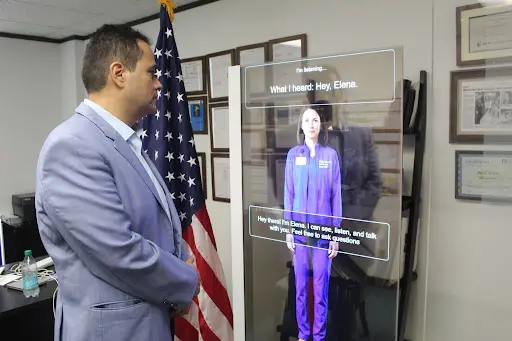
Aexa Aerospace founder Fernando De La Peña Llaca interacts with "Elena," an AI-powered hologram depicted in a nurse’s uniform. "Elena" was created to be a resource for hospital visitors. (Rachel Leland/Community Impact)
In 2021, NASA flight surgeon Dr. Josef Schmid was holographically teleported to the International Space Station using artificial intelligence.
A female astronaut checking her email turned around and saw his 3D hologram floating next to her and yelled, “Hey, go back! You’re invading my personal space,” before laughing and apologizing to mission control on the ground.
Fernando De La Peña Llaca, founder of Clear Lake-based Aexa Aerospace, which created the AI-powered hologram, said the astronaut’s reflex to the hologram invading social boundaries speaks to how convincingly human the holograms feel.
Current situation
De La Peña Llaca said as a creator in this field, one of his goals is to dispel the myth that AI innovation only happens in California’s Silicon Valley.
While California still dominates AI development and investment, Texas—including Houston's Bay Area—is making gains in workforce adoption of AI technology.
In Houston's Bay Area, AI innovation is taking shape alongside these concerns.
However, AI adoption does not come without concerns and risks, from the spread of AI-generated misinformation to questions about the technology’s reliability in high-stakes environments.
What to expect
Now, De La Peña Llaca hopes to expand the technology to a variety of industries far outside the aerospace world.
Aexa Aerospace secured a contract with a Texas airport to install holographic AI units in an international terminal during the World Cup. The AI agents were trained to answer travelers’ questions in multiple languages. De La Peña Llaca hopes to train the agents to communicate in over 88 languages in addition to making the agents pick up non-verbal cues.
"A lot of people arrive with a lot of stress. 'Where is my flight? Where is my baggage? How can I get to my hotel?'" De La Peña Llaca said. "What we found is that it needs to be more human, so we developed something called Aexa Aware … [which reads] your body language and micro-expressions to create more empathy."
The AI agents will also be installed in local clinics and MD Anderson to help patients check in and families navigate large hospitals.
A closer look
Throughout all sectors of labor in Houston, workers polled in a survey said they expect AI to make at least a minor impact in their workplace.
Zooming in
Houston Methodist Clear Lake staff have been able to reduce systemwide documentation by 40% with AI tools, said Heidi Reigel, Houston Methodist Clear Lake Hospital’s vice president and chief operating officer.
Hospital nurses spend up to 60% of their 12-hour shifts documenting care, Texas Nurses Association CEO Serena Bumpus said.
“We've seen a significant increase in patient experience scores because our clinical staff can actually spend quality time at the bedside with our patients and get there quickly," Reigel said.
When hospitals adopted electronic health records decades ago, nurses were largely excluded from designing the software, Bumpus said. She added to avoid making the same mistake with AI, point of care hospital staff should be involved in designing and building AI tools.
Growing challenges
While local officials say AI has benefited workplace needs, AI integration is not without risks and the Bay Area’s biggest employers are aware of the new challenges posed by AI.
"Deepfakes" are sometimes more subtle, said Troy LeBlanc, chief information officer of the NASA Johnson Space Center, pointing to an altered photo that was generated by AI, which showed an Orion capsule with severe heat damage.
To block deepfakes at the source, NASA is working with camera manufacturers and software developers to embed cryptographic credentials and origin metadata directly into the image file at the exact moment the astronaut or photographer clicks the shutter button, so downstream manipulation can be detected, LeBlanc said.
Mission control flight controllers often have to make life or death decisions in real time, and AI tools could add irrelevant data, LeBlanc said. For example, AI tools could flag false hazard reports and distract controllers from genuine flight abnormalities, putting crew safety at risk.
LeBlanc said reliability does not equal trustworthiness, before adding that AI should be used as an assistant, not a replacement for human judgement.
"Sending humans into space takes highly skilled teams to accomplish all the time,” LeBlanc said. “As the technology advances, the human element always has to be present as the core of how we go out and explore the world.”