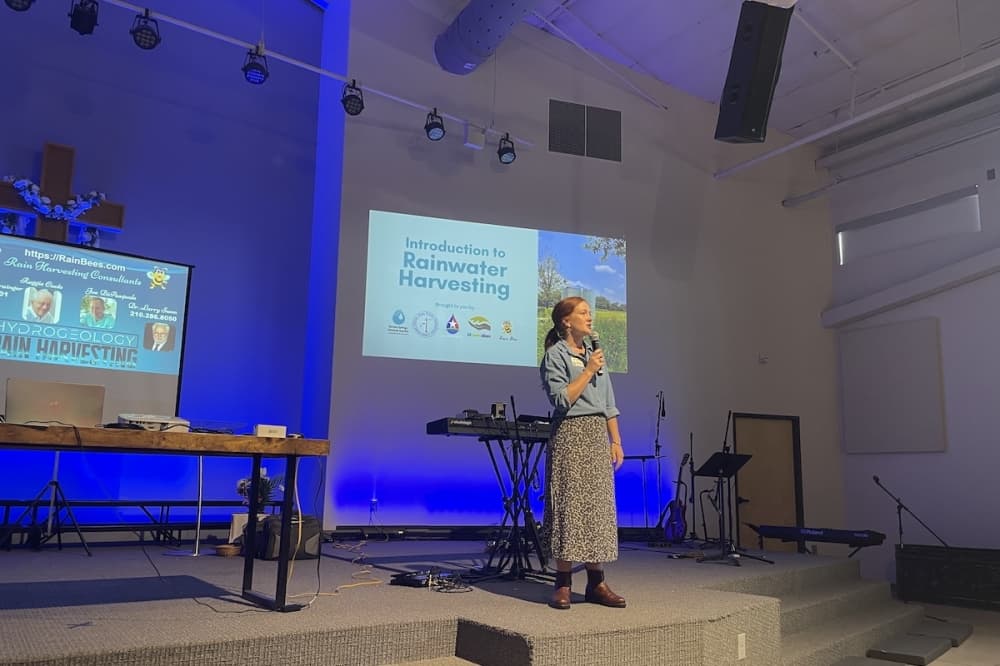
Population growth, decreased rainfall and drought are among the factors contributing to the water supply conditions in Central Texas. Hill Country Alliance, RainBees and several Central Texas groundwater conservation districts hosted a presentation April 28 in Dripping Springs to inform local homeowners and community members about rainwater harvesting as an alternative to wells.
RainBees offers free consulting services related to designing and installing a rainwater harvesting system for businesses, builders and homeowners.
The details
There are two main types of rainwater collection systems: dry and wet. In a dry system, tanks are closer to the house or structure, and pipes deposit water directly into the tanks.
In a wet system, tanks tend to be further from the structure. Pipes are installed underground and come above ground closer to the tank. When the rain stops, wet systems will still retain water in the pipes. A wet system also features a low-point cleanout, allowing water to be released before freezing temperatures to prevent the pipes from being damaged, according to RainBees consultant Larry Sunn.
Why it matters
Although the water supply conditions of lakes Buchanan and Travis are normal due to large amounts of rainfall last summer, groundwater is in “really bad shape,” according to Lane Cockrell, Southwestern Travis County Groundwater Conservation District, or STCGCD, general manager.
Due to a variety of factors, including aquifer depth and porosity, the Lower Trinity Aquifer is not as readily recharged as surface water, and some areas will not be recharged for thousands of years, Community Impact previously reported. Barton Springs-Edwards Aquifer Conservation District, or BSEACD, general manager Charlie Flatten said, “We need ... to find alternative sources of water.”
As of May 15, the STCGCD and BSEACD have both declared extreme drought. The Hays Trinity Groundwater Conservation District is in an emergency stage of drought, with the district predicting that 37 inches of rain is needed over the next six months to end it, which has a less than 1% probability of occurring.
By the numbers
Sunn provided several formulas to help home owners calculate how much water they would need to collect for their own system.
For every inch of rain, each square foot of roofing can collect 0.62 gallons of water. A system with a 2,400-square-foot roof can collect 1,488 gallons per inch of rainfall.
To calculate the amount of water needed for a given household per day, multiply the number of people by 50. A family of four uses roughly 200 gallons of water per day.
RainBees consultants recommend that people keep three months of water supply on hand to account for periods of reduced rainfall. For a family of four, that equates to roughly 18,000 gallons.