Amid growing electric demand, Texas lawmakers are working on legislation that would increase regulations on large electric consumers, including data centers.
At a glance
Demand on Texas’ power grid reached a record 85,508 megawatts in August 2023, and the Electric Reliability Council of Texas has estimated it will grow to about 150,000 megawatts by 2030. Lawmakers have said large data centers and industrial projects could cause significant strain to the grid unless changes are made.
“We have single customers coming to Texas with an electric demand that surpasses the size of cities’ needs,” Rep. Ken King, R-Canadian, said during a May 7 hearing of the House State Affairs Committee. “Within the next few years, the entire [Rio Grande] Valley has an electrical peak demand of three gigawatts. Stargate in Abilene has electric demand projected to be twice that in 2030.”
To address these challenges, legislators are considering Senate Bill 6, a wide-ranging measure that proponents say would strengthen the power grid, boost accountability for large consumers and better protect residential customers from outages. Critics said SB 6 could negatively affect public safety and hinder new economic development in Texas.
“We're talking about the future of the economy. ... Our economy is so deeply tied to our energy systems that it's not hyperbolic to say the future of the state's economy hinges on some of these decisions,” Austin-based energy consultant Doug Lewin told Community Impact.
State senators passed SB 6 unanimously in March. After two hours of discussion on May 8, the House State Affairs Committee left the bill pending. Ken King, who is sponsoring SB 6, said he would propose an amended version of the bill during a future committee meeting.
What you need to know
One of the primary goals of SB 6 is to rework how Texas handles power grid emergencies. During a Senate committee hearing in February, bill author Sen. Phil King, R-Weatherford, said utility providers need more flexibility to manage “non-critical” large loads during extreme conditions.
To prevent a systemwide blackout in an emergency, ERCOT uses a process called “load-shedding,” which involves directing transmission companies to temporarily disconnect some customers, according to agency documents. Phil King said smaller customers, including residences, sometimes lose power first in these situations.
“Remember, during [Winter Storm] Uri, no one died at the office building and no one died at the manufacturing plant,” he said on Feb. 27. “They all froze to death in their homes in 2021 and that will never happen again. It cannot.”
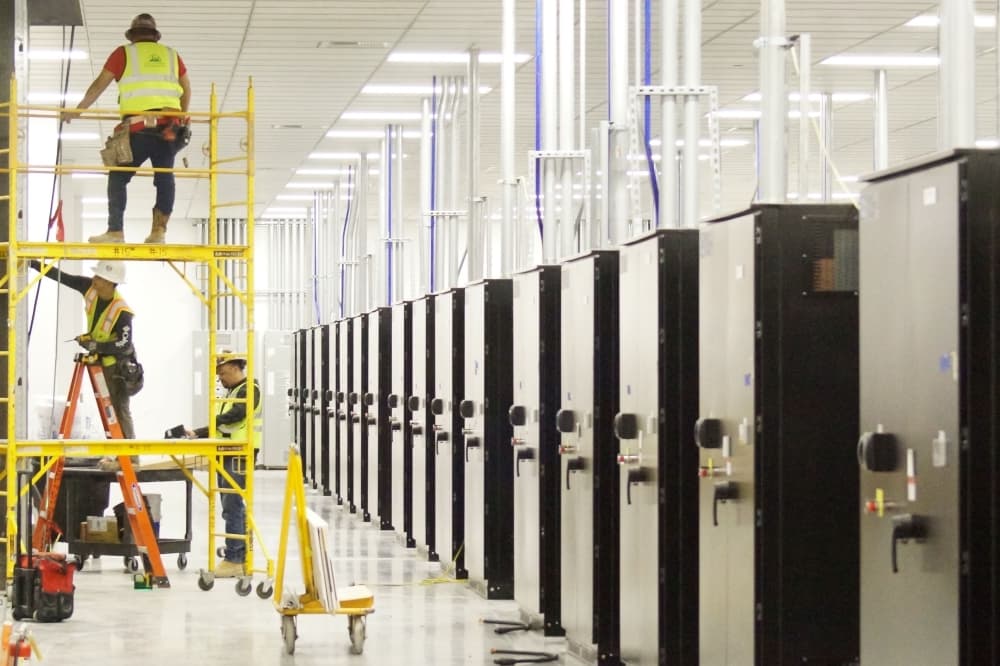
During emergencies when load-shedding is necessary, SB 6 would require customers that use at least 75 megawatts of power, such as data centers, to switch to backup generators to reduce strain on the grid. Large customers would also need to install equipment allowing the state to remotely disconnect power from their facilities, known as a “kill switch” provision.
During the February Senate hearing, Dan Diorio, a senior policy director for the Data Center Coalition, said he was concerned about the unintended effects of these proposed rules. According to the coalition, data centers are buildings that organizations use to “house their critical applications and data”—and Diorio said shutting off their power could impact public safety.
“[Data center clients] include a range of essential services such as federal, state and local governments, law enforcement, cybersecurity [and] hospitals,” Diorio said Feb. 27. “They require and depend on the data center to maintain constant uptime, to provide uninterrupted services. Even a momentary interruption of that service can have significant consequences.”
Lewin said data centers need to be able to “work in partnership” with state officials, rather than giving ERCOT the authority to shut off their power.
“This is where the kill switch thing is problematic. ... If we’ve got a winter storm coming, the last thing we can have is the AI data center processing calls for a 911 call center being shut down,” Lewin said in an interview.
Some stakeholders told the House committee that companies building data centers may look at other states if the current version of SB 6 becomes law.
“We do support the effort to ensure that appropriate requirements for reliability protections and transparency are in place. ... However, SB 6 could create roadblocks for needed new generation and large load built in Texas,” Walt Baum, CEO of the trade association Powering Texans, said during the May 7 hearing. “I think there's a lot of reasons why... you've seen a lot of new announcements in other states over the last several months, and not as much here in Texas.”
Baum said he hoped House amendments to SB 6 would “signal that Texas is innovative, excited and open for business, while maintaining reliability and affordability for all Texans.”
More details
SB 6 would also adjust how ERCOT measures future electric demand. In February, Phil King said current formulas rely too much on hypotheticals.
“No one knows if this 150 gigawatts is real. ... ERCOT and the [Public Utility Commission of Texas] just simply aren't sure if the large loads in their interconnection queue are real or just speculative,” he said. “Without credible data on these potential loads, we run the risk of over-building with high costs being passed on unnecessarily to customers—or we could underbuild, further exacerbating scarcity.”
ERCOT CEO Pablo Vegas told senators that SB 6 would help make “the grid today and the grid of tomorrow” more reliable.
“Being able to better understand the load forecast that's coming in [is] a really critical element to this, because so much of what we do depends on having a good load forecast,” Vegas said on Feb. 27. “If we can use flexibility in modeling and in doing our reporting, then we'll be able to reflect more accurately ... what the grid's risks are in the future.”
Under SB 6, large customers that intend to join the ERCOT grid would be required to pay their local utility company a $100,000 fee before the planning process begins.
“We believe there is a large amount of phantom load in the queue,” Will McAdams, president of McAdams Energy Group, said May 7. “These are projects that may or may not be real. Bringing transparent standards for all loads wishing to interconnect will help ERCOT better understand what's real or not.”
Bills must be approved by both legislative chambers before they can become law. Texas’ 140-day regular legislative session ends June 2.