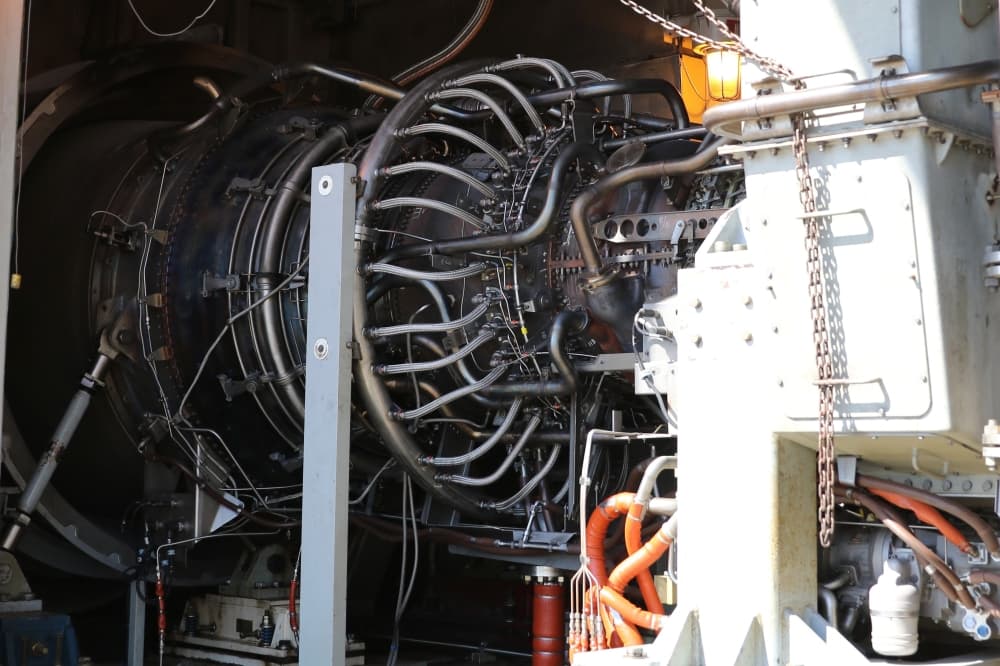
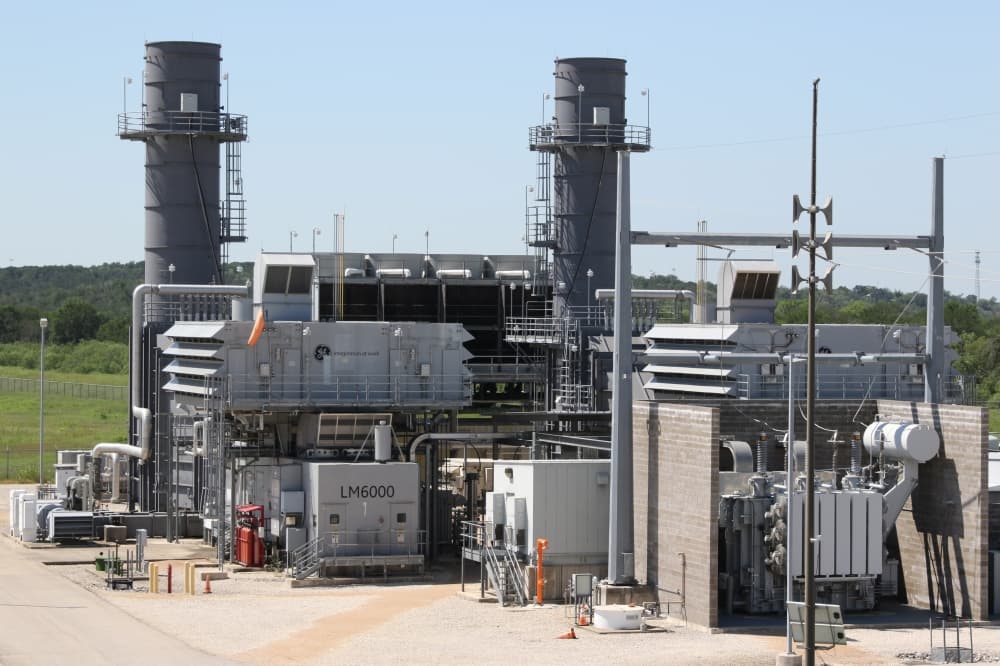
Austin Energy operates single cycle peaker units at the Sand Hill Energy Center. (Courtesy Austin Energy)
City Council required additional monitoring and mitigation measures as Austin Energy brings new natural gas generation units online, a week after officials signed off on the controversial project.
The setup
Since the adoption of AE's Resource, Generation and Climate Protection Plan to 2035, the city-owned utility has been working to add new generation capacity to its Austin-area grid in a push for reliability and sustainability.
This year, the process led to several long-term contracts for solar installations and battery storage. It also included agreements for nearly 300 megawatts of wind capacity, as well as 400 MW from new natural gas "peaker" units. That strategy was approved behind closed doors this spring over broad community objections.
AE already uses natural gas peakers with hundreds of megawatts of capacity at two main East Austin power stations. The backup installations are viewed as an "insurance policy" for times of peak power demand, from a hot summer day to severe weather incident.
Utility officials said adding more of the fossil-fuel emitting peakers to the local generation portfolio will stabilize Austin's grid as customer demand, and the potential for major climate and weather impacts, increases. They reported AE would be at significantly higher risk of blackouts in extreme times of high power demand if new peakers aren't installed.
Council, serving as AE's board, signed off on the utility's planned peaker expansion May 21 in a closed executive session. The project's cost and other details haven't been publicly shared; both city and utility officials said secrecy is needed due to competitive power market issues.
Ahead of that May vote, dozens of residents stated their opposition to both the approval process and overall peaker plan. Concerns centered around adding more carbon dioxide- and nitrogen oxide-emitting facilities given Austin's goals to slash greenhouse gas emissions, and whether the peakers' location would continue a local history of disparate environmental impacts.
Austin Energy operates single cycle peaker units at the Sand Hill Energy Center. (Courtesy Austin Energy)
The conditions
While council members privately voted to advance AE's peaker initiative, several expressed reluctance about the plan and shared doubts with Austinites who'd testified against it. Officials went on to approve a group of resolutions to serve as community guardrails as the project moves forward, which would:
Cap peakers' CO2 and NOX emissions, ensure they're only turned on at times of highest need, and evaluate when AE's current peakers could be retired after new units are added
Mitigate negative impacts from peaker construction, including utility benefits for nearby residents
Consider environmental justice issues in East Austin when placing the new peakers
Revamp AE's electric vehicle charging and battery storage programs to limit power grid impacts
Council member Mike Siegel, who joined council members Ryan Alter, José Velásquez and Zo Qadri in bringing those measures on May 28, called the earlier May peaker vote an "unhappy choice" due to concerns over cost, pollution and the approval process.
“I think it's fair to say that these resolutions reflect our concerns and misgivings about the peaker plan," he said in an interview. "In the bigger picture, the city of Austin is doing a wonderful job compared to most cities in this country in prioritizing renewable energy by having a really robust and equitable electric generation plan. ... But this decision feels like a step backwards towards a fossil fuel-free future."
What they're saying
Alter said he brought his item, geared toward limiting peakers' environmental effects, to protect local air quality and ensure AE's gas emissions don't rise in the long run. A new policy to cap emissions and adjust peaker operations will be presented to council by the end of next year.
Noting that there's no perfect site for the new facilities, Siegel said his measure is aimed at "placement justice" as peakers are installed. A new utility program under his resolution could resemble AE's previously planned Solar for All benefit program, before its termination by the Environmental Protection Agency.
"For the communities that are next to these polluting facilities, how do we make investments that provide a sort of reparation to the harm they're experiencing to their air quality?" Siegel said. "The closer you live to one of these facilities, the more likely your children are to have asthma or other health impacts. And that's indisputable."
Also focusing on peaker locations, Velásquez referenced the city's history of infrastructure placements and said he aims to ensure new facilities aren't solely sited east of I-35.
“Over the past 100 years, Austin’s Eastern Crescent has disproportionately shouldered the impacts of decisions imposed on them by a ruling class that devalued their health and well-being," he said. "With this item and in the interest of environmental and social justice, we are prioritizing a balanced range of sites across our city—bearing in mind that the 10 existing peakers are exclusively located in East Austin.”
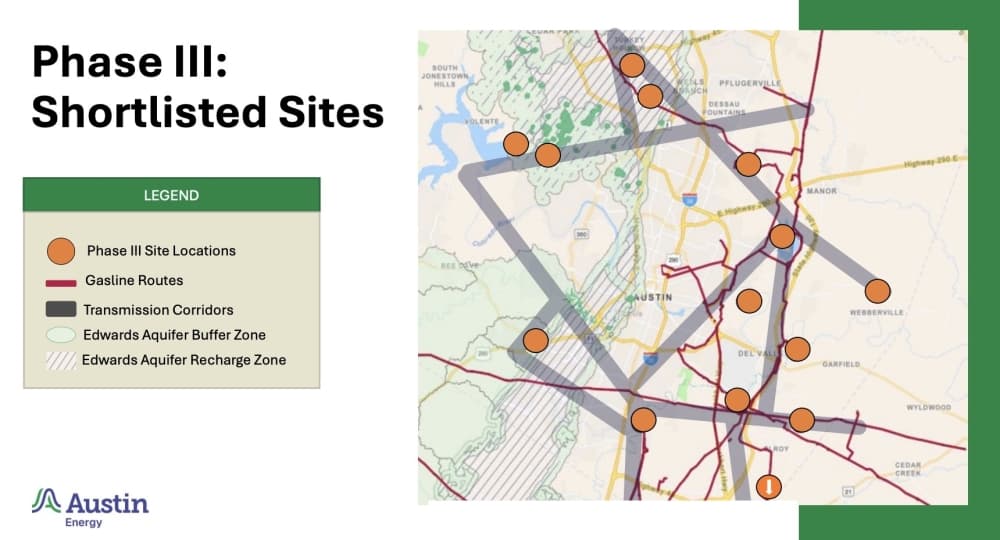
AE currently has a shortlist of more than a dozen possible peaker locations, most on the east side, and further community outreach is planned as final placement choices are made.
Austin Energy has a shortlist of potential locations to install new natural gas peaker units. (Courtesy city of Austin)
Finally, Qadri said his item could limit overall reliance on any peakers by encouraging smart EV charging strategies when overall power demand and costs are lower.
“My hope is that this resolution helps Austin continue leading around innovation, while also setting on a long-term path toward reducing reliance on peaker plants and other higher emission energy sources over time," he said.
Flood updates: Heavy rain, potential flooding impacting I-35 corridor this week