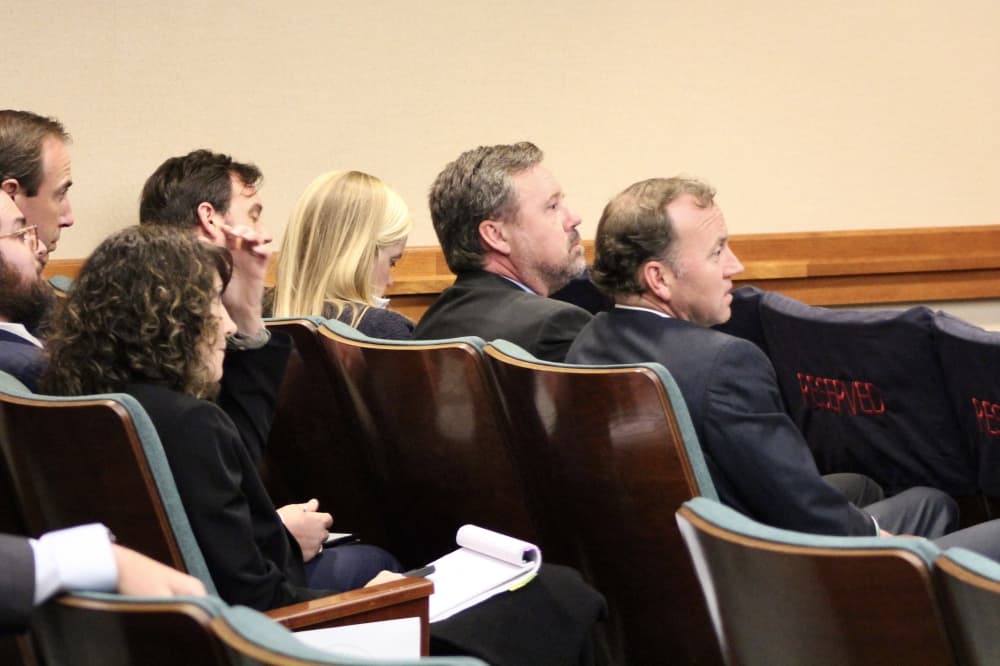
Members of the Eastland family, which runs Camp Mystic, and their legal counsel listen to testimony during an April 28 hearing at the Texas Capitol. (Hannah Norton/Community Impact)
Camp Mystic, the Texas Hill Country camp where 28 people died in catastrophic flooding last July, announced April 30 that it will not welcome campers this summer.
The decision comes nearly 10 months after 25 young campers, two teenage counselors and the camp’s executive director, Dick Eastland, died as the Guadalupe River camp flooded July 4. Camp Mystic’s owners had planned to open a secondary campsite in late May, but backed down at the urging of flood victims’ families and state lawmakers.
“As parents, we are left asking hard questions that cannot be withdrawn or postponed. We will continue to seek answers, because honoring our daughter means demanding better for every child,” Ryan and Elizabeth DeWitt, whose 9-year-old daughter, Molly, died at Camp Mystic, said in a statement.
A spokesperson for the Department of State Health Services, which licenses Texas youth camps, confirmed to Community Impact that Camp Mystic had withdrawn its application to operate in summer 2026.
The Eastlands backtracked two days later, writing that they did not want to “unintentionally effect further harm” on flood victims and their families.
“We also recognize that over 800 girls want to return to Camp Mystic Cypress Lake this summer,” Camp Mystic officials wrote in an April 30 statement. “Our special bond with our Camp Mystic families does not change or end with the announcement. We love each of you.”
A DSHS spokesperson said Camp Mystic’s 2025 license expired March 31. Under state law, all summer camps are allowed to continue operating while their licenses are being reviewed, but since Camp Mystic withdrew its 2026 application, its license is no longer active, according to the DSHS.
During legislative hearings this week, the Eastlands apologized to the victims’ parents and acknowledged that they could have done more to respond to the deadly flood. The family also defended its efforts to better prepare for future summers, noting a 60-page emergency plan that was in the works.
“We tried our hardest that night, and it wasn't enough to save your daughters,” Edward Eastland, one of the camp’s directors, said. “I regret not communicating more with each of you earlier, and I'm so sorry.”
The families of the girls who died at Camp Mystic attended court and legislative hearings in April, holding photos and wearing pins honoring their late daughters, who are known as the “Heaven’s 27.” Seven of those families testified at the state capitol April 28, telling lawmakers this was the first time many of them had seen the Eastlands in person since dropping their children off at camp in late June.

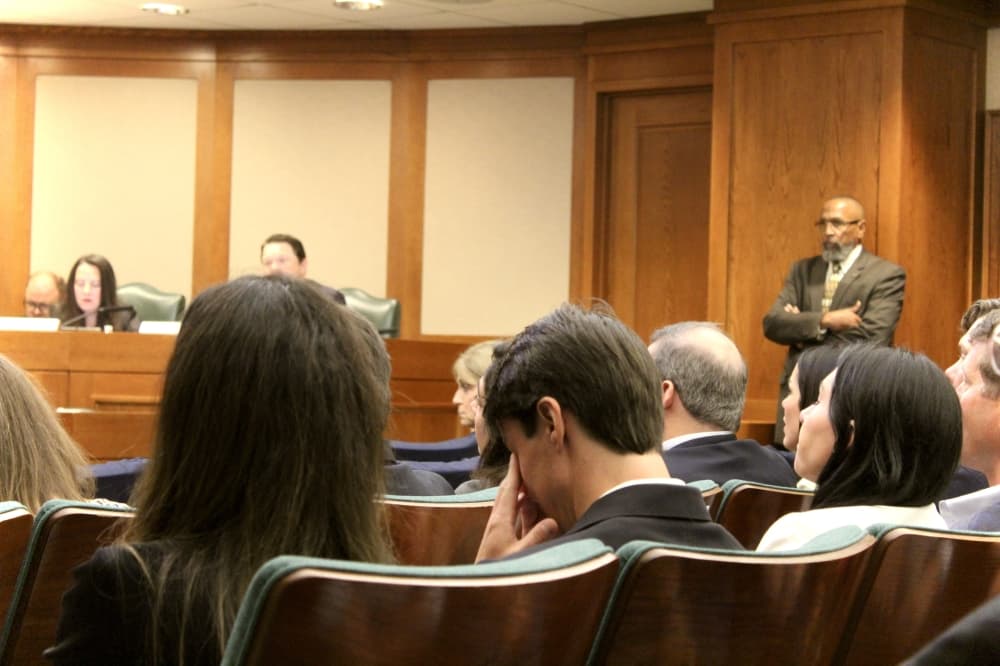
The father of a young girl who died in the July 4 flooding at Camp Mystic wipes his eyes during an April 27 legislative hearing. (Hannah Norton/Community Impact)
“No camp will be safe for any child as long as the Eastlands are associated with it,” CiCi Steward said. “If a child dies at a Texas camp this summer, it will not be because we lack the information to prevent it. It will be because we did not act on it.”
Steward’s 8-year-old daughter, Cecilia “Cile” Steward, is the only camper who remains missing after the flood.
What’s happening
The April 30 announcement comes as multiple state agencies and the Texas Legislature are investigating the all-girls Christian summer camp over allegations of insufficient safety measures and disaster response practices leading up to and during the July 4 flood.
“No administrative process or summer season should move forward while families continue to grieve, while investigations continue and while so many Texans still carry the pain of last July’s tragedy,” Camp Mystic wrote.
Investigators laid out a detailed timeline of the tragedy during an April 27 hearing. They said evidence shows that all deaths at Camp Mystic could have been prevented if camp leadership had taken action sooner and had a written evacuation plan.
Despite cabins being located within hundreds of feet of the flood-prone Guadalupe River, Camp Mystic did not have detailed plans for floods or other emergencies, investigators and victims’ families said. They spoke of untrained counselors and staff, inefficient evacuations and an “obedience culture” that they said drove some girls to stay in their cabins as floodwaters rose.
“[The girls] were obedient to a fault, to where these cabins filled with water and they weren't going anywhere,” committee co-chair Rep. Morgan Meyer, R-University Park, told the Eastlands April 28. “These girls listened to y'all, they listened to their counselors, and if there was an evacuation plan, you wouldn’t have lost any girls.”
National Weather Service records show that a flash flood warning was issued for portions of South Central Texas—including Camp Mystic—at 1:14 a.m. July 4. Investigators said camp patriarch Dick Eastland, who later died in the flood, was aware of flood risks to the area and began looking for more forecasting information on his phone immediately after he received the NWS alert.
The state timeline shows that Dick Eastland and other Camp Mystic leaders did not begin evacuating cabins until about 3 a.m. July 4, which left them about 30 minutes before floodwaters were too high to walk or drive through. Investigators said the Eastlands did not use a public address system located throughout the property to order evacuations, noting there was “no reason to believe” the PA system was inoperable at the time of the flood.
Some members of the Eastland family also admitted they had not seen flood watches and warnings issued by the NWS on July 3 and in the early hours of July 4.
In an April 30 statement, Gov. Greg Abbott said results of investigations into Camp Mystic by the DSHS and the Texas Rangers “will be made public as soon as possible.”
More details
Lawmakers asked state health officials April 28 to suspend Camp Mystic’s operating license, pointing to camp safety laws passed last summer that they said were designed to prevent camps from operating due to on-site deaths, child abandonment or other violations of state law.
"The Legislature acted with specific intent to establish nonnegotiable safety standards, eliminate agency discretion and ensure no procedural mechanism could be used to keep a dangerous camp operating," Rep. Drew Darby, R-San Angelo, said.
At the time, DSHS Commissioner Jennifer Shuford said she did not think the agency had that authority.
Lt. Gov. Dan Patrick, who repeatedly urged the DSHS to prevent Camp Mystic from opening this summer, praised the camp’s decision.
“I am thankful to hear that, today, the Eastland family withdrew their application,” Patrick said in an April 30 post on X. “Given the tragic circumstances, this is the correct decision to protect Texas campers and to allow time for all investigations to be completed.”
State Rep. Wes Virdell, a Republican who represents Kerr County, said he sent a letter to Abbott requesting a special legislative session to loosen some of the emergency preparedness requirements and licensing fees lawmakers enacted last summer.
“I share the goal of ensuring the safety [of] the millions of Texas children who attend youth camps each year,” Virdell wrote in the April 30 letter. “However, ... it has become abundantly clear that these bills’ implementation has created severe operational and financial challenges for camp operators across the state.”
Earlier in the week, some families of flood survivors and the girls who died at Camp Mystic asked lawmakers not to pull back the camp safety laws.
“I can guarantee you that there will be no dilution of the Heaven’s 27 Act,” Meyer told families April 28. “Mark my words.”