From left, Electric Reliability Council of Texas CEO Pablo Vegas and Public Utility Commission of Texas Chair Thomas Gleeson listen to a Jan. 22 winter storm briefing in Austin. (Hannah Norton/Community Impact)
The state grid operator projected that peak electric demand could hit 367,790 megawatts by 2032—more than four times the current demand record of 85,508 megawatts, which was set during an August 2023 heat wave. Much of this forecasted growth is due to data centers, according to ERCOT documents.
However, ERCOT leaders warned that the growth forecast is “preliminary” and needs adjustments.
What you need to know
During an April 17 meeting, ERCOT officials told the Public Utility Commission of Texas that they plan to issue a revised forecast in the coming weeks.
ERCOT said in documents filed with the PUC that there are “concerns” about using the current forecast in future reports, noting in an April 15 news release that the forecast “is not a prediction of what will be built.”
“Texas is experiencing exceptional growth and development, which is reshaping how large load demand is identified, verified and incorporated into long-term planning,” ERCOT CEO Pablo Vegas said in an April 15 statement. “As a result of a changing landscape, we believe this forecast to be higher than expected future load growth.”
PUC officials agreed to work with ERCOT to refine the state’s forecasting data before using it for future grid reliability and transmission planning.
“I think it's clear we need to engage in the process and look at ways to refine this number to something that's more usable,” PUC Chair Thomas Gleeson said April 17.
ERCOT's preliminary forecast, which agency leaders said was overinflated, states that peak electric demand on the grid this summer could reach 112,000 megawatts, shattering the current demand record. However, ERCOT said a more realistic estimate is between 90,500-98,000 megawatts of peak summer demand.
“ERCOT’s long-term load forecast is the backbone of so much of what we do here, and so much of our reliability planning and of our reliability assessment,” PUC Commissioner Courtney Hjaltman said. “Every decision that we make as commissioners and everybody else makes really depends on the accuracy of the forecast, and what we do as far as building or not building [projects] will be affected by that.”
How we got here
ERCOT was required to file the growth forecast under Senate Bill 6, a 2025 law designed to regulate large electric consumers, including data centers, and help the state measure future electric demand.
This was the agency’s first time using an SB 6-mandated process to calculate upcoming load growth, Chad Seely, ERCOT’s general counsel, said April 17. He said officials plan to communicate utility providers to draft a revised forecast.
“We have a significantly high load forecast as a result of that process,” Seely said. “Even for 2029, that is a very high load forecast that could have a lot of implications in our studies [and planning].”
The forecast was put together using ERCOT’s base economic forecast and information provided by power transmission and distribution companies, such as Oncor, AEP and Texas-New Mexico Power, per agency documents.
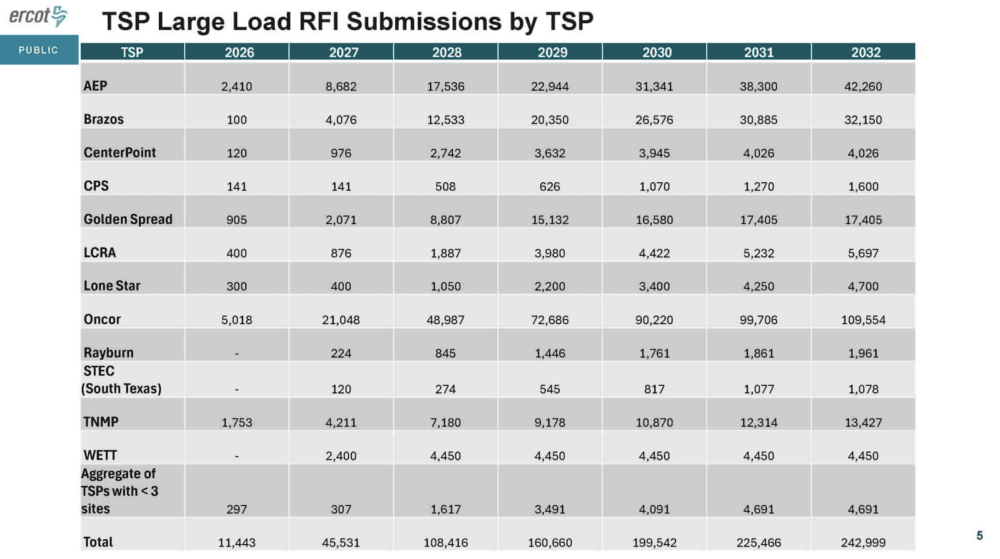
Dallas-based Oncor submitted significantly larger projections than other utility companies, with over 109,000 megawatts of projects anticipated in Oncor's boundaries by 2032. The next-largest submission was from AEP, which estimated that over 42,000 megawatts of large projects would be built in its service area by 2032. AEP is headquartered in Ohio, with the utility’s Texas arm serving South and West Texas.
Transmission service providers submitted nearly 243,000 megawatts of potential large-load projects that could be built in their service areas through 2032. (Courtesy Electric Reliability Council of Texas)
In total, transmission and distribution providers submitted information to ERCOT indicating that nearly 243,000 megawatts of large loads would be added to the grid by 2032. More than 228,000 megawatts would be data centers, ERCOT said, while other submissions include cryptocurrency mining facilities, large industrial projects or oil and gas facilities.
In early April, Vegas told state lawmakers that ERCOT is tracking large projects that could require about 410,000 megawatts of electricity. Roughly 87% of those requests are for data centers, he said.
Experts have emphasized that “there's still a lot of uncertainty” about where data center projects will be located and if some will be built at all, noting that not all 400-plus gigawatts of potential projects will come to fruition.