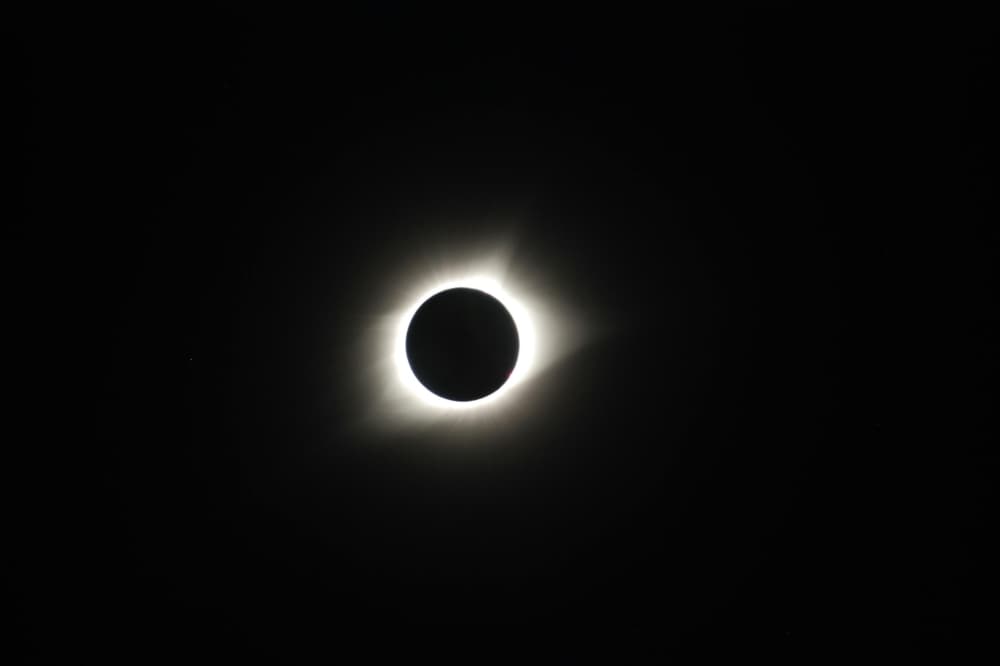
A roughly 120-mile-wide shadow will cast nearly all of Williamson County into subdued darkness April 8. A total solar eclipse only occurs over the same location once every 360 years, according to NASA.
What you need to know
The eclipse can be seen in Williamson County between 12:18-2:58 p.m. with maximum totality lasting for between three to four minutes around 1:36 p.m, according to a Williamson County news release.
During the solar eclipse, it is not safe to look directly at the sun without special eye protection designed for the cosmic event. Those interested in taking a peek should acquire special eye glasses, according to the Texas Parks & Wildlife Department. It is also not recommended to look through a camera lens, telescope or binoculars.
The last total solar eclipse to occur in North America was in 2017 from Oregon to South Carolina, in which some counties along the path of totality saw a more than 200% increase in traffic, a fact sheet produced by Texas A&M University reported. The state of Tennessee saw over 1 million out-of-state visitors.
Travis County recently declared a local disaster as the county prepares its first responders for the event. Central Texas is expected to see three to four times the normal population surrounding the event, according to previous reporting by Community Impact.
As the sun and the moon align for this rare celestial event, Williamson County officials urge residents to consider some of the following tips:
- Avoid stopping on road shoulders to view the eclipse; it can lead to traffic hazards.
- Keep emergency vehicles in mind when parking. Maintaining room for emergency vehicles is critical during large-scale events, such as the eclipse.
- While driving, be on alert for distracted pedestrians looking to the sky.
- Limit travel on major roadways in Central Texas on April 8 due to increased traffic for eclipse viewing.
- Reschedule nonessential appointments for April 8 to reduce travel.
- Prepare for possible travel delays; consider carpooling and allow extra time for travel before and after the eclipse.
- Keep an emergency kit in your car.
- Refill gas, and stock up on food and essential items before the eclipse to mitigate inventory shortages caused by increased visitors.
- Establish a family communication plan in case of cell phone service disruptions.
- If unable to reach 911 in an emergency, try calling from a landline, using a phone with a different carrier or switching to Wi-Fi calling, if possible.
More information on road conditions can be found at www.drivetexas.org.
The options
Williamson County will host a viewing event at River Ranch County Park in Liberty Hill. Experts will be available to offer educational insights about the eclipse, alongside interactive activities and access to viewing equipment.
Visitors are encouraged to bring their own food and drinks. The event will take place on the front lawn of the park's interpretive center.
Park admittance is $4 per person on a first-come, first-served basis. The park will close to visitors once it reaches capacity.
Alternate viewing parties may be held on private property. Landowners intending to hold an event can find a preparation checklist here.
What to bring with you:
- A map and directions of the area; printing directions is best as cellular service may be limited by high use surrounding the eclipse
- Necessary medications for you and your pets
- Cash (ATMs may be limited during this time)
- Large amounts of drinking water
- Comfortable walking shoes
- Eclipse viewing glasses
- Jacket or sweatshirt
- First aid kit
- Sunscreen
- Sunglasses
- Hat/visor
- Folding chairs
- Snacks