Following a Jan. 9 bomb and active shooter threat to Leander High School that activated a campus lockdown, Leander ISD officials discussed its emergency communication protocols and reunification process with Community Impact.
Some context
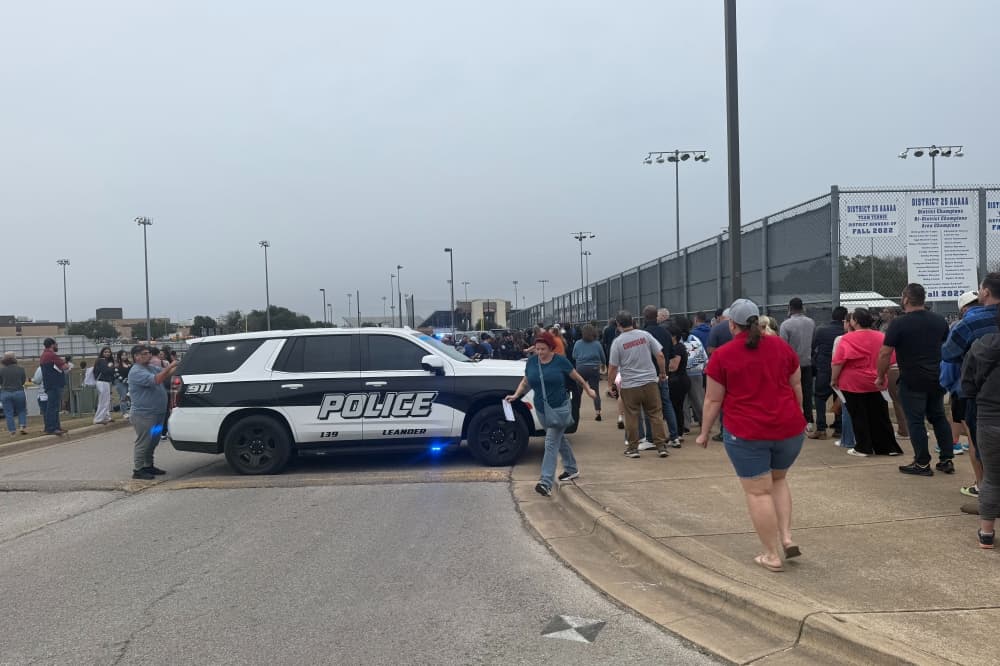
According to the Leander Police Department, LHS received the threat through a phone call at 1:25 p.m. LPD and Leander ISD police department officials immediately responded and began investigating the threat, triggering the campus’s lockdown.
Officers with the Cedar Park Police Department and Texas Department of Public Safety utilized explosive detection K9s during lockdown, which allowed for a controlled campus evacuation by Central Texas Regional SWAT and Williamson County SWAT to a waiting area.
LPD officials stated that once the campus was cleared and no suspicious items were located, LISD staff took over for its reunification procedures.
What they’re saying
In an email to Community Impact, Chief Communications Officer Christina Hardie said a message flagged as “urgent” was sent to families at 1:40 p.m. Jan. 9, overriding parent communication preferences and sent through email, text and voice message. The communication team then sent messages every 15 minutes with updates to families and staff.
Once the campus received the all clear, LISD officials began its reunification process, which follows a standard protocol outlined by the Texas School Safety Center, Emergency Management Director Miguel Escobedo said in an email to Community Impact.
The overall framework is consistent, Escobedo said, but reunification steps and locations can vary based on the type of incident, the campus involved, and guidance from law enforcement and emergency responders.
“Families are informed as quickly as possible through ... ParentSquare, with clear instructions on where to go, what to bring such as photo identification, and what to expect,” Escobedo said. “Campus staff also receive coordinated direction through district leadership and emergency response channels so everyone is following the same process.”
Hardie said the district follows a consistent communication framework in the event of an emergency, but the timing and level of detail can vary based on the nature of the incident and information available.
“For example, communications may differ depending on whether a campus is in a standard response protocol—secure, hold, lockdown or evacuation status—and whether law enforcement asks that certain details be temporarily limited so they can safely investigate and respond,” Hardie said. “In every incident, the law enforcement agency is the lead investigative agency.”
District police officers work directly with campus administrators to support emergency response, assist with securing the campus and coordinate communication, reunification and safety procedures, LISDPD Chief Sha Rogers said in an email to Community Impact.
“Command and coordination during an incident depend on the nature and scope of the situation,” Rogers said. “In many cases, LISDPD is part of the initial response and helps manage the campus-level response. If the incident requires a broader law enforcement response—or involves jurisdictional responsibility—command may be coordinated with, or transferred to, the appropriate agency. Such was the case during [the Jan. 9] bomb threat; Leander PD became the lead investigative agency due to the size and scope of the situation.”
What you need to know
The best way for families to receive accurate, up-to-date information during an emergency is to rely on official sources and district communication channels such as ParentSquare, Hardie said. District officials encourage families to:
- Ensure contact information is current in the district’s student information system so they receive messages promptly.
- Monitor official LISD communications, including ParentSquare, email and text notifications.
- Follow updates from the lead investigative agency, as law enforcement is the lead agency in assessing threats and determining safety status.
- Avoid arriving at the campus during an active incident, as it can interfere with emergency response efforts and delay reunification processes if those are needed.
- Be cautious about sharing unconfirmed information, and allow time for the district and law enforcement to verify details before updates are released.
“Our goal is to communicate as quickly as possible while ensuring the information we share is accurate and does not compromise safety or law enforcement operations,” Hardie said.
Hardie said emergency updates are sent directly to the impacted campus community in most cases, as those are "the ones immediately affected and need timely, specific information.”
“At the same time, Leander ISD does share internal updates more broadly as appropriate, particularly with district leadership, safety and operations teams, and other campuses upon requests from campus or district leaders,” Hardie said.
Escobedo also said lockdown decisions are made based on the specific situation and location of the threat in coordination with law enforcement.
“In most cases, only the impacted campus takes action, such as a lockdown, hold, secure or evacuation, because those measures are designed to address immediate conditions on that site,” Escobedo said. “However, if law enforcement determines there is a broader concern—such as a threat that could affect multiple campuses, nearby locations, transportation routes, or districtwide operations—the district can implement additional precautions at other campuses as appropriate.”
What else?
While LISD allows students to carry cellphones, House Bill 1481—which passed during the Texas Legislative session last year—prevents students from using cellphones during the school day.
“Our campuses follow established protocols, and students are supervised by trained staff the entire time,” LISDPD Assistant Chief Tricia Mirabelle said in an email to Community Impact. “Phone use may be limited at the start so everyone can stay focused and we don’t create additional confusion. As soon as it’s safe, students may be allowed to contact their families.”