

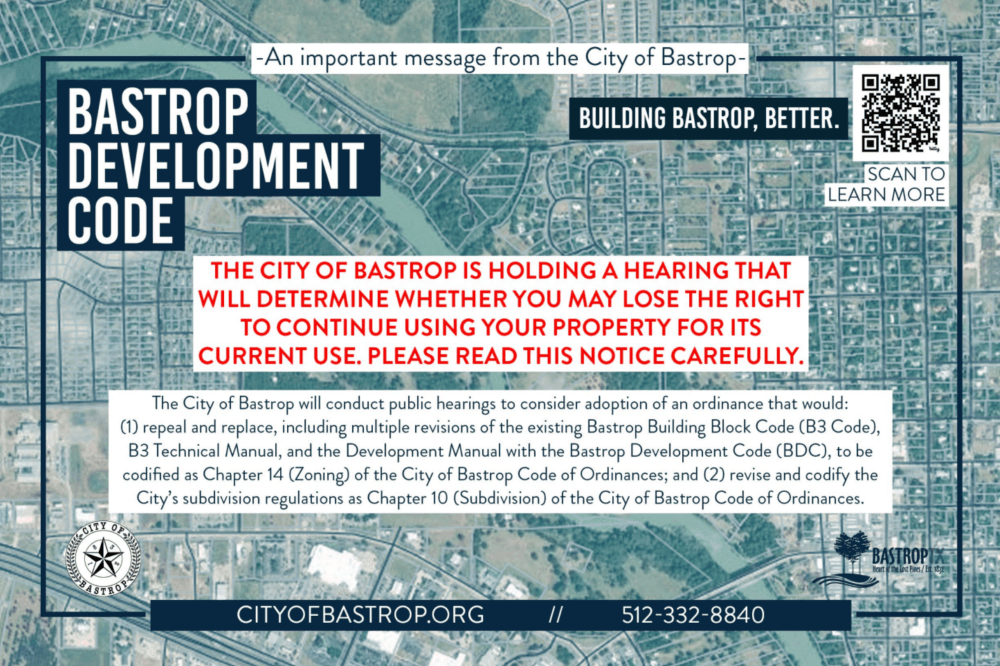
If you’ve received a mailed notice from the City of Bastrop with strong language about property rights, you’re not alone; and you’re probably wondering what it actually means for you.
In short, the city is proposing a new rulebook for how land can be used and developed. It’s a big update, but it’s meant to make things clearer, not more confusing.
Below is a plain-language breakdown of what residents and property owners need to know.
1. This does not mean you’re losing your home or business
The legal notice sent to property owners is required by state law anytime zoning rules are updated. The wording can sound alarming, but city documents emphasize that this does not mean people are suddenly losing the right to live in their homes or operate existing businesses.
What’s being proposed is a rewrite of the rules, not a sweep that takes away existing uses. Homes stay homes. Existing businesses are expected to remain allowed. The city repeatedly describes this as a “crosswalk, not a reset,” meaning properties are translated into equivalent new zoning categories rather than being rezoned from scratch.
2. The city is changing how zoning rules are organized
Right now, Bastrop uses a system called the B3 code. The B3 code focuses heavily on how buildings look, including where doors go, how buildings meet the street and where parking sits.
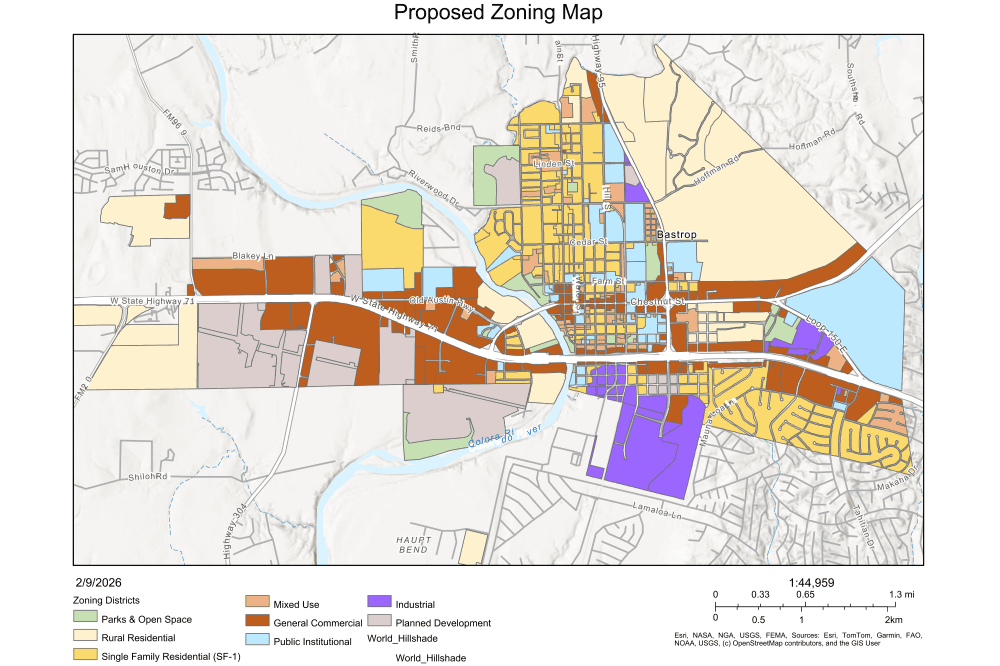
The proposed Bastrop Development Code switches to a more traditional Texas-style zoning system. Instead of complex design rules everywhere, the city would use clear zoning categories, such as single-family neighborhoods, commercial areas and mixed-use areas, with simple charts showing what’s allowed and what’s not.
For most residents, this means the rules should be easier to look up and easier to understand.
3. Different rules will apply in different areas of Bastrop
One of the biggest takeaways from using the B3 code was that one set of rules doesn’t work equally well everywhere.
Under the proposed code, neighborhoods are primarily focused on protecting single-family character; downtown keeps special standards that support walkability and historic buildings; and flood-prone areas are covered by a new overlay designed to reduce risk and protect natural floodplain functions.
The idea is simple: what makes sense downtown doesn’t always make sense in a quiet neighborhood or in a park.
4. The process should be clearer if someone wants to build or open a business
In addition to reorganizing zoning districts, the proposed code updates how development decisions are made.
The review process is laid out in clearer steps, with fewer informal exceptions. New tools allow limited administrative adjustments and conditional use permits for case-by-case decisions. City materials say this structure reduces surprises and helps residents, applicants and staff understand who makes decisions and when.
5. What property owners should know, going forward
City officials encourage residents, builders and business owners to talk with Development Services early, especially before starting a business. Doing so can help avoid costly mistakes and clarify what’s allowed under the proposed code before time and money are invested.
Public input is also part of the process.
“A lot of community engagement is going into what we’re doing with the city as a whole,” Development Director and Building Official James Cowey said.
The city urges residents to attend the Planning and Zoning Commission hearing scheduled for February 26, followed by City Council readings on March 24 and April 14, to make their voices heard. The Planning and Zoning Commission hearing will be held at City Council Chambers in City Hall at 1311 Chestnut St., Bastrop.

A long-term effort, shaped by many
City officials describe the proposed Bastrop Development Code as the result of years of work and coordination across multiple city departments. Over the past year, in particular, staff gathered feedback from residents, internal departments, the development community, Main Street partners, the Parks Board, the Historic Landmark Commission, the Planning and Zoning Commission, and City Council.
According to the city, the intent is to keep Bastrop’s character intact while making the rules easier to follow. This way, residents don’t need a planning background just to understand what they can do with their own property.
The Development Services Department urges residents to contact them with any questions or concerns.
"We're here to help you. We're here to clarify things. Don't be scared to contact us in Development Services for any questions," Cowey said.
You can find the Development Services Department’s contact information here.
The above story was produced by Senior Multi-Platform Journalist Sydney Heller with Community Impact's Storytelling team with information solely provided by the local business as part of their "sponsored content" purchase through our advertising team.