Nearly 40 years after planning began, construction on Oak Hill Parkway in Southwest Austin is substantially complete. After five years of construction and at a cost of nearly $680 million, the improved roadway now serves the growing number of commuters in the area.
“The Oak Hill Parkway project is an example of how TxDOT remains committed to advancing safety, mobility and connectivity throughout Austin as well as the entire state,” Texas Transportation Commissioner Robert Vaughn said at a Sept. 24 ribbon-cutting.
Almost 32 million people live in Texas, and that number could grow to 42 million by 2060, Vaughn said. Additionally, Austin’s population recently surpassed one million residents for the first time. As more people move to Texas and the Austin area, Vaughn said it puts significant pressure on the state’s transportation network.
“This project enhances safety and addresses one of the region’s most congested corridors,” Texas Transportation Commissioner Steven Alvis said in a news release.
The framework
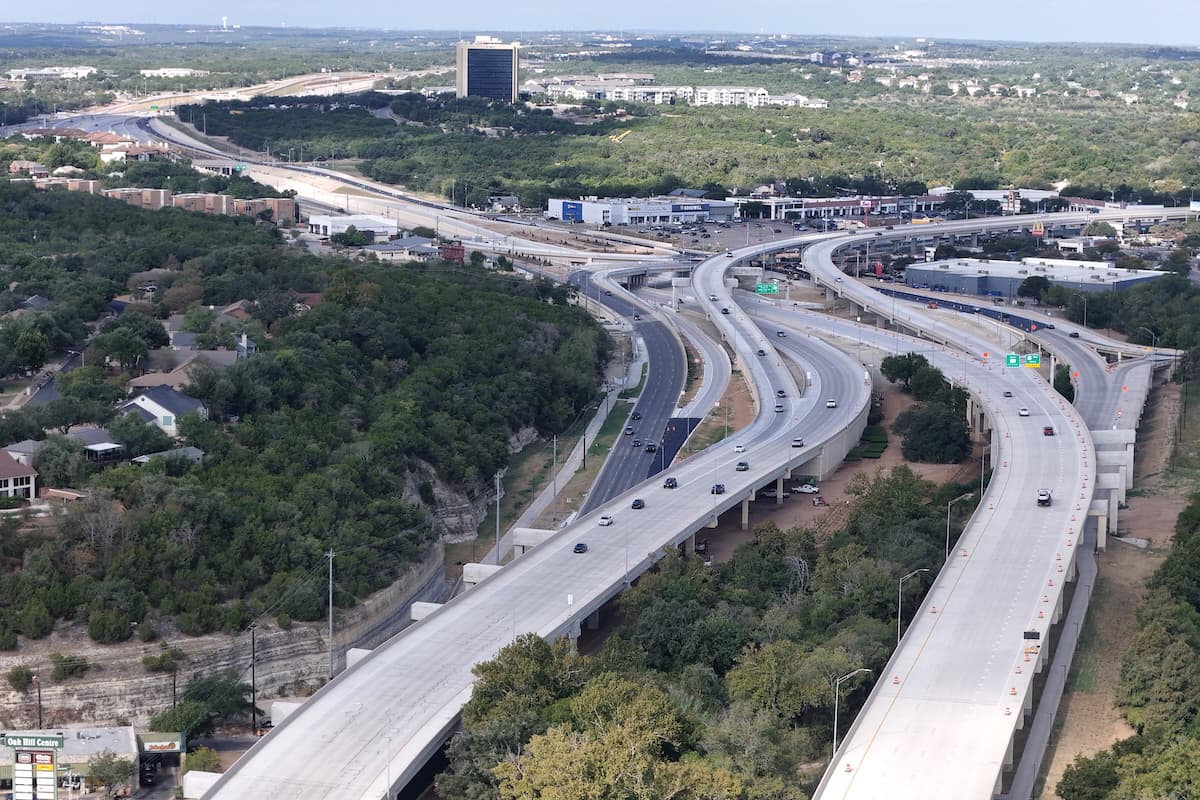
The $677 million reconstruction of the seven-mile roadway segment has been ongoing since 2021, transforming a four-lane, undivided roadway into a six-lane divided highway with new frontage roads and 15 miles of shared-use paths.
Travelers can now utilize two to three main lanes and frontage road lanes in each direction, as well as bridge intersections at Convict Hill Road, RM 1826, Scenic Brook Drive and Circle Drive. 'The Y,' or the intersection of Hwy. 71 and Hwy. 290, now features flyovers to avoid through traffic.
Looking back
From 2005 to 2012, TxDOT coordinated with several groups, including the Oak Hill Association of Neighbors and the Save Our Springs Alliance, to gain input on the design and construction impact.
"[The project's completion] really is a milestone we are celebrating, and the need for this project goes back to the 1980s," said Tucker Ferguson, TxDOT Austin District engineer.
The local impact
Natalie Sanders, general manager of Sweet Treets in Oak Hill Centre, said the business recently expanded its offerings to include coffee in hopes of improving foot traffic, which is still lower than before construction.
Matthew Fouss, a local resident and shift leader at Tucci’s Southside Subs, said the business also made adjustments to adapt to the new norm. After construction began, the business updated its point-of-sale system to accept all delivery services to increase sales. Fouss said that although revenue increased, the business pays higher fees to third-party apps, reducing profit margins.
Sanders said that while the traffic bottleneck at William Cannon has improved, she thinks decreased foot traffic will be a long-term impact of the project.
"Our retail traffic, it's still pretty severely impacted now that it's a [thruway] ... we aren't seeing as many customers as we used to see," Sanders said.
"[I'm] slightly impressed by the speed at which they did it ... but I feel like it could've been a little more organized," Fouss said.
Breaking it down
The improvements to Oak Hill Parkway are intended not only to alleviate traffic congestion, but also to improve safety and emergency response times.
“While specific emergency response data is not available, the project’s new nonstop mainlanes and flyover ramps are expected to help improve response times by allowing emergency vehicles to travel through the corridor without stopping at traffic signals,” TxDOT public information officer Antonio Luján said in an email to Community Impact.
Additionally, an emergency vehicle access route was added along westbound Hwy. 290 between Thunderbird Road and Scenic Brook Drive.
In 2025, Oak Hill Parkway was ranked 45th on the Top 100 Congested Road Segments in the state, according to the Texas A&M Transportation Institute. However, Luján said that by separating local traffic from through traffic with the bypass lanes, “there is an observable difference when you drive through Oak Hill.”
What happens next
While all the big-ticket projects are complete, Luján said a few final tasks are still underway and will continue through November.
Work items that are being finalized include shared-use paths, landscaping and painting.
Now that most of the construction is complete, Fouss said he thinks business in the area will pick up in the long term and that new commercial developments will be drawn to the Oak Hill area.
“I would say if [people] haven’t been over here lately, come check it out because it’s a lot easier to get around,” Fouss said.