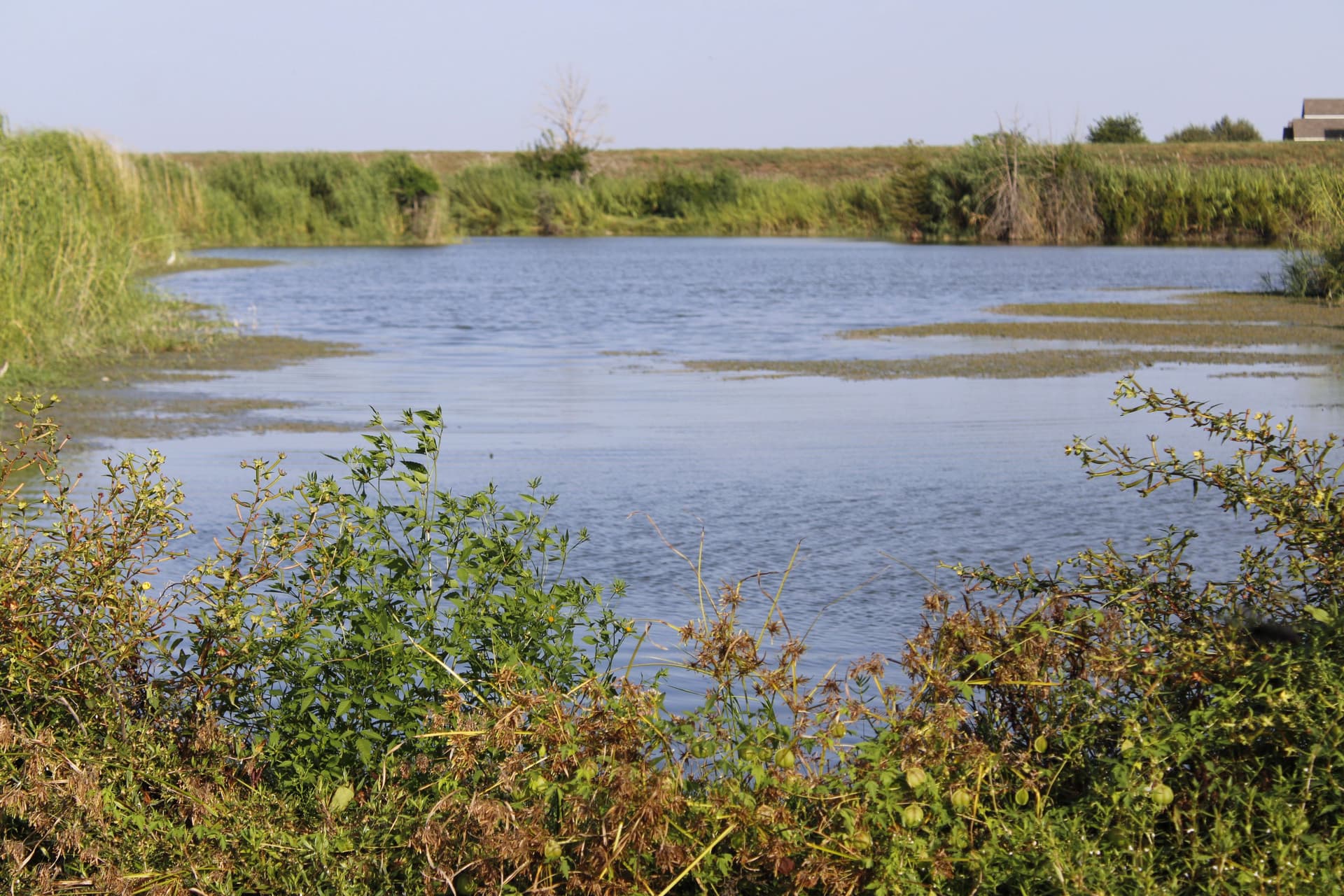
The city of Kyle is funding a research project that will deploy floating wetlands on Lake Kyle in an attempt to improve water quality and protect the surrounding Plum Creek Watershed, which funnels rainfall and runoff into Plum Creek and its connected waterways.
The overview
Sangchul Hwang, a Texas State University professor of civil and environmental engineering, is the lead researcher on the three-year “In-Reservoir Water Quality Management with Floating Wetlands” project.
The Kyle City Council approved the project on Dec. 16, 2025 and granted Hwang $456,546 in funding, according to agenda documents.
“This grant represents recognition and trust from the community that our research can contribute to addressing real-world environmental and water challenges,” Hwang said.
The project will test the impact of floating wetlands on Lake Kyle. The roots of the buoyant platforms absorb nutrients in the water and hold microorganisms that break down and trap pollutants, cleaning the water, according to a Texas State University news release.
Diving deeper
Plum Creek is a 52-mile stream flowing southeast through Kyle before converging with the San Marcos River. In 2004, the Texas Commission on Environmental Quality, or TCEQ, identified high E. coli concentrations in the creek that make it unsafe for contact recreation, according to agenda documents.
Contact recreation includes activities such as wading, swimming, kayaking and canoeing.
The “In-Reservoir Water Quality Management with Floating Wetlands” project aims to assess current water quality in Lake Kyle and potentially use floating wetlands to improve it, according to the news release.
“[The project] provides an opportunity to translate our academic research into practical solutions that can directly benefit the community,” Hwang said.
Looking forward
Hwang and his team have monitored Lake Kyle since January, measuring water quality and identifying potential pollution sources, according to the release. They have tested a small-scale floating wetland in their lab.
The “In-Reservoir Water Quality Management with Floating Wetlands” project will provide the city of Kyle with the necessary information and tools to protect local water resources as the community grows.
The city has seen significant growth in recent years, with the population jumping by 53% between 2020 and 2025, reaching a total of 69,917 residents, according to the U.S. Census Bureau.
The researchers are currently testing a larger wetland in conditions similar to those of the lake. The full floating wetlands are expected to be implemented and subsequently monitored in spring 2027.
“Our research goes beyond the laboratory,” Hwang said. “We are working on-site and testing a nature-based solution that could have practical value for the community.”