On Feb. 11, VIA Metropolitan Transit briefed the San Antonio City Council on the current status of the transit system’s multifaceted upgrade, including an update on the Better Bus Plan, the Advanced Rapid Transit Green and Silver lines, and technology and safety upgrades.
Two-minute impact
Presented by VIA leadership, including VIA board Chair Laura Cabanilla and Jon Gary Herrera, VIA president and CEO, the progress report touched upon funding, competition, the use of the new sales tax, planning and ridership.
“What you are seeing is a generational shift in how this agency operates, how we serve our riders and how we compete for the future of the mobility of the region, forever changing the way we are moving San Antonio forward,” Cabanilla said.
Cabanilla said the upgrades throughout VIA’s transit network were timed to align with the implementation of a 1/8 sales tax that was approved by voters in 2020. She said VIA will also leverage these funds to attract roughly $1 billion in total federal Capital Investment Grant funds.
However, she also noted that, though there are funds and an implementation plan, VIA is still the least funded major transit agency in Texas, and the new funding will not erase decades of underinvestment.
“These are overdue investments catching up to real needs,” Cabanilla said.
She said the most recent milestone was launched Jan. 12 and was made possible through the hiring of 107 new full-time bus operators in 2025. These simultaneous upgrades in the agency’s history affect approximately 30 routes.
Cabanilla said VIA is also reorganizing itself to become more efficient.
“The transformation of VIA is not just about what our riders experience on the street,” Cabanilla said. “It is also about strengthening the organization behind the scenes. We have fundamentally changed the culture of this agency. We redesigned our mission to reflect VIA’s role as a driving force for our community's growth and success.”
A closer look
The Better Bus Plan is a six-year plan designed to create a faster, more direct service on traditional bus routes. Currently, 65% of the plan is estimated to be implemented by the end of 2026.
Better Bus Plan goals:
- Decrease wait times across the network to 30 minutes or less
- Provide more frequent service on key corridors
- Connect people with faster, more direct service
- Make service simpler and easier to use
- Make transit available when and where it is needed
According to the presentation, since 2019, VIA Link— an app that allows riders to book a ride in specially designated vans that drop them off anywhere within a Link Zone—has had six active zones throughout the city, with 10 total planned. Upcoming zones include the Medical Center and Stone Oak.
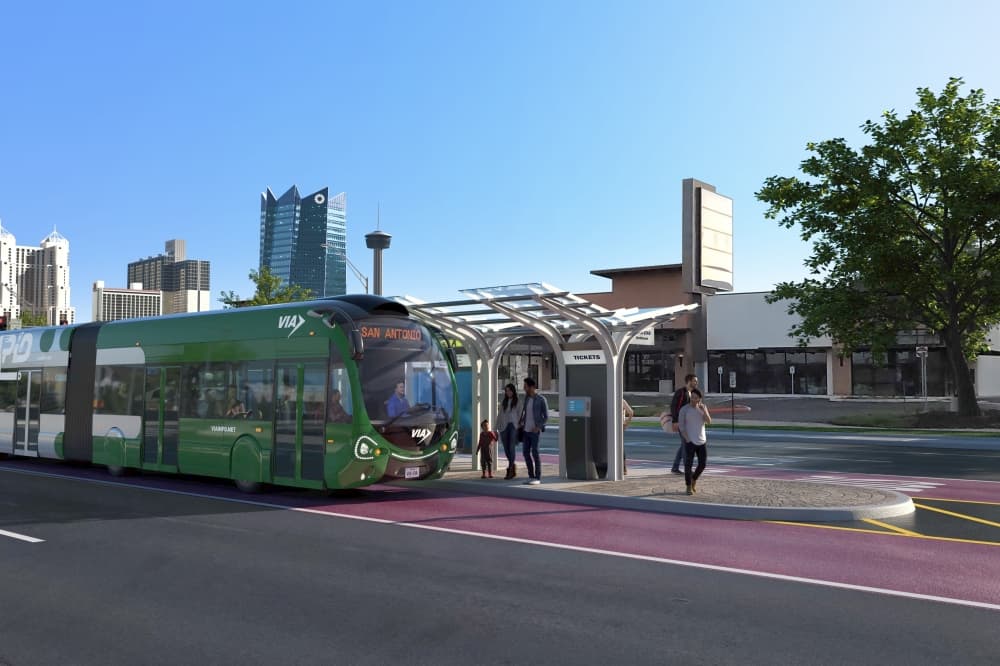
Rod Sanchez, senior vice president for planning and development, said VIA’s Advanced Rapid Transit system, or ART, is on schedule. The Green Line, a 10.35- mile corridor running from the north to the south, will have stops stretching from Brooks Transit Center to the airport.
The project has completed its design phase and is in the beginning phases of construction. Sanchez said workers are performing utility work, including adjusting utility poles, moving power lines, moving telecom lines and removing and moving drainage and sewer lines. Heavy construction is estimated to begin in March. The Green Line's budget is $480 million, including $268 million in federal grants.