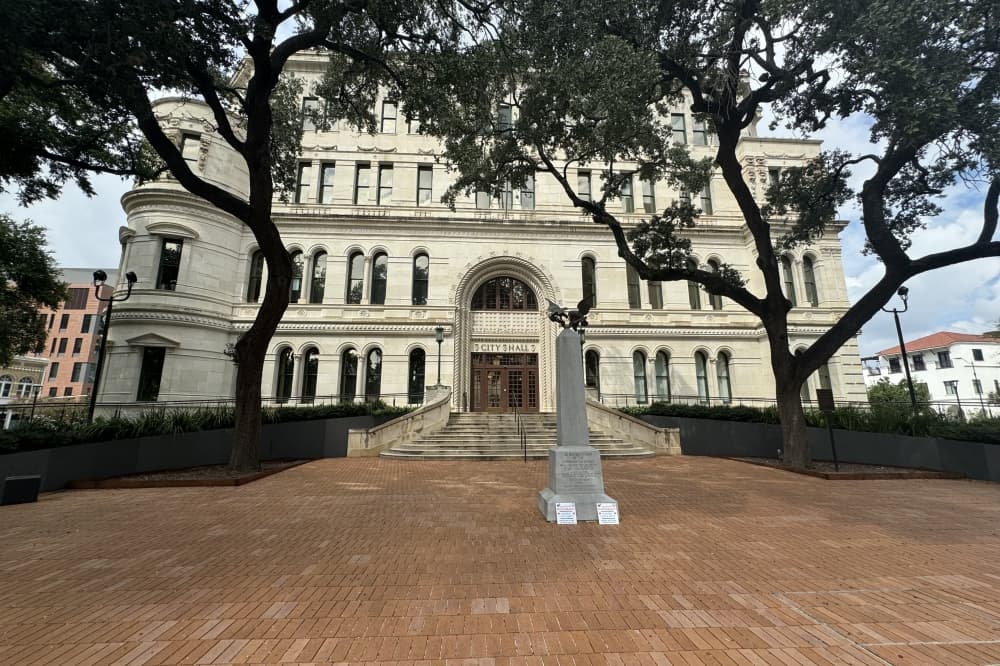
The San Antonio City Council received an update on the Edwards Aquifer Protection Program during its Jan. 15 meeting.
The overview
Presented by Grant Ellis, natural resources manager for San Antonio Parks and Recreation Department, the presentation covered the program's background, land identification and acquisition, the property evaluation process and acquisition strategies.
According to city documents, the Edwards Aquifer is a karst aquifer, which consists of porous, soluble limestone rock that allows water to flow through it. Additionally, the aquifer naturally regenerates when water flows through specific zones via a network of recharge features, such as fractures, fissures and sinkholes.
These porous features allow the aquifer to recharge very quickly compared to other aquifers, such as the Carrizo Aquifer, which is a sand aquifer that recharges very slowly due to the lack of porous filtration.
Three primary zones of Edwards Aquifer are:
- The contributing zone in the Hill Country north of San Antonio
- The recharge zone which runs through San Antonio
- The artesian zone where water is pumped up for use
“Edwards Aquifer makes up over 50% of drinking water for the city of San Antonio,” Ellis said.
Ellis also broke down how the city identifies potential land for conservation and the acquisition process. To assist the EAPP with this task, the Scientific Evaluation Team and the Land Acquisition Team were established.
The Scientific Evaluation Team is a science-based advisory group responsible for determining the weighting matrix for the GIS spatial model used to rank properties. The GIS spatial model ranks properties based on water resources, biology, property size and location.
“The scientific evaluation is the science-based advisory group that we have proposed with experts from various agencies and organizations throughout the city and the area that helps us identify which properties are most sensitive and most important to the program,” Ellis said.
The Land Acquisition Team:
- Assists with negotiation of acquisitions and helps coordinate necessary due diligence
- Reports to the Conservation Advisory Board on the availability of property
- Is comprised of EAPP staff and Green Spaces Alliance of South Texas and the Nature Conservancy, which are two nonprofit conservation organizations
The approach
Acquisition strategies are divided into two forms: conservation easements and fee simple ownership. According to city documents, 95% of property interests acquired by the EAPP are conservation easements, and 5% are fee simple acquisitions, which involve:
- Landowners retain ownership and certain land use rights, but give up future development rights.
- Development is limited to 0.5% of total square footage for future development.
- Landowners are compensated 30%-50% of fair market value as established by appraisal.
All acquired properties are monitored on an annual basis by city officials and the Edwards Aquifer Authority staff under an interlocal agreement.
The EAPP property evaluation process involves:
- Property modeling and ranking
- Conservation Advisory Board reviews the property
- Geological assessment and property appraisal
- Environmental site assessment completed and property negotiations
- Final CAB approval and city council consideration
Ellis said purchased properties have been added to the Canyon State Natural Area, with some becoming parks, such as Classen-Steubing Ranch Park, which allows the city to use the land in multiple ways.
“[City officials] were able to acquire 160 acres of the 204-acre park using aquifer protection dollars,” Ellis said.
Currently, the EAPP has 187,343 acres of protected land.
By the numbers
The backstory
The EAPP was initiated in May 2000 when voters approved Proposition 3, which is a ⅛-cent sales tax up to $45 million for the acquisition of lands over the Edwards Aquifer for parks and watershed protection. Proposition 3 ran from 2000-2005 and was limited to Bexar County. The program was extended in 2010 and renewed again in 2015. Additionally, changes in state legislation allowed the program to expand outside of Bexar County.
In 2020, City Council approved a 10-year, $100 million alternative funding program through San Antonio Municipal Facilities Corporation, which issues debt for the Edwards Aquifer Protection Program.
Quote of note
After the presentation, Mayor Ron Nirenberg spoke about the importance of maintaining the EAPP as San Antonio continues to grow.
“I hope the Edwards Aquifer protection policies and programs remain a priority, remain in the discussion as people select who leads this community, because there's not, perhaps, a more important or existential issue that we will deal with in the future than the security and availability of our water,” Nirenberg said. “We are in the midst of a historic drought. Second only probably is the 1950s drought, and today we're at some of the lowest levels of the Edwards Aquifer ever recorded in human history. The growth of this community and the urbanization of this region is not slowing down anytime soon, so it’s incumbent upon us, particularly our future leaders, to ensure that Edwards Aquifer’s protection, and the safety and security of our water supply remain a top-tier [priority].”
What’s next
Using $10 million approved in the adopted fiscal year 2024-25 annual budget for acquisitions, the EAPP will continue to target properties in sensitive recharge and contributing zones, and work to connect existing protected lands.