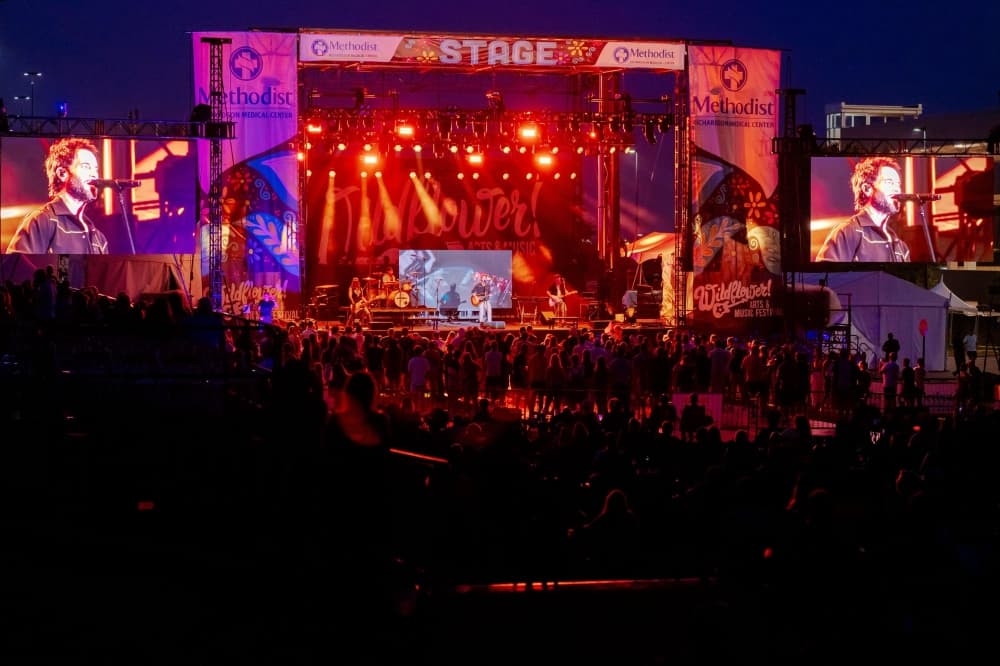
Richardson’s Wildflower! Arts & Music Festival will discontinue Sunday programming and move to a two-day event next year, as well as eliminate a stage and modify opening hours, in order to combat rising costs and budget pressures.
Yvonne Falgout, director of parks and recreation, presented attendance and ticket data from May’s Wildflower! Festival along with recommendations for the 2027 event to City Council on June 22. The proposed changes would save the city an estimated $800,000.
“More than anything, we want to establish a more financially sustainable model that will maintain the spirit of what Wildflower really is,” Falgout said.
The overview
The festival showcases a lineup of musical artists along with food, beverages and a marketplace of local vendors.
Prior to the 2026 festival, which ran May 15-17, the city conducted a community survey and economic impact study. Based on those results, Wildflower introduced several modifications this year, including free general admission Sunday, a rebranded family-focused area called “The Grove,” adjusted stage schedule timelines and internal operational changes to cut overtime expenses.
While the 2026 festival saw increased attendance from last year, its total revenue decreased by almost $30,000.
Based on this year’s data, the community survey, the economic impact study and comparisons with similar festivals, Falgout recommended to council a number of changes to the 2027 festival. Primary adjustments include shifting to a two-day festival on Friday and Saturday with consistent operating hours, eliminating the Plaza Stage and adjusting the festival’s layout.
She said these changes aim to significantly reduce operating costs, staff overtime and impacts to neighboring properties while maintaining the festival’s signature programming, traditions and experience.
By the numbers
The festival saw 18,164 attendees, an increase of almost 1,500 people compared to last year. Attendees include volunteers, vendors, property partners and credential holders in addition to ticket-holders. Over 17,000 tickets were sold or claimed, an increase from 2025, but due to Sunday’s free admission, this translated into a slightly lower ticket revenue compared to last year.
The festival’s total revenue for 2026 was $585,980, a decrease of almost $30,000 compared to 2025. Wildflower was able to cut almost $200,000 in expenses this year, leaving the city with a $1.62 million subsidy, down from $1.79 million in 2025.
At a March council briefing, Falgout said the festival has seen significant cost increases over the last few years, including expenses for catering, site logistics, production and entertainment. In light of city budget pressures driven by the statewide cap on property tax increases, city staff aim to reduce the amount of city subsidy needed to operate the festival.
The proposed 2027 budget after the recommended adjustments to the festival would cut the city’s subsidy in half.
A closer look
Wildflower has seen consistently low attendance on Sundays despite attempts to attract more festivalgoers, Falgout said. This year Wildflower offered free admission on Sundays, hoping to “remove all obstacles for people to attend” and to bring in more food and beverage revenue. Past efforts have included Sunday corporate packages, a free kids day and music genre adjustments.
Although several of the festival’s community activities saw higher attendance on the free Sunday this year, including Battle of the Bands and the Budding Talent Vocal Competition, Falgout said this didn’t translate to higher attendance in the rest of the festival.
City staff concluded that Sunday is “not a sustainable day to maintain” at Wildflower, Falgout said.
“Our vendors have a high level of dissatisfaction in regards to the attendance, the sales and then the time commitment that they are spending at the festival on [Sunday],” Falgout said.
The community-focused events can be scheduled on other days of the festival, Falgout said.
“Those are important to our Wildflower brand, but they’re also important because they are helping to foster the arts and youth,” Falgout said. “We feel like that is an investment back into the community of Richardson, so those can be absorbed into a different day.”
Cutting the rest of the Sunday activities will reduce the festival’s overtime and site expenses, Falgout said, as well as its impact on property owners, businesses and residents.
Diving in deeper
Falgout also recommended modifying festival hours on Friday and Saturday to 3-11 p.m. on both days, aligning with attendance patterns and providing consistency for attendees.
These hours will still allow the festival to incorporate its primary activities Falgout said, even while eliminating the Plaza Stage.
Falgout said the festival has seen a drastic change in the viewing area at the Plaza Stage since reintroducing the area in 2024 after not including the stage in 2022 or 2023. Due to expanded apartment complexes in the area, the stage now has a smaller and more uncomfortable audience area, no VIP space, limited backstage support and reverberated sound from buildings.
The stage averages $325,000 in direct expenses with no corresponding increase in revenue or attendance since returning to the festival, so eliminating the stage again will cut additional costs and reduce scheduling overlap for performances.
Also of note
Falgout also recommended adjusting the festival’s VIP ticketing distribution, as most VIP tickets are currently given to the festival’s strategic partners, with limited capacity to sell additional tickets and recover costs.
Falgout recommended reducing the number of VIP tickets that strategic partners can claim as well as increasing the number available for retail. The festival is currently at a loss of revenue for VIP tickets, but opening up more for sales could create roughly $14,000 in profit, Falgout said.
Looking ahead
Mayor Amir Omar said he supported Wildflower’s efforts to adjust in order to continue operating amid the city’s budget pressures.
“We’ve seen neighbors of ours make some really dramatic adjustments, and you almost hurt for them because it’s such a big deal for these cities to lose those opportunities to showcase themselves,” Omar said.
Falgout said city staff will continue evaluating operational efficiencies and cost-saving measures that preserve the festival’s overall quality and attendee experience. The budget estimates for 2027 reflect a conservative approach to the festival’s revenue, Falgout said, and Wildflower “hopefully will overdeliver.”
“We also anticipate that we would be able to have some further savings after the first year,” Falgout said. “After that first year, staff would have a better understanding and a better setup for the layout of everything, and we could find more efficiencies.”