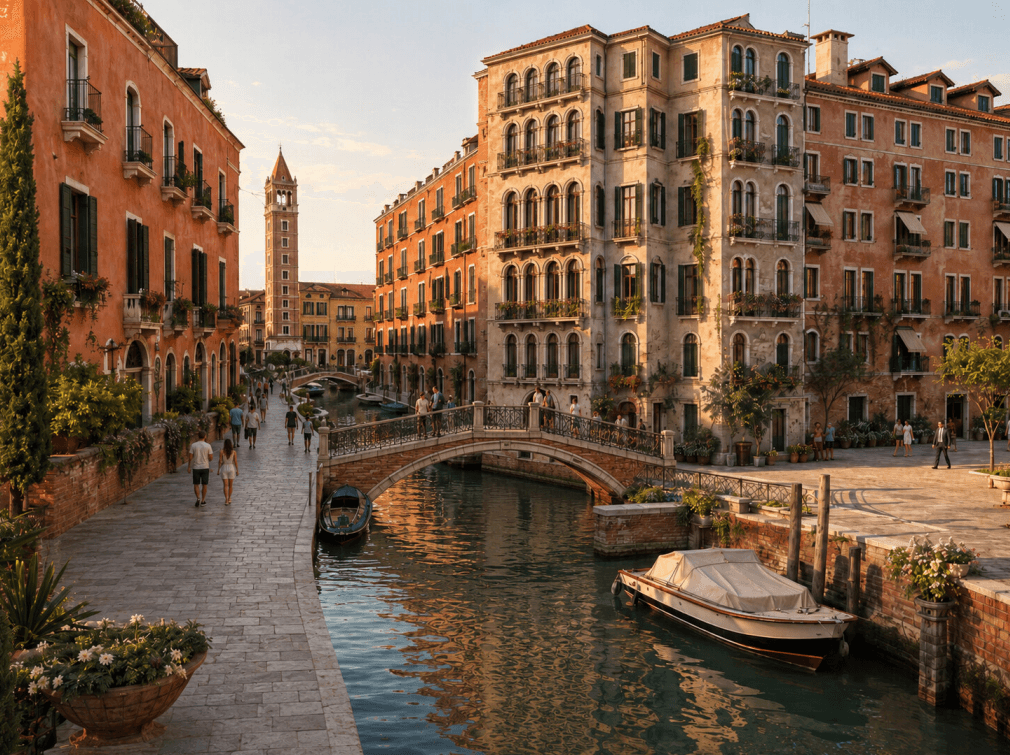
The Marco, a mixed-use development modeled after an Italian village, has received approval from the town of Prosper.
Prosper Town Council unanimously approved a rezoning and planned development for the project at an Oct. 27 meeting.
Plans for the development include a lagoon, canals, corporate offices, shopping, a theater, up to two hotels and a variety of housing options, according to town documents.
The Marco represents an estimated $2 billion investment, a project representative said.
What’s special about it?
The Marco is planned for 143 acres on the northeast corner of Dallas North Tollway and US 380, a parcel of land developer Jeffory D. Blackard has called “the best piece of undeveloped real estate, maybe in the world.”
The development’s defining feature is a 15.5-acre lagoon with a canal system large enough to navigate by boat, according to conceptual plans.
In addition to serving as the development’s primary open space, the lagoon will also act as stormwater detention.
The lagoon will be encircled by a passeggiata, a 26-foot-wide walkway with limited access to cars, and traffic and parking are concentrated along the outer ring of the development to emphasize walkability.
More details
On the hard corner of DNT and US 380, Blackard plans to build one or two corporate campuses surrounded by smaller offices.
The tallest office buildings will be up to 14 stories, and their height will help block road noise from reaching the rest of the development, according to previous reporting.
The northwest corner of the property will house a market square, a grocery store and low-intensity residential options like villas and townhomes, per town documents.
Plans for The Marco allow for up to two waterfront hotels, with one planned on the western edge of the lagoon and one planned on the eastern edge.
Blackard hopes to work with Prosper ISD, whose voters approved $125 million for a performing arts center as part of the district’s 2023 bond, to build a theater that could be used for both school events and professional performances, he said.
As of September, Blackard had not finalized any plans for the theater with district officials.
If the district decides to work with Blackard to build the performing arts center, it could be incorporated into one of the development’s hotels, Blackard has said.
The specifics
The eastern part of The Marco will be largely occupied by mid- and high-rise residential buildings, according to conceptual plans.
In all, plans for The Marco allow for up to 4,400 residential units:
Mid-rise apartments: maximum 2,500 units
High-rise residential (condominiums or apartments): maximum 400 units
Age-restricted apartments: maximum 500 units
Single-family and duplex housing (villas, townhomes, etc.): maximum 1,000 units
The exact breakdown of the types of residential units can be adjusted as long as there aren’t more than 2,500 mid-rise apartments or more than 4,400 units total, per town documents.
Mid-rise apartments on the property will also be subject to restrictions based on the construction of non-residential components.
No apartments can open until after the lagoon is complete, and after the first 1,000 mid-rise apartments are built, the developer will have to build at least 30,000 square feet of retail and restaurants before building additional units.
How we got here
Blackard first presented plans for The Marco at an Aug. 18 Planning and Zoning Commission meeting.
At that meeting, commissioners recommended approval of the project in a 4-2 vote.
Chairman Damon Jackson and Commissioner Josh Carson voted against the recommendation of approval because they wanted additional clarification on parts of the plan like permitted uses, building heights and minimum unit sizes.
“I feel like we’ve done less with [The Marco] than we’ve done with much less significant projects,” Carson said.
After the commission’s recommendation of approval, council was scheduled to vote on The Marco at a Sept. 22 meeting but ended up tabling the project until October to refine some of the language in the proposal.
While the vision for the development has remained consistent, Blackard made several changes to the version of the proposal approved by the commission based on feedback from town officials.
Many of the changes related to multifamily housing, including:
Prohibiting mid- and high-rise multifamily in certain areas
Requiring completion of the lagoon before any residential units open
Requiring at least 30,000 square feet of retail and restaurants before opening any mid-rise apartments after the first 1,000 units
Requiring open space and a pet area for every apartment building
“This is a very important project, the biggest in the town’s history, so we want to get it right," Town Manager Mario Canizares said.
Zooming out
The Marco isn’t Blackard’s first development inspired by close-knit European communities.
He’s also the developer behind Adriatica Village, a mixed-use development in McKinney based on a Croatian fishing village.
Prosper officials believe a unique development like The Marco will be the best use of Prosper’s land along DNT, they said.
A new section of DNT from US 380 to FM 428 is set to open in late 2027, according to the North Texas Tollway Authority.
When it does, Prosper will have roughly 3 miles of tollway on either side, and town officials are eager to maximize their access to a key commercial corridor.
“The Dallas North Tollway and U.S. 380 intersection represents one of the region’s premier growth corridors,” said Madison Clark, Prosper Economic Development executive director, in a statement. “The Marco’s approval marks the latest phase of Prosper’s economic expansion, turning key acreage into a long-term economic engine.”
Looking ahead
The next step for The Marco is a series of development agreements, Prosper Development Services Director David Hoover said.
In order for the project to move forward, council will have to approve agreements in four areas, ideally by the end of the year:
Once those development agreements are in place, the developer expects construction on the lagoon and other site-wide infrastructure to begin in late 2027, a project representative said.
"There's a lot of work ahead, and we're glad to be doing it here," Blackard said in a statement.