City of Plano data shows about 240 miles of the city’s distribution pipes are made of cast iron after ongoing water rehabilitation projects, which replace aging pipes.
Public Works Community Investment Project Manager Drew Zaeske said distribution mains are city pipes under 12 inches that are used in neighborhoods.
Current situation
A large portion of the city’s cast iron pipes are located in central and east Plano in the oldest parts of the city, Zaeske said. He said cast iron pipes are estimated to last around 50 years before needing to be replaced.
Plano Senior Director of Public Works Abby Owens said most of the distribution mains on Plano’s west side are less than 40 years old and have PVC pipes, which are estimated to last for 100 years.
Owens said each rehabilitation project changes roughly 2 miles of pipes. She said the city typically replaces 10 to 12 miles of distribution mains a year.
“We prioritize [distribution mains] based upon which ones are having active main breaks and issues, and then try to move that direction,” she said.
The city has replaced an estimated 110 miles of distribution mains since 2017, with half of them previously using cast iron pipes and the other half previously using ductile iron.
Dig deeper
Zaeske said the city has roughly 1,450 miles of distribution mains across the city. He said 70% of those lines are PVC pipes, while 17% are cast iron. The other 13% are made of ductile iron, a more durable type of cast iron.
Zaeske said PVC pipes are the cheapest and easiest type of pipes to deal with.
“It’s very infrequent where the cheaper upfront cost is also the cheaper long-term cost,” Zaeske said.
Owen said PVC is a more flexible material than ductile or cast iron, which works better with shifting soil. She added ductile iron doesn’t corrode as much as traditional cast iron pipes.
“There’s certain size pipes that when you look at the durability you need of that pipe in order to withstand the pressures of the water system, ductile iron is still used,” she said.
While a small portion of distribution lines have ductile iron, Owen said the material is more commonly used for pipe systems outside of residential areas. She said cast iron pipes are no longer used to replace aging pipelines in the city.
What residents should know
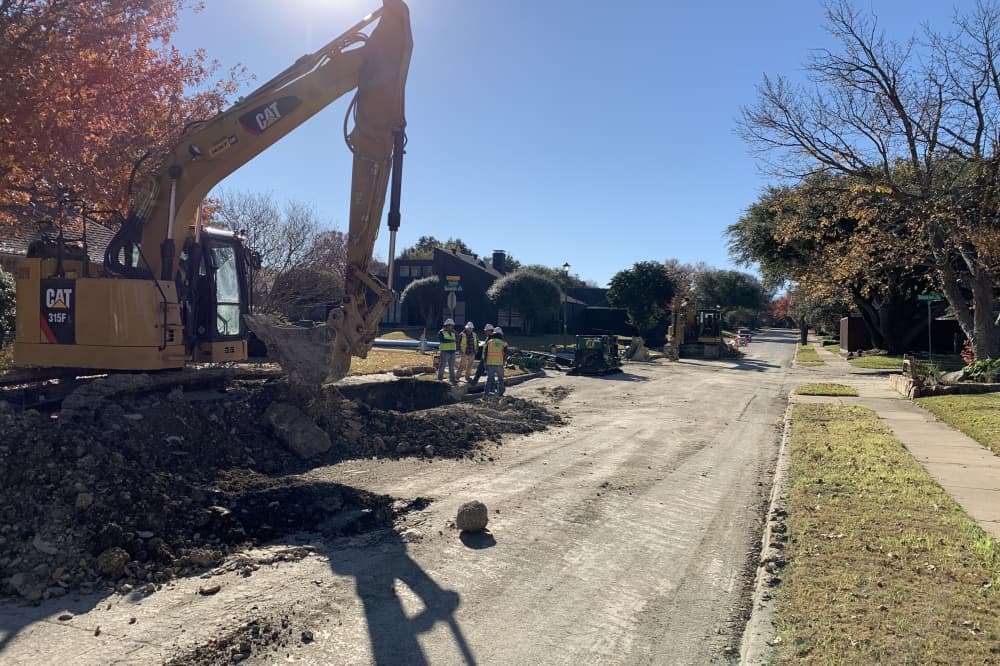
Clay Lipscomb, the city’s community investment program engineering manager, said water rehabilitation projects last between nine to 12 months depending on its size, and work is done in phases:
- First: The city installs and switches services to the new PVC pipes. Any removed pavement might be replaced with temporary asphalt. This phase might take two to three weeks for each street.
- Second: The contractor removes temporary asphalt and installs permanent concrete for streets that have had their water mains replaced. This phase might take a week or two for each street.
- Third: The contractor fixes any additional project items, like replacing disturbed sod, which Lipscomb said can take a couple of weeks of work.
Lipscomb said residents living in a project area can expect to see workers for one to two months on their street. He added the timeline could change depending on the street and neighborhood.
The specifics
The city has at least eight recently completed, ongoing or upcoming projects related to distribution main replacements for PVC pipes. Impacted neighborhoods include:
- Old Shepard Place in west Plano
- Kimberlea Additions, Kimberlea Estates, Parkway Estates, Whiffletree Addition, Prairie Creek, Post Oak and River Bend in central Plano
- Douglas Community, Creekside Estates, Los Rios Estates and Ranch Estates in east Plano
Park Boulevard also saw distribution main replacements, with its first phase completed in April 2026 and its second phase completed in September 2025, per previous reporting.
The city’s project in the Douglass Community started in May, according to the city’s community investment project dashboard. Communities like the Parkway Estates and Whiffletree Addition are estimated to start in August, while the Kimberlea Additions will start in November.
Some of the city’s current projects still in the design phase don’t have an estimated timeline.