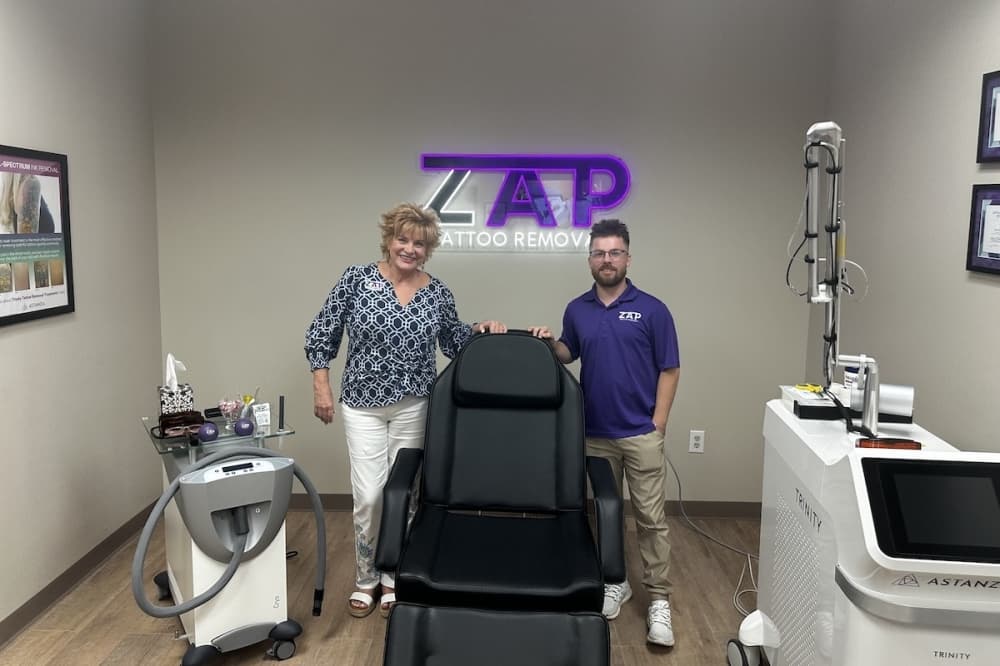
ZAP Tattoo Removal owner Jenifer Glenn first became interested in tattoo removal more than a decade ago, when her nephews got “a few bad tattoos.”
“They knew almost immediately they made a mistake,” she said. “I was thinking if I could ever get to the position where I can open a tattoo removal studio, I'd really like to do that to help people.”
Fast forward to today, ZAP has been in business near downtown Plano for more than a year, and that desire to help still drives Glenn’s passion for her business.
“We’re not against tattoos, it’s just that people have made mistakes and have regrets,” she said. “When customers leave, it's almost like we're on this euphoria high, because we have helped this person.”
At a glance
Certified Laser Specialist Noah Harmon said ZAP focuses on bringing a “personal touch” to tattoo removal.
“Every single patient, we can tell you what they do on the weekends, what their favorite drink is,” he said. “Our job is not just to get the laser done, but to sit down and listen to these people and understand what their stories are.”
He also said that the business is often dealing with patients that have misconceptions about laser tattoo removal, or have had a bad experience in the past.
“We want to make sure everybody understands how the process works, to feel good about it and to feel good about us doing it for them,” Glenn added.
How it works
Harmon said that one of the biggest misconceptions they see is people believing that laser tattoo removal “burns off the top layer of skin.” In reality, Harmon said, the laser is hitting the layer under the skin.
“We're just sending pulses of energy in there, and it's breaking those bits of ink up, and then your immune system is essentially flushing it out,” he said.
He added that every treatment plan is personalized based on the color of the tattoo, the amount of ink, the patient’s immune system and other factors.
“We want a snap sound, we want to see that ink kind of swell up and the first couple treatments, you'll see what we call frost—it's just [carbon dioxide] releasing from your skin,” Harmon said. “Each time I'll start on the same settings I was on last time, but if I don't get a snap or a swell, I'll bump up. ... The first thing people ask is, ‘How many is it gonna take?’ I always tell people, let me treat you once or twice and see how your body reacts to a laser.”
Why it matters
Harmon said that the hardest thing for many patients is taking the first step.
“Once they get that done, they're like, ‘I wish I would have started five years ago,’” he said. “We've noticed that as much as there could be pain involved in [laser tattoo removal], it’s worth it for them to go through with that and get that awful reminder off.”
Glenn said ZAP offers discounts for teachers and military. She added that the business is working to help with removal of tattoos related to sex trafficking and gangs at no cost.