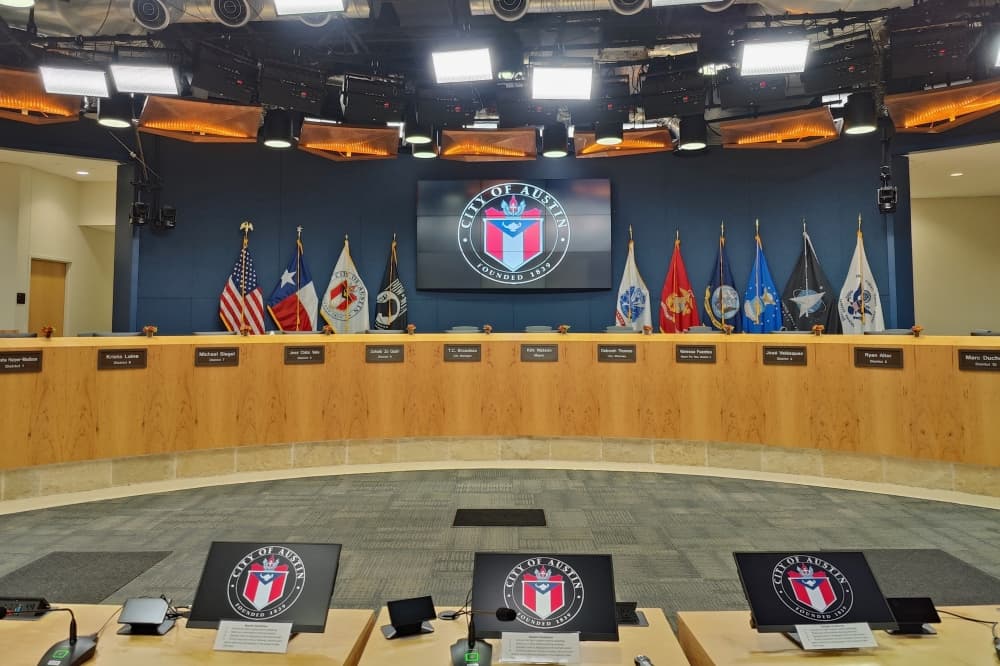
City Council offices will now operate under new policies for their expenses. (Ben Thompson/Community Impact)
City Council members voted to update policies governing their offices' spending, one of several financial and operational reforms they're pursuing in the wake of last year's failed tax rate election.
What happened
Officials first suggested revising Austin's council spending policies in the fall, and have since been developing a new outline of allowable expenses and transparency measures.
The updated policy unanimously approved Jan. 22 lays out various allowable expenses for council offices, as well as related financial reporting, staff training and enforcement standards.
Officials' spending on items like office supplies, travel, hospitality, software, conferences and gifts are now outlined in the city's rulebook. All relevant city employees will now receive annual training on the policy, and public reports on all council office spending will be published online every year going forward.
Mayor Kirk Watson, who first suggested the spending reforms after the November election, said the update consolidates and clarifies past guidelines while moving Austin's rules more in line with other Texas jurisdictions.
"This will help safeguard public confidence and offer greater clarity on permissible and impermissible use of funds," he said. "When we reviewed the council spending policies, we found a bunch, a lot, a whole lot of decentralized administrative bulletins and governing policies. So this kind of ... brings those together.”
Zooming in
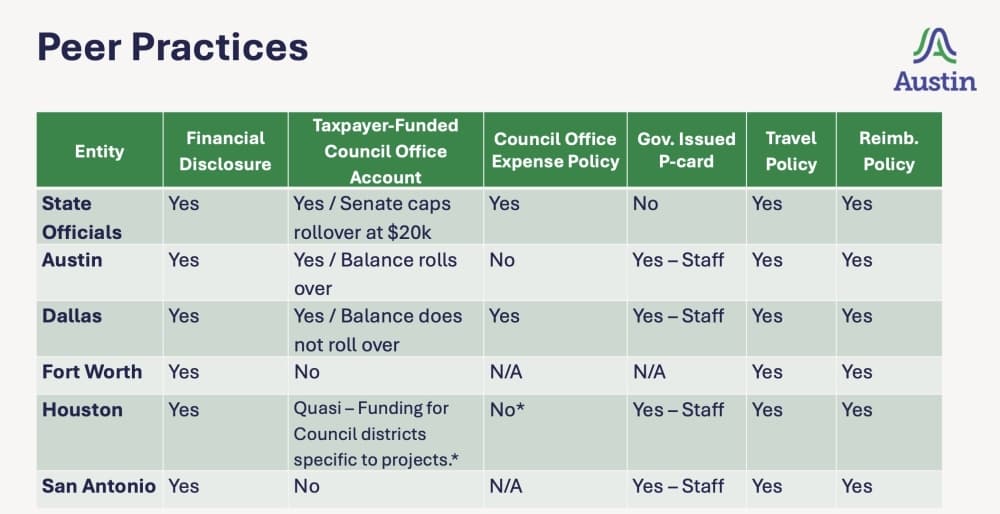
A city analysis of local practices versus others across the state found Austin City Hall to be an outlier in terms of how officials' remaining funds are handled year-to-year. No other Texas cities allow council offices to carry any of their leftover budgets across fiscal years, and state senators are permitted limited office rollover.
The draft version of Austin's new expense policy would have capped rollover budgets at $50,000, but that limit was removed through an amendment from council member José Velásquez who said offices need to maintain flexibility to better serve constituents.
"While we all receive the same amount of funding, our communities have very different needs. Some examples of those are interpretation and translation services, and meeting with organizations and community leaders that serve monolingual Spanish speakers and immigrants," he said. "With regard to equity, I believe each council office better understands their communities’ individual needs rather than the body as a whole."
City Council members approved unlimited year-to-year rollover funding in their offices, differing from practices in other Texas cities and the state Legislature. (Courtesy city of Austin)
The rollover cap was removed, over some objections, in a 6-4-1 vote. Watson and council members Vanessa Fuentes, Krista Laine and Marc Duchen opposed the move, and council member Mike Siegel abstained.
“I am not comfortable being an outlier. I am not comfortable taking this level of additional privileges in terms of how money is spent versus the rest of the city, and the rest of public government in Texas," Laine said.
Council member Ryan Alter said the presence of leftover finances could suggest council offices are being overfunded to begin with, a question that may be reviewed during summer budget planning. While crediting an improved expense policy overall, Watson said he was disappointed in the rollover decision so soon after city voters gave "a clear signal" in response to past council spending practices.
"I’m not going to be able to really explain why Austin is different from the rest of the world on this, why we are exceptions to the rule. And I’m going to have some difficulty describing what goal that achieves—particularly in terms of transparency and accountability and equity and good fiscal discipline," he said. "I think that is a mistake at a time when we’re working very hard to restore confidence."
What else?
The January discussion tied into separate debate on the council dais over a new program aimed at supporting priority projects in each member's district.
That concept of District Service Funds advanced back in 2024 through a proposal from council member Vanessa Fuentes. With those service funds, council members could direct city dollars to local improvements that they or their constituents might want help with. Examples could include neighborhood park upgrades or targeted sidewalk fixes.
District-level funds are common in other cities, but Austin has yet to roll out a similar system. Fuentes' original outline was approved and the city created a program outline last year, but it was never funded. Several officials said they now want to see it launch in the near future.
Study shows less rainfall is reaching Lakes Travis and Buchanan