For the first time since November 2021, Canyon Lake has reached full capacity, following a series of large storms that caused flooding along the Guadalupe River, the lake’s main tributary.
How it happened
Canyon Lake levels have increased in part due to rainfall in the upper Guadalupe River Basin from the July 4, 2025, floods, which increased inflows into the reservoir and raised the elevation by nearly 15 feet by August 2025, said Lindsey Campbell, communications director for the Guadalupe-Blanco River Authority, or GBRA, in an email to Community Impact. The lake’s water levels also reached 909 feet mean sea level, or MSL, following heavy rainfall from the week of July 13. The reservoir was at 61% capacity in July 2025, according to data from the Texas Water Development Board.
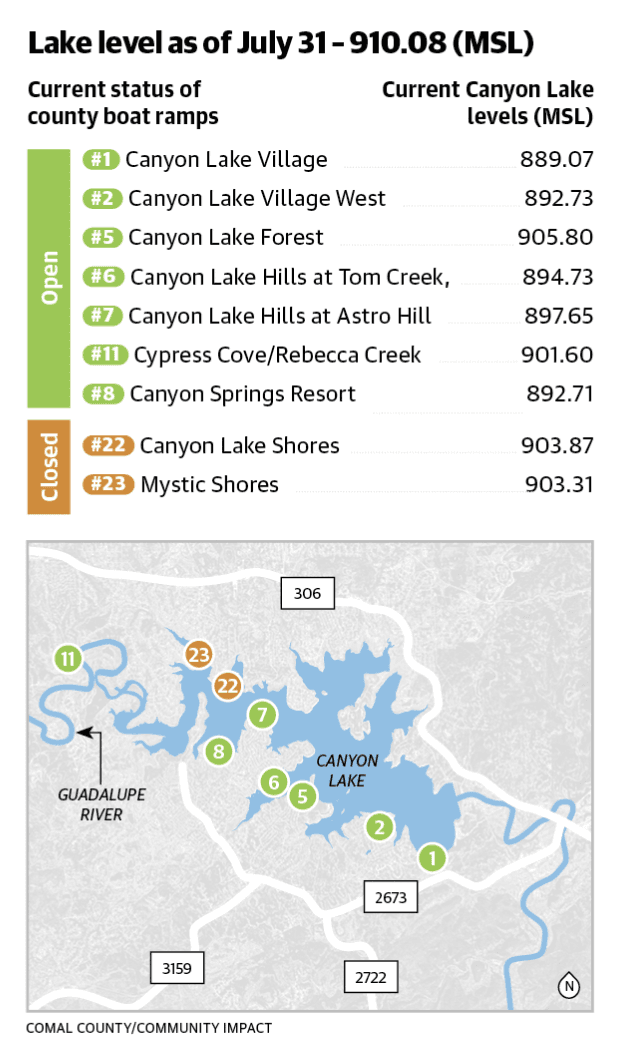
Now that the lake is full, seven boat ramps managed by Comal County have reopened, with plans to open more in the future once debris clears, Precinct 1 Comal County Commissioner Doug Leecock said.
“We’re going to work to open up all of our nine county-operated ramps, but we have to take it [on a] case-by-case basis depending on where material decides to end up,” Leecock said.
Boat ramp access is managed by Comal County, the U.S. Army Corps of Engineers and the Water-Oriented Recreation District of Comal County, or WORD, depending on the location.
What the experts say
Recovering from a prolonged drought usually requires several years of above-average rainfall and inflows across the watershed. While the recent drought is comparable to the 1950s “drought-of-record,” the Guadalupe River has also seen rain events—like in 2002—which would have refilled the lake multiple times over, Campbell said in the email.
Canyon Lake, managed by GBRA, was designed to store water during wetter periods and provide a reliable water supply when natural river flows decline. Releasing water during drought is one of the reservoir’s intended purposes and varies based on reservoir conditions, inflows, customer demand, operational needs and flood operations.The reservoir begins to recover when inflows exceed release rates, which allows the lake to refill over time, according to Campbell’s email.
During drought, GBRA’s customer releases typically range from 50 to 90 cubic feet per second, or CFS. Depending on the inflows at the Spring Branch gauge, approximately 90 CFS serve at the normal maximum drought release. Prolonged drought has been the primary factor affecting the reservoir’s storage over the past several years. Canyon Lake’s water levels are also influenced by evaporation and water used per existing water rights and contracts, Campbell's email states.
Before you go
Leecock said small towns, such as Sattler and Startzville, along with small businesses in the area thrive on lake tourism.
“Some people have moved here in the past five years, and they’ve never experienced a full lake, and for them to see it now at its current stage,” Leecock said. “We look forward to folks coming back here, to Comal County, and especially in the Canyon Lake area.”
Leecock also encourages individuals to be safe on the lake and wear a life vest.
“There is a lot of debris that’s making its way across the lake, so if you do choose to boat, do so with extreme caution,” he said.