Shaheryar Khan contributed to this reporting.
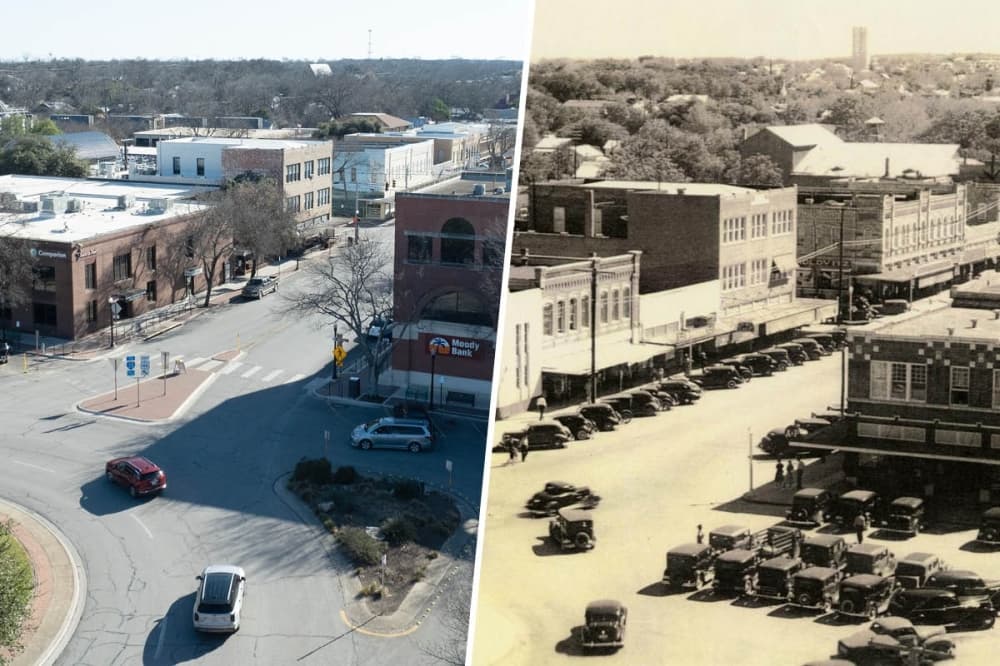
New Braunfels was founded in 1845, and by 1850 it was the fourth largest city in Texas, according to the Texas State Historical Association. While the city has lost that claim to fame, government and community groups are spearheading preservation efforts to maintain the city’s charm.
In the last 10 years, more than 7,000 permits, from roof repairs to remodels, have been filed with the city to complete work on historic facilities in the city’s downtown as new businesses open in the old facilities, according to city data.
While several new businesses have opened recently in the downtown historic district, other buildings sit empty or under construction as business owners say they are navigating the unique challenges of finding a home in these spaces, including extra permitting steps and additional renovation costs.
Why it matters
Keva Hoffmann Boardman, a fifth-generation New Braunfels resident and programs coordinator for the Sophienburg Museum and Archives, can share the history of each building along the city’s streets.
Cowboys & Cadillacs, a rooftop bar, opened in February at 125 N. Castell Ave. The building below it once housed a pharmacy and various shops, Hoffmann Boardman said.
The Phoenix Saloon, at 193 W. San Antonio St., opened in 2010 in a building built in 1871 and was first used as a saloon under the same name. It was allegedly the first bar in Texas to allow women to drink, the site of chili powder’s creation, and home to an alligator pit and badger fights. It closed during Prohibition and was used for other businesses before reopening as a bar.•In the 1800s, the Zum Schwarzen Walfisch opened in a wood building. The saloon moved and was replaced by the local newspaper. In 2007, new owners opened the Black Whale Saloon—the English translation of the original name—on the same site, although the building had changed, according to the new establishment.
Many downtown historic district landmarks remain in active use as businesses. However, not every building has been saved.
“We’ve demolished a lot, especially on this courthouse corner. We killed it,” Hoffmann Boardman said.
For many locals, preserving historic downtown structures depends on making business viable in the space.
“There has to be a balance because you have to do stuff that is cost-effective, or it is not going to happen. That’s when people just allow buildings to deteriorate,” said Lark Mason III, a member of Preserving New Braunfels.
The challenges
The city has four historic districts, where all buildings within are subject to extra regulations, New Braunfels Historic Preservation Officer Katy Totman said. Other buildings can be designated as historic by the city, state or nationally, and each designation comes with different requirements. Some buildings might have no designation, despite being as old or well-preserved as those that do.
TJ Grossi, executive director at Schumann Consulting, said the key to navigating the challenges is having a lot of experience with the different processes.
Schumann Consulting is currently working on the Faust Hotel remodel and has shepherded several projects throughout the city through the process.
Nathan Feingold, owner of NB Remodeling and vice chair for the New Braunfels Historic Commission, said obtaining historically appropriate materials can be costly and time-consuming. He also said the permitting process presents challenges.
"As far as I’m concerned, [the permitting process is] a jumbled mess,” Feingold said.
What business owners are saying
Sisters Lilliana Brabham and Laura Hickman own the bookstore and coffee shop Chapter & Co. on W. San Antonio Street. Stairs reading “First National Bank” from the late 1800s lead into the building.
“This building has a soul,” Brabham said.
The front section of the building had been mostly restored when the pair took it over. They said the permitting process was smooth, and they’ve had few issues with the building’s age.
The back of the building is unfinished, and the pair are committed to maintaining as many historic elements, including using original windows and light fixtures and converting some of the original beams into shelves or countertops.
“People just want to know where they come from,” Brabham said. “And even if you don’t come from here ... this is a piece of history.”
A trio of New Braunfels residents are converting The Voigt House into Kennedy’s Tavern. The home features an 1840s brick house inside a 1870s home. While it is located outside of the city’s historic districts and comes with few restrictions for remodeling, the team is committed to keeping it as close to the original as possible, owner Kyle Kennedy said.
“If we just let people knock things down, our downtown would look like anywhere,” Kennedy said.
As a lifelong New Braunfels resident, he said it is important to keep it locally owned and have as much local participation as possible.
Local involvement
Historic preservation groups, such as the New Braunfels Historic Landmark Commission, the New Braunfels Conservation Society and the Sophienburg Museum and Archives, play a role in restoration efforts.
“It creates the fingerprint and an aesthetic for the area that people fall in love with,” said Jennifer Singleterry, executive director for the Sophienburg Museum.
Lark Mason—president and CEO of Lark Mason Associates—is working with his colleagues to develop a website that will address the challenges and importance of managed growth. Lark Mason and his son, Lark Mason III, are members of Preserving New Braunfels, a new initiative to save and protect historic structures in the city
“It’s an overwhelmingly difficult thing to do for a private person to engage in any kind of historic preservation effort,” said Lark Mason.
How to get involved
The city is working to simplify the process and align guidelines with neighboring cities, said Christopher Looney, director of planning and development services. It also offers financial incentives, including a 20% property tax reduction for downtown historic district properties and waives some permitting fees.
Business owners can contact the city’s historic preservation office for renovation guidance and assistance with the permitting process. The New Braunfels Historic Landmark Commission also holds public information meetings.
Even those not opening a business can get involved in New Braunfels culture and history by attending or volunteering at cultural events.
“Buildings are just empty structures. ... Without the people, without [cultural] events, they’re just husks,” said Lark Mason III, who organizes the New Braunfels Renaissance Faire.