City officials will test new digital wayfinding signs at three parking lots in downtown McKinney that display space availability.
At a glance
The city is partnering with AMSYS Innovative Solutions to track parking availability in real time, which will be displayed through wayfinding signs, according to officials. Digital signs will be installed at the parking lots on South Kentucky and East Cloyd streets, Planning Director Lucas Raley said.
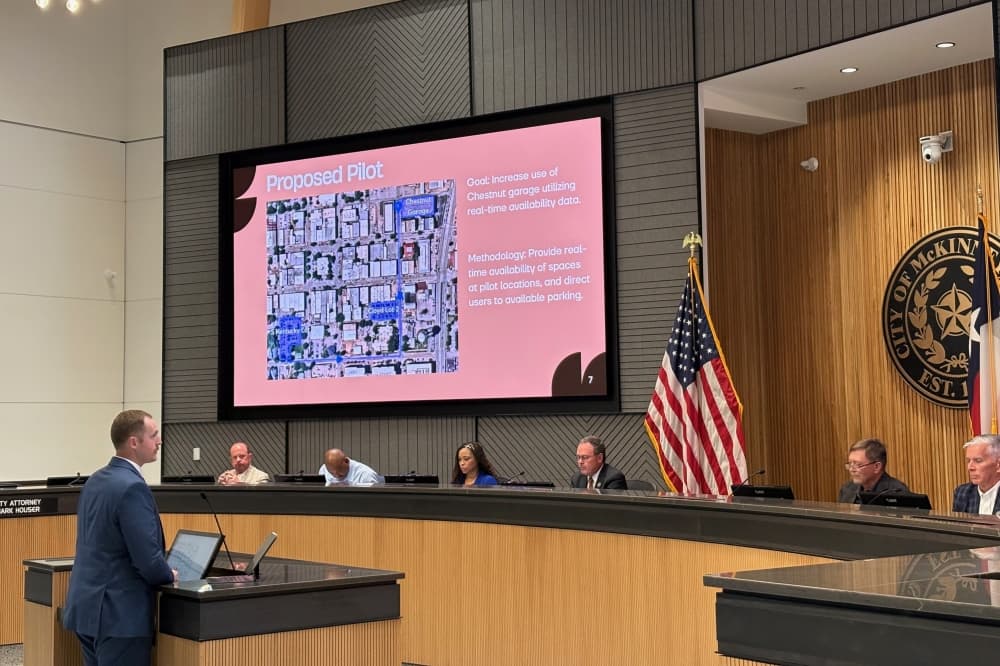
In the event that both lots are full, signs will direct drivers to the Chestnut Parking Garage on Chestnut Street. Parking data will be tracked through “computer vision” technology that utilizes cameras, according to a staff presentation. Tracking and computing will be completed on-site, and footage is wiped every 30 days, Raley said.
AMSYS will not receive footage from the cameras and will only receive the data output of occupied or vacant parking spaces, he said. The company uses a process called “edge computing” that utilizes hardware on-site to compute and display parking availability, Raley said.
“It’s stored at the edge on the hardware associated with the camera,” he said about the video footage. “Every 30 days, it’s automatically overwritten.”
Project funding
The pilot is being funded by McKinney’s Tax Increment Reinvestment Zone No. 1. Board members approved up to $150,000 during a June 2 meeting, and council members approved a budget amendment for the project the same day.
A TIRZ is an economic development tool that directs increased tax revenue in a specific geographic area to projects within that same area. TIRZ No. 1 was established in 2010, and the board is made up of multiple City Council members, a representative from McKinney’s Planning and Zoning Commission, and a representative from Collin County Commissioners Court.
The project is estimated to cost $105,000, but city staff requested up to $150,000 in case additional funding is needed to get the “best signing” they can get, Raley said.
The context
City staff previewed the pilot program during a council work session in May, but the action in June will formally fund the project. The signs will display the number of available spaces at each parking lot and at the parking garage on Chestnut Street, Raley said.
“There’s a million different options that we could have come up with here,” he said.
City staff selected an “unrestricted lot” that has no time restrictions, a “restricted lot” that limits parking to three hours and the parking garage where there are generally available spaces, Raley said.
Part of the pilot’s goal is to increase use of the parking garage on Chestnut Street with the technology, according to the staff presentation.
Looking ahead
Drivers in downtown McKinney are still a few months away from seeing the new signs. Required hardware and software will be installed within the next three months. After that, officials will establish a “baseline” examining how full the lots are typically, Raley said.
The digital signs will be installed at the two parking lots and parking garage after the baseline has been established, he said. TIRZ board member Steve Lebo asked about the possibility of installing remote digital signs that direct drivers entering downtown.
City staff is focused on these three lots for the pilot program because it’s a “controlled environment,” Raley said. If the technology and pilot program are successful, however, it could be expanded to include remote signs in a potential second phase.
“If we feel that it’s successful and we’re able to direct people effectively, then that could be one of the first things we look at for a Phase 2,” he said. “Can we catch people as they’re entering downtown?”