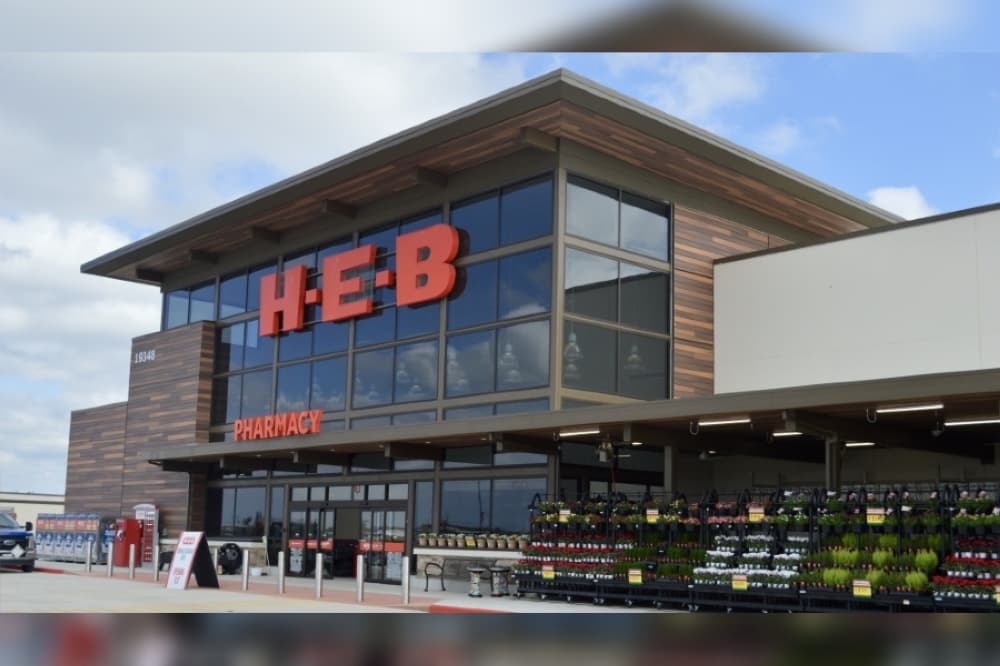
The Leander 102,000-square-foot H-E-B grocery store opened in 2021 at the intersection of Hwy. 29 and Ronald Reagan Boulevard. (Community Impact staff)
The Hwy. 29 and Ronald Reagan corridor—once a stretch of wide-open growth between Liberty Hill, Leander and Georgetown—is quickly hardening into a retail-and-residential hub, as a wave of major commercial projects contribute to recent new housing swells—reshaping the area into a more self-contained suburban center.
The big picture
The Hwy. 29 and Ronald Reagan corridor—where the cities of Liberty Hill, Leander and Georgetown meet—has seen elevated housing growth in the last few years.
The wave of new construction has helped push the housing inventory higher, and real estate agents in the area say the current market is favorable to buyers.
More recently, a surge in commercial projects aims to provide amenities and balance the local tax burden, said Christian Kurtz, Liberty Hill Economic Development Corp. director.
At the northwest corner of the Hwy. 29 and Ronald Reagan Boulevard intersection, the Walmart-anchored Santa Rita Ranch Center development is under construction. At the nearby intersection of Hwy. 29 and US 183, Liberty Hill’s first Target is under construction and Costco recently opened.
With the introduction of more commercial development, the region is transitioning from a series of remote neighborhoods into a self-sustaining urban hub as infrastructure and retail catch up to population growth, Kurtz said.
A slew of residential developments have cropped up in recent years, with a commercial hub now offering retail nearby. (Community Impact staff)
A closer look
Major retailers, such as H-E-B, Costco and Walmart, will provide a diversity of grocery options closer to homeowners in the area. And in many cases, they anchor larger developments offering new dining and retail options.
These new businesses allow residents to stay in their city, instead of traveling 30 minutes or more to eat or shop, said Adam Overhauser with Keller Williams Realty.
Kurtz said the new development allows the city of Liberty Hill to diversify its economy and share the tax burden.
It also makes it easier to “live, work, play” within one community, Kurtz said.
For the surrounding cities, this commercial boom is an economic tool that local municipalities are actively prioritizing, Kurtz said. Relying solely on residential growth places a higher tax burden on homeowners to fund necessary infrastructure, like roads, Kurtz said.
The commercial influx is “catching up” to the population already established there, local real estate agent Laura Britt said.
She said its addition is relieving a long-standing lack of local restaurants and shopping rather than acting as the primary draw for new residents.
However, the area is still seeing new housing growth with Perry Homes, Pulte Homes, Highland Homes, Regency and Lennar all building in multiple new neighborhoods.
And, with approximately 5,000 homes built, the Santa Rita Ranch development in Liberty Hill’s extraterritorial jurisdiction is still less than 50% built out, according to its website. RCLCO Real Estate Consulting ranked the development as the No. 1 master-planned community in Austin for new home sales in 2025, with 483 sales from various builders last year.
Note: This map is not comprehensive.
Zooming out
Data for Leander, Liberty Hill and Georgetown ZIP codes show total listings remain elevated, with peaks over the last couple of years. There is approximately six months of housing inventory available.
“Definitely the market is picking up a little bit, but ... we’re still in a buyer’s market,” Britt said.
Despite being an inventory-heavy market, Britt said the resale market is facing stiff competition with new home builders who can offer competitive incentives, such as lower interest rates.
Overhauser said this means sellers of existing homes need to be more strategic with pricing and ensure their properties are in a condition to compete.
Something to note
Not all commercial development along the Hwy. 29 and Ronald Reagan corridor directly benefits nearby cities’ tax bases.
Some major projects, including Santa Rita Ranch Center, fall within municipal utility districts, meaning Liberty Hill will not collect sales tax revenue from those sites.
Furthermore, Liberty Hill is grappling with what City Manager Thomas Hunter referred to as “violent growth.” While the city limits currently house roughly 16,000 residents, the surrounding ETJ holds around 87,000 people, who are not served by city infrastructure.
Georgetown faces similar pressures as growth outside city limits increases demand on regional infrastructure.
“Although this area is outside of Georgetown’s extraterritorial jurisdiction, we do provide water to a portion of this area, which will benefit from the enhancements to Georgetown’s water system,” Assistant City Manager Nick Woolery said. “Georgetown also has closely coordinated with Williamson County on their improvements to Ronald Reagan Boulevard.”
As housing, retail and infrastructure continue to expand, local officials say the current challenge is ensuring that rapid growth is matched by the revenue and planning needed to support it without shifting costs onto existing residents.