On May 6, local biologists will lead guided hikes through the Balcones Canyonlands Preserve in celebration of the 20th anniversary of the program that created the project—the Balcones Canyonlands Conservation Plan.
In 1996, Travis County became the first area in the U.S. to offer developers a streamlined method to build in areas housing endangered species habitats, BCCP Coordinating Committee Secretary Sherri Kuhl said.
In 2016, 739 areas or entities are participating in the program, said Adam Zerrenner, field supervisor for the U.S. Fish and Wildlife Service.
History
During the late 1980s and early 1990s, endangered species located in Travis County began being listed on the federal list of endangered species, Kuhl said.
“That is when the [endangered] species were listed [federally] here in Travis County,” she said. “That’s when people were getting down in caves and chaining themselves to bulldozers. There really wasn’t a mechanism to allow development to go on and protect the [endangered] species at the same time. So it was this big clash between the development community and the environment community.”
At the time, a developer needed to apply to USFWS for a permit to build in a habitat area, Kuhl said. The process to obtain this permit took years, so Travis County officials joined other local officials and groups to develop the Habitat Conservation Plan whereby developers had the option to pay money to the BCCP partners to purchase land elsewhere as a preserve for the endangered species the development would be destroying, or “taking,” she said. This fast-tracked approach could be completed in weeks instead of years, she said.
A $22 million bond approved by Austin voters in 1992 provided the start of the Balcones Canyonlands Preserve, and enabled the city, on behalf of its partners—including Austin, Travis County, The Nature Conservancy, Travis Audubon Society and the Lower Colorado River Authority, to purchase land that would be used to mitigate, or offset, for the land being developed. Another bond, in the amount of
$20 million, was used by Austin to purchase the area now known as the Barton Creek Wilderness Preserve.
“With those two bond propositions, we started buying property extensively in the early ‘90s,” Kuhl said. “That was when a lot of those properties had turned over to the Resolution Trust Corp. [in foreclosure]. So there were rock-bottom prices. We bought tracts for $3,000 an acre, things that you couldn’t touch for that price [today].”
Originally, the BCCP partners were told by their advisory team to purchase 125,000 acres of habitat, Kuhl said. However, a compromise ensued, with the BCCP partners directed to amass 30,428 acres and USFWS to preserve 40,000 acres by 2026, she said.
To date, 31,785 acres have been preserved under the BCCP using bond funds, donations and other funding mechanisms, Kuhl said.
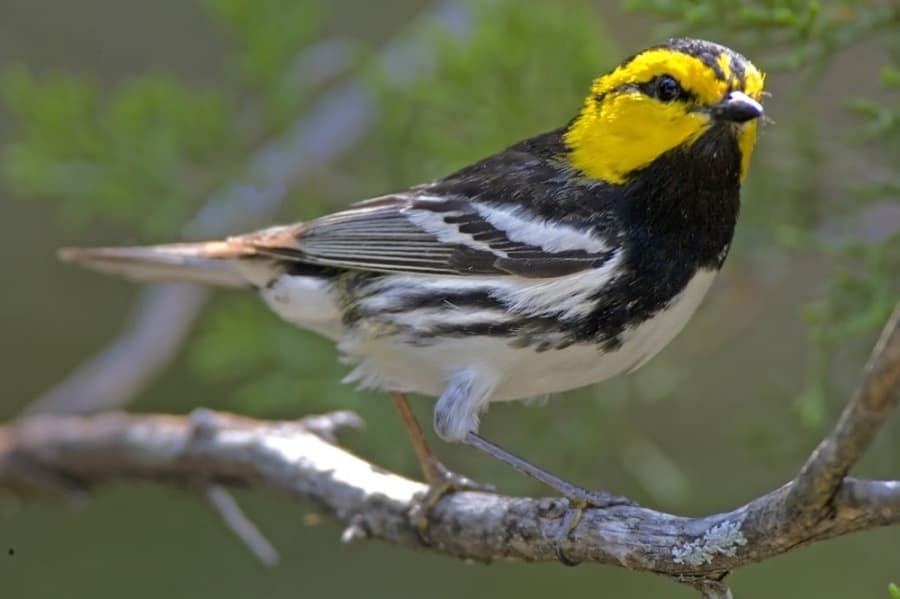
“There were long lines [for permits], and USFWS couldn’t keep up with the demand,” Kuhl said. “[The BCCP] enabled us to buy up these large blocks of habitat that we really needed for the golden-cheeked warbler to survive. So it benefited the developers, but it also benefited the [endangered] species.”
 “Double-edged sword”
The increased growth in the Austin area has pitted the goals of the BCCP against the need for traffic relief—adding roads through habitat regions, Kuhl said.
“When the preserve system was created, it was very critical that it not be bisected and fragmented,” she said. “Along the major highways like [RR] 620 and [RR] 2222—areas that might need to expand—there was a provision in the permit to widen those roads or put in extra turn lanes or do improvements to those roads. And they have. So there are provisions in the permit for those roads to expand, but what we can’t do is build a brand-new road fragmenting the preserve, across the preserve. That preserve is mitigation for all that development that has already occurred.”
Travis County Commissioner Gerald Daugherty, who is a co-chairperson of the Balcones Canyonlands Coordinating Committee with Austin City Council Member Leslie Pool, said he considers preserve, or BCP, property to have “become a little bit of a double-edged sword.”
“[BCP] makes it very, very difficult to put infrastructure on the ground as it relates to roadways,” Daugherty said. “I do think [the BCP] has created a hardship for us, especially in western Travis County, because there are places that need roadway capacity. I think that a human being is more important than a bird.
“We need to find ways to work with [US] Fish and Wildlife [Service] to perhaps have some sort of ability to go in and put in some roadways.”
The next decade
Although the BCCP requirement of preserving 30,428 acres of land by 2026 has been met, the partners are still obligated under the plan to meet specific goals for other smaller sites, or macrosites, contained within Travis County—including the Bull Creek macrosite, the North Austin macrosite and the South Austin macrosite, Kuhl said. The plan also requires the partners to acquire 62 named caves, a goal that has also not been met, she said. At the end of the 30-year permit life, Austin City Council and Travis County Commissioner’s Court will decide if they want to extend the permit or end it, she said.
“I’m assuming in 10 more years, everything outside the preserve is not going to be fully developed,” Kuhl said. “So we would still want to hold that permit and let people develop.”
BCP or BCCP? What's the difference?
Balcones Canyonlands Preserve (BCP)
In exchange for an expedited process to develop in environmentally sensitive areas, Travis County, Austin and other BCCP partners agreed with U.S. Fish and Wildlife Service to amass 30,428 acres to be set aside and maintained for habitat preserve. That land is called the Balcones Canyonlands Preserve, or BCP—land set aside to allow development to occur elsewhere in Travis County.
Balcones Canyonlands Conservation Plan (BCCP)
The Balcones Canyonlands Conservation Plan is a regional plan established in a permit issued to Travis County and the city of Austin by the USFWS on May 2, 1996. It provides a streamlined approach to allow development within an environmentally sensitive area. Before 1996, developers who wanted to build in environmentally sensitive areas of Central Texas had to individually negotiate a permit with the USFWS, a process that took at least two years to complete and required the developer to create his or her own habitat plan. The BCCP allows developers to pay a fee to mitigate for endangered species habitat loss, a process that takes about 30 days.
Celebrating the plan
On May 6, the city of Austin and Travis County will host an event celebrating the 20th anniversary of the Balcones Canyonlands Conservation Plan including distinguished speakers, guided hikes and education booths. 2-4 p.m. Free. Reicher Ranch Park, 3621 S. RR 620, Austin.
512-474-9692. www.austintexas.gov/wildlandevents