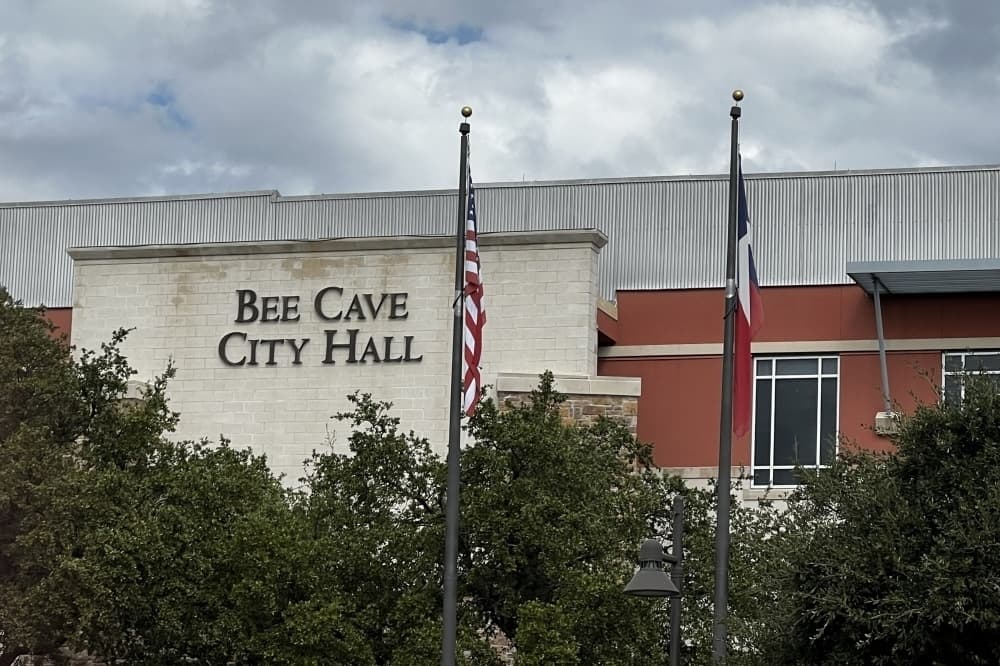
Bee Cave City Council is reviewing the city’s data-sharing policies and oversight of Flock cameras amid growing concerns about privacy and accountability.
The context
Flock Safety makes ALPRs, or Automatic License Plate Readers, that photograph all passing vehicles.
Artificial intelligence interprets the photos by tagging them with identifying information including license plate numbers, vehicle color, make and model, and other identifying characteristics such as dents or bumper stickers, Ian Leslie, public affairs manager for Flock Safety, said at the Nov. 10 Bee Cave City Council meeting.
ALPRs have been a source of controversy in Central Texas and across the country as community members have raised concerns about privacy, accountability, data security and general misuse.
Those who support the use of ALPRs state that the cameras can be valuable tools for law enforcement.
In recent months, several surrounding cities including Austin, Bastrop, Leander, Liberty Hill and Pflugerville have ended their contracts with Flock Safety, according to prior reporting from Community Impact.
The local impact
The city of Bee Cave began its contract with Flock in 2022 with two cameras located at the entrance and exit of Bee Cave Central Park.
The cameras were initially purchased to aid with deterrence and prosecution of car burglary suspects at Central Park.
Bee Cave’s policy for the cameras requires that the ALPR data only be used for official purposes and is only shared for “legitimate law enforcement purposes,” Bee Cave Police Chief William Pitmon said.
Officers must verify that a search is related to a qualifying case or incident with an accompanying case number.
Bee Cave Police Department also has a “Flock Transparency Portal” where the public can view data on the cameras.
While the city only owns two Flock cameras, independent businesses and local homeowners associations also have cameras within city limits, bringing the total number of Flock cameras within the city to 24.
The issue
One of the primary issues discussed by Bee Cave City Council was the sharing features of the cameras.
Each entity has control over whom it shares data with, Leslie said.
The Bee Cave Police Department shares its camera network with “bona fide police departments” that also share their network with the Bee Cave Police Department and are within the State of Texas, as well as with federal agencies, Pitmon said.
“I’m very happy with how our police department handles this because we have good folks there and we do a good job overseeing them,” Council member Kit Crumbley said. “I can’t say that about every other police department in the state of Texas because I just don’t know… . There have been reports of usages for personal reasons, like stalking … and I just don’t know who else is getting [the data].”
Concerns surrounding privacy and the cameras flagging identifiable features on people were also brought up, yet Bee Cave Mayor Kara King said privacy “doesn’t exist” in 2026.
“The way I see it is, I go for a walk in my neighborhood with my dog and every single person’s Ring camera captures me. If I’m talking on the phone, which I usually am, they’re capturing my phone call. They can look me up and they can see me,” King said.
King also mentioned an incident in which Flock cameras aided in finding a kidnapping victim across state lines.
“I think about it, and if that was my daughter and someone took her, I would want every available tool possible to find her and get her back to me before she was harmed,” King said.
No Bee Cave residents spoke in opposition to the cameras and one resident noted his support.
“I feel some of the concerns are conflated,” Bee Cave resident John Wickens said. “I feel safer with the Flock … and I would really like to keep [the cameras].”
What’s next
Although no action was taken at the meeting regarding the status of the cameras, city staff were directed to look into neighboring cities' policies regarding data sharing access.