The $4.3 billion budget the Fort Worth City Council approved Sept. 15 went into effect on Oct. 1, the start of the fiscal year.
Part of the budget includes several rate and fee increases for water, wastewater, trash and environmental fees that combine for an overall 6.6% increase.
In addition, a new pavement management fee aimed at fixing roads will start in 2028.
Water and wastewater
Water and wastewater rate increases impact both the volume and fixed monthly service charges for all classes, with the average bill increasing by $1.32 per month.
The city states the average customer uses 7,069 gallons of water and discharges 4,450 gallons of wastewater per month. Customers who use irrigation to water lawns will see higher rate increases per month based on usage, according to city documents.
The water and wastewater increase will go into effect Jan. 1, 2027.
Trash
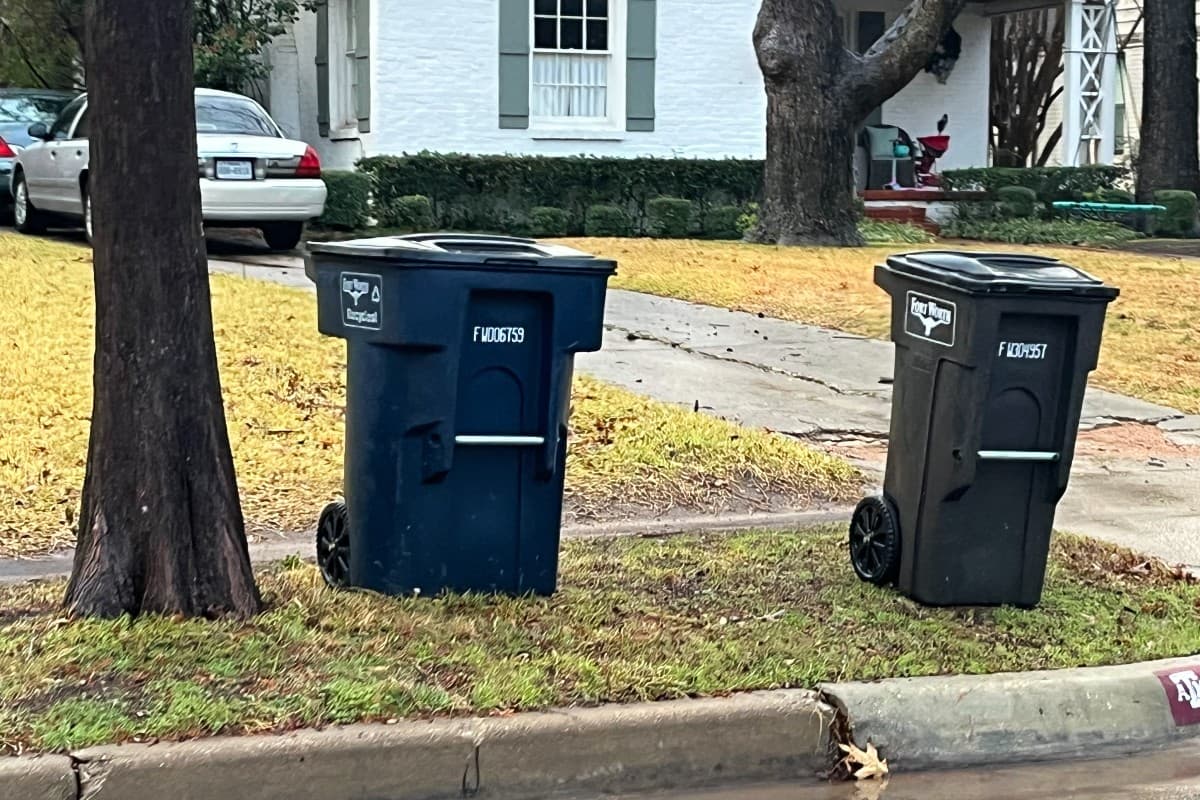
Starting Oct. 1, solid waste fees increased for residential garbage cart sizes, which include 32-gallon, 64-gallon and 96-gallon sizes. The 32-gallon price will increase by $2.75 per month, 64-gallon users will see a $3.90 hike and 96-gallon users will have a $5.15 difference compared to last year.
The solid waste cost is part of the water bill, according to a news release. Commercial garbage fee increases are based on frequency.
The fees cover disposal services, recycling, yard waste, bulk waste collection and access to the city’s drop-off stations and environmental collection center, according to a news release.
The limit for collection ranges from 100 pounds to 250 pounds, depending on cart size, according to the city website.
Environmental protection fee
Residents with an active water account will see a monthly fee of $2.50 to $3.33 for environmental protection fees. Single-family residential and multi-family units with two or fewer people will pay $0.25 cents more per month. Those in duplexes will have an increase of $0.33 cents to $3.33 per month.
Commercial, industrial, non-profit and municipal accounts will also see an increase in fees based on account type.
According to city documents, the increase will help cover fees for cleanup of illegal dumping, illegal campsite cleanup, litter control, street sweeping and contracted litter-abatement crews. They will add two new street sweepers to the fleet. The city previously purchased 12 street sweepers in 2023, which went into service in 2024, according to previous reporting.
The increase went into effect on Oct. 1, a city spokesperson said.
Stormwater
A 4.9% increase over fiscal year 2025-26, raising the average resident fee from $6.61 to $6.94.
The fee hike will help maintain the existing system of pipes and channels and look to improve drainage and reduce erosion, according to the city website.
According to a news release, the city will inspect 110 more sites of private stormwater facilities and will increase miles of channels inspected from 15 to 20.
The stormwater increase will go into effect Jan. 1, 2027.
Street maintenance fee
Fort Worth has more than 8,600 lane miles, and a street maintenance fee of $3 per household will take effect in February 2028. The fee will be added to the water bill, according to a city presentation.
The fee is projected to raise $27.4 million annually, about 40% of the identified funding gap needed for repairs, according to the city website. It will provide maintenance for streets in good condition once every five years and would prevent roughly $125 million in future reconstruction costs each year, which would reduce the need for future bonds connected to road repairs.
City voters passed an $845 million bond in May, and part of that package was $511.48 million for streets and mobility improvements, according to previous reporting.
Multifamily properties will be charged based on dwelling units, hotels on room count, schools on student population and commercial properties generally on square footage.
Editor's note: This article has been updated to include the environmental protection fee increases.