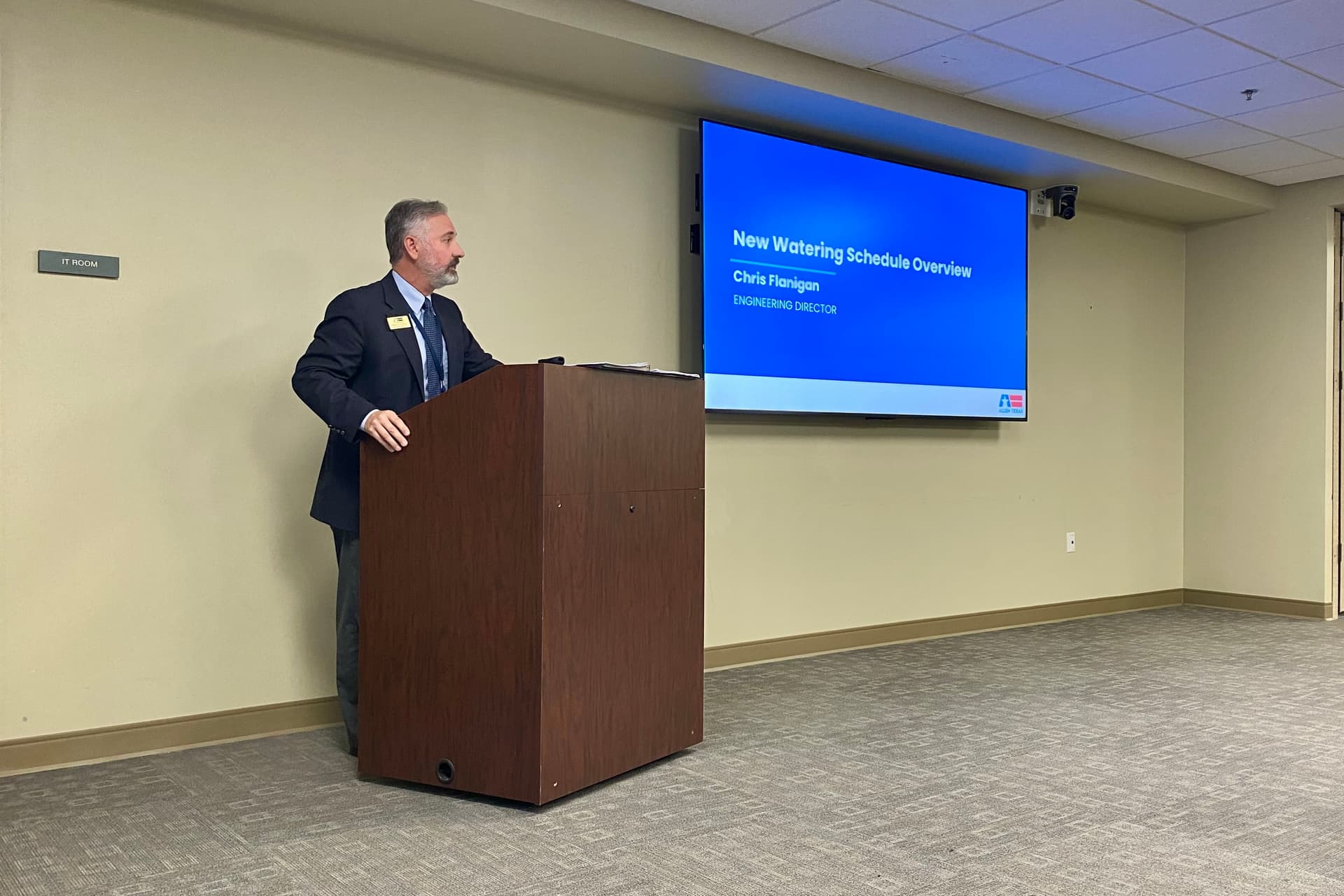
Michael Slattery, chairman of the Fort Worth Data Center & Infrastructure Commission, presented a report on data centers at a special Fort Worth City Council meeting Nov. 10.
The TCU professor was tapped to lead an 11-member commission of experts in various fields who reviewed four pillars: electricity and energy reliability, water use and local resources, land use and neighborhood impacts and economic impacts.
The final report and recommendations were provided in a 156-page packet to council. No action was taken by council members following the report.
According to an email from District 10 Council Member Chris Jamieson's office, the report serves as proposed guidance for council. Changes to zoning, noise standards, water policy or incentive practices would require a council vote through the process outlined in the city charter.
The overview
The commission was formed during the Aug. 11 council meeting to provide research on the impacts of data centers from environmental, financial, infrastructure and economic perspectives.
Slattery said the 11 members of the commission are considered subject experts in engineering, economics, environment, energy, energy finance and artificial intelligence.
The commission provided 19 recommendations:
A setback of 350 feet was suggested, with added protection for taller buildings to extend the distance. The city’s current setback is 50 feet; city staff proposed 250 feet in June.
“Residents are asking about their electric bills, their water, their quiet evenings and whether anyone has really checked the claims being made on both sides of what has become an intensely politicized issue, but I really think that skepticism is healthy,” he said. “It’s exactly why getting the science right in this commission absolutely mattered.”
Slattery said the commission studied the noise impact for five weeks, looking at the city residential regulations of 70 decibels in the day and 60 decibels at night. For commercial and mixed-use areas, the daytime limit is 80 decibels and 70 at night, according to the city website.
The report stated that the QTS Data Center in the Alliance area created substantial noise, often reaching 85 decibels to 100 decibels near the building.
The commission did not provide a recommendation on where data centers, zoning-wise, would fit best. Slattery said that the four existing data centers should have no issue accommodating the setbacks and accommodating the noise level requirements if the 350-foot buffer was approved.
The context
Six new recommendations introduced by the commission include:
Require a standardized technical fact sheet from large-load applicants for city incentives, scaled to project size and coordinated with economic impact
Require data centers to accurately measure and publicly share their local energy and water use while preventing companies from using off-site environmental pledges to offset their actual local water consumption
Complete a low-frequency noise pilot study of existing data centers and pursue a broader monitoring program as resources allow
Improve public access to backup generator data and ensure the city's long-term environmental plans study the air-quality impacts of multiple generators operating in the same area
Ask that the 2050 Comprehensive Plan or associated environmental plan consider the thermal impact of large data centers
Require a report showing how a new data center would affect its specific surrounding neighborhood, such as nearby housing, schools, traffic or local infrastructure
The report stated that additional discussion on electricity supply and cost, water supply and regional planning, air permitting, backup generator operation, state sales tax exemptions and projects outside city limits are beyond current capacity or city authority.
Slattery worked with city staff from development services, water and wastewater utility, the Fort Worth Lab, which handles the city budget, environmental services and the city attorney's office.
“Facilities are being proposed, they're being designed, they're being financed faster than the researchers can measure what they do to a neighborhood, a water system or a utility bill,” Slattery said.
A closer look
Slattery said the commission held a meeting at a data center in Fort Worth, looked at a data center under construction and he flew to Missouri to look at a modular data center in shipping containers in Centralia. He said they held conversations outside of the data centers to hear the noise levels from the chillers running.
One of the recommendations was a closed-loop, or liquid cooling, system for data centers. He mentioned that for a 50-megawatt data center, mid-sized based on the electrical power it can draw, it would take anywhere between 150,000 and 300,000 gallons for an initial fill for the closed-loop system.
By comparison, a single-family household in Fort Worth uses 85,000 gallons of water a year, so a data center would use up to 3 1/2 times the average household's usage. Slattery said after the initial fill, some data centers’ closed-loop systems can hold up to 1.5 million gallons of water, which is about 17 1/2 times the annual usage of a single-family house.
What's next?
Slattery said in the report the biggest decisions on data centers will rest with the Electric Reliability Council of Texas, the Public Utility Commission of Texas and the Texas Legislature.
The earliest the city council could vote on a moratorium on accepting applications for data centers is Feb. 23, 2027, Assistant City Manager Jessica McEachern said. According to previous reporting, council voted Aug. 11 to start the process to enact a 90-day moratorium.
The first of two required public hearings was also held Nov. 10.