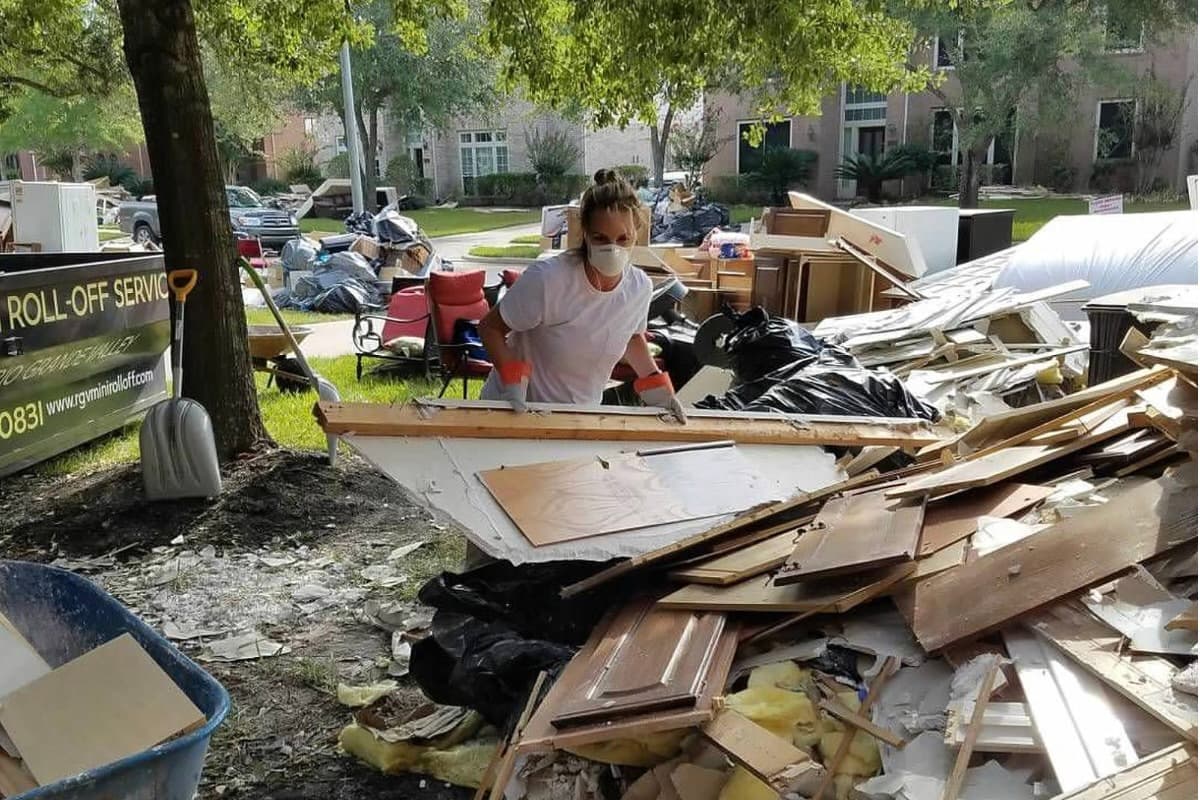
Janet Gardner cleans up debris from her Katy home damages after Hurricane Harvey in 2017. (Courtesy Janet and Samuel Gardner)
Nearly a decade ago, Hurricane Harvey hit southeast Texas and the Greater Houston area, resulting in the loss of lives and billions of dollars worth in damages.
Locally, Janet and Samuel Gardner lived behind Creech Elementary near the intersection of South Mason and South Fry roads when the storm reached Katy.
At first, they believed they only needed to shelter in place until they were told to evacuate.
When their family and neighbors were on their way to Creech, they couldn’t even make out the bottom of the deep, rushing waters.
By the time the Gardners got there, they realized the reality of what they were enduring—they were underwater.
When the Gardners eventually returned to their home, they came back to hurricane damage and discovered they lost irreplaceable mementos such as their wedding album and letters Janet Gardner’s father had written to her.
“We lost things that people don’t understand and you can’t replace those things,” Janet Gardner said.
Since Hurricane Harvey, officials in Katy, Fulshear and Harris County have been working on flood mitigation projects to ensure the destruction the storm brought never reaches those heights again.
The big picture
The city of Katy recently completed the $4 million Patna drainage improvements. The city also funded a $5 million drainage project completed in 2025 in the area of Heights, Airline and Drexel Streets, City Engineer David Kasper said.
Both the $9.9 million drainage project along Katy Hockley Road and the West Katy drainage project totaling $4.2 million are currently ongoing with West Katy expected to be completed by the beginning of 2027.
Meanwhile, Fulshear officials said all developments post-Harvey have been held to a higher standard for detention and mitigation requirements including the $2.33 million downtown eastside drainage project and Fourth Street reconstruction.
Additionally, there have already been three drainage capital improvement projects approved for fiscal year 2026-27, said David Licon, Fulshear’s assistant director of public works.
Harris County Precinct 4 has also lead various flood mitigation projects to help strengthen the area from flooding. Projects include Addicks/Barker Reservoir channel rehab, an east detention basin improvement as well as a Buffalo Bayou and tributaries resiliency study.
The background
In 2016, the “Tax Day Floods” caused $3 million in damages in unincorporated Harris County, Community Impact previously reported.
Hurricane Harvey led to 32,000 acres of land in the Katy area to be flooded, causing over 13,000 Federal Emergency Management Agency claims.
Shuhab D. Khan, a professor of geology at the University of Houston, said flooding in the Greater Houston area stems from extreme weather events such as hurricanes and the drainage systems becoming overused.
Khan said Katy is one of the fastest subsidizing areas in the region, which is when the land sinks due to storms, groundwater overpumping and urbanization.
What else is being done?
Fulshear Public Works Director Cliff Brouhard said when it comes to drainage, the two main factors are detention and flood mitigation requirements.
“What you have to do is you have to detain that water,” Brouhard said. “You have to build ponds, they capture your increased flow, your increased runoff and then you have to slowly release that into the system to ensure that you're not sending massive amounts of water to a ditch.”
Russ Poppe, first assistant engineer of the Fort Bend County Drainage District, said a “regional approach” is more efficient when addressing flooding.
“When you have one large pond that you can use to mitigate multiple areas versus smaller ponds distributed across that same area, just there's a level of efficiency that you can achieve by doing something more regional,” Poppe said.
One of the major flood mitigation undertakings in Fort Bend County is the $85.2 million “Brazos Project” consisting of six projects to minimize erosion and flood risk along the Brazos River and Mustang Bayou.
Additional efforts include:
Regional Flood Resiliency Coalition: Representatives from Harris County, Waller County and the Brookshire-Katy Drainage District signed a memorandum of understanding to form a regional flood resiliency coalition in August.
Community Rating System: The city of Katy is looking to join the National Flood Insurance Program’s community rating system to potentially lower residents’ flood insurance rates.
Possible Bond Election: The Brookshire-Katy Drainage District is proposing a $140 million bond election for May 2027 that will help fund five regional stormwater detention basin projects and five channel improvement projects.
Also of note
In 1968, the federal government passed the National Flood Insurance Act to provide insurance to help reduce the socio-economic impact of floods.
In October 2021, FEMA released Risk Rating 2.0, a new rating system for the National Flood Insurance Program that provides federally backed home insurance for floods. The program is designed to more equitably insure homes.
The rates account for flood frequency, flood types, distance to a water source and property characteristics including elevation and cost to rebuild.
Before rates were based on property elevation within zones on a flood insurance rate map.
Looking ahead
Khan said the frequency and intensity of major storms such as Hurricane Harvey are increasing as time goes on.
Beyond projects and planning, local governments and officials have been collaborating with residents on the best ways to handle flooding going forward.
Katy Mayor Dusty Thiele said the city of Katy has focused on a larger scope after Harvey.
“We don't plan a year in advance,” Thiele said. “We're planning out years and years in advance on what's coming in and what we can do to help our citizens here in the city.”
Reynaldo Guerra, Harris County Precinct 4 chief infrastructure officer, said the county has a two-prong approach when it comes to preventing flooding: planning ahead and doing what can be done now.
“We're both improving maintenance and delivering billions of dollars of capital projects,” said Lesley Briones, Harris County Precinct 4 commissioner. “Meanwhile, we're also working on this resilience plan that will guide our work for years to come.”