


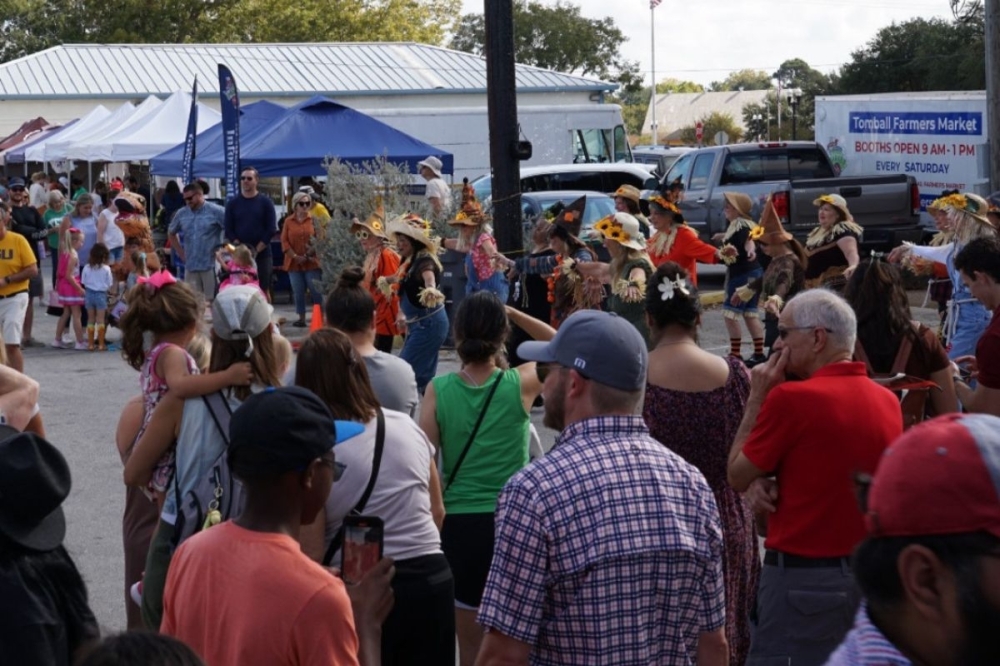
“They’re going to be overwhelmed and realize they didn’t bring enough stuff, enough bags,” Tomball Farmers Market Manager Amanda Kelly said, describing what newcomers can expect as they walk into a market that stretches across multiple rows and pulls in everything from fresh produce and eggs to prepared foods and artisan goods.
Kelly said that big, bustling scene didn’t exist when the market began in May 2008 with five vendors. Today, the market has a total of 97 vendors, with up to 80 set up on a given Saturday, depending on how many farmers are in the mix.
Two-minute impact
The Tomball Farmers Market is open Saturdays from 9 a.m.-1 p.m., rain or shine; the market closes only when the Tomball German Heritage Festival is in town, Kelly said.
To call yourself a farmers market, Kelly said, you need at least one certification, meaning an outside agency has reviewed the market’s rules and operations and recognizes it under a formal program or directory, often with standards tied to producer participation, food-safety practices or where products come from.
Tomball Farmers Market, she said, chose to go “above and beyond” because of what she described as an obligation to the public to be “as clean” as possible and to bring in the most local products it can.
In Kelly’s view, the market’s certifications and local requirements aren’t just extra; they’re part of what lets the organization tell shoppers, with confidence, that vendors are being held to a standard.
Kelly said products must be grown, raised, handcrafted or prepared within a 180-mile radius, and prospective vendors must have already spent at least a year and a half at another market.
Taking a step back
Kelly said the market is supported by two groups with distinct roles: a vendor committee and a nonprofit board.
The vendor committee—nine members—reviews applications, assists with farm visits and helps monitor health and safety compliance during market days, Kelly said. Farm visits happen every two years, she said, in part to verify that farmers are selling what they actually grow.
The board, meanwhile, must be made up of community members rather than vendors, Kelly said, adding that the separation helps avoid conflicts of interest for a nonprofit. The board mirrors the vendor committee with nine seats.
Keeping vendors compliant is also part of the job. Kelly said vendors are expected to carry whatever permits and documentation apply to their category: food-handler permits for cottage food vendors, commercial kitchen documentation when required, business liability insurance and more. She said the market also operates under a contract with the city of Tomball to use city property and is audited through its certifications.
Why it matters
Kelly described the market as an incubator for local small businesses that aren’t quite ready, financially or operationally, for a brick-and-mortar leap.
“We probably bring 2,300 to 4,000 people every Saturday,” she said.
She said that the market also offers resources such as small-business classes and connections meant to help vendors grow into their next stage.
Over the last decade, Kelly said 31 businesses have outgrown the market and moved into brick-and-mortar spaces, including Chefs Providence and Della Casa Pasta and 12 others in Tomball.
The foot traffic isn’t just big, it’s regional, according to a survey Kelly said she conducts every couple of years. In the most recent results she referenced, she said 58% of visitors came from Katy and Cypress, while 13% came from Tomball.
Looking ahead
Kelly said the market’s future goals include expanding garden-focused programs and building pathways for more residents to grow and sell food locally.
She said the organization has run garden scholarships for two years—five scholarships the first year and seven the next—awarding middle and high school students raised garden supplies and tutoring with master gardeners.
Kelly also said the market is working with Harris County Precincts 3 and 4 on community garden projects, including a veterans-focused effort tied to the Texas A&M Master Gardeners program, with the long-term idea of helping participants grow produce and then have a place to sell it.