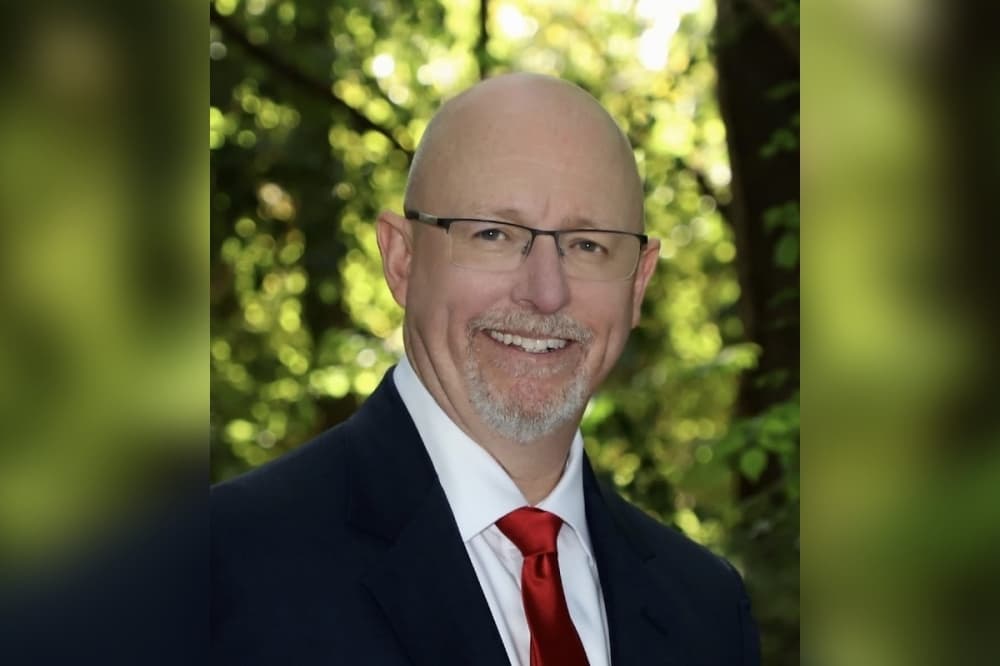
Mike Holley began serving as Montgomery County’s new district attorney in late October, after being appointed by Gov. Greg Abbott on Oct. 29. Holley succeeds former DA Brett Ligon, who resigned from the position in early October to run for Texas Senate District 4—Brandon Crighton’s seat, which he vacated due to being named chancellor and CEO at Texas Tech University.
In an interview with Community Impact, Holley discussed his career journey, his top priorities as the county’s new DA and the crime challenges he sees in Montgomery County. This interview has been edited for length and clarity.
Can you share a little more about your career journey and what led you to this position?
I was born in Odessa. ... [I] grew up, attended Odessa Permian High School and got involved in junior RTC, which led me to ROTC, and I got an RTC scholarship to college. ... I became commissioned as a psych lieutenant, military police corps and sent to ... Fort Hood, Texas. ... I spent most of my time with combat arms folks, but then I got deployed to Panama. ... I learned that the army would send you to law school and pay for your law school, and so I applied for that and got that called the Funded Legal Education Program. So the Army paid me for my college and they paid for a law school. ...
[I went] to Fort Bragg, North Carolina, ... was a prosecutor there, ... got sent to Korea as a defense attorney.
... I got an LLM [Master of Laws], which is an advanced degree in law. I was supposed to stay and teach, but on the graduation stage, I was told ... I would be sent to Iraq, and I was. ... That took about a year.
I came back, ... I was a civil lawyer for six years. ... I was doing prison ministry, and I ran across a guy named Carol Vance, who was the former district attorney for Harris County, ... and very deeply involved in prison ministry. And so Carol suggested that if I was going to be a prosecutor, I should come to Montgomery County. ...
I started here as a misdemeanor prosecutor in 2012. In 2016, Brett Ligon made me his first assistant, which is essentially the person who supervises all the attorneys, and I've done that for the last nine years, and then when Brett resigned to run, I obtained an appointment to be the district attorney from the governor, and filed to run for district attorney.
What are your top priorities in the new role?
If I was going to summarize my kind of philosophy ... is that people who are doing good things should be happy in this county, and people who are doing bad things should be scared. That's my philosophy.
I want families and students and kids and retirees, and people who are working, or just anybody who folks that are struggling, if they're trying to do the right things, I want them to be safe and find joy. But for the people who commit serious crimes, they need serious time, and I want them to be afraid that if they're in this county, ... they're going to be arrested, and they're going to come to us, we're going to prosecute them. And if it's serious crime, we will seek long sentences, and we don't apologize for that.
Beyond that, not every crime is a serious crime, and not every defendant has to go to prison. There are other things that we can do to restore people to our community and to their families, and we do that. Veterans Treatment Court is an example. Drug Court, DWI Court, those kind of things. But my bread and butter is that—keeping people safe. Good people should feel joy, bad folks should feel terror. That's what I'm about.
What's your vision for the department as the community is also growing?
Brett and I have been working on that for years, and he had a vision for what it looks like, and I'm going to continue that vision, which is, we continue to modernize. We are traditional, but we look for things that are innovative that help us do the work the right way. And so, for example, we transition from paper files to paper list files, from CDs or DVDs with video on them to a server with a link. So we continue to do that.
We're using [artificial intelligence] in some ways to help us with some of our work. We continue to just professionalize prosecutors; we created a position ... [for] people, [who] are usually employees that have shown an aptitude for case analysis, and they pair with a prosecutor and help them work on the harder cases. So we're keeping ahead of the work, we don't have a backlog. We're aggressively recruiting. We're just staying at the cutting edge of prosecution.
What are some initiatives that your predecessor had that you're wanting to continue or some new initiatives that you want to introduce?
What we've done really well is ... we take calls from police at the scene, and we handle those calls from the start, which is unusual. It's very unusual. In many jurisdictions, a prosecutor won't get a case until days, weeks, sometimes months after the arrest, and a lot can happen in that time, including the possibility that somebody may have been charged inappropriately. That's the possibility. We, from the very start, say, "This is a good offense, the evidence is there, and these are the things that we can do in the right charge."
So we're going to continue to do that. That's a very important process, what we call our 24-hour intake, which means that we have a prosecutor on the phone 24 hours a day, seven days a week, every day of the year. So we're going to keep doing that.
We're going to continue to be very aggressive in the Internet Crimes Against Children world. Unfortunately, crime doesn't stay static either, and the use of computers and the exploitation of children, the people who do that are getting more aggressive. And so we're responding in kind. And we have built a lab here, which is very unusual for a prosecutor's office, to be able to get into computers, get into cellphones, so ... one of the things that we will do is continue to build that and develop that. I would like to advance the ability for our prosecutors to get into the courtroom and have the visuals they need and the resources they need, like some of the civil firms I work with, so that if a victim in this county suffers a crime, they get the very best lawyer in the courtroom with the best resources to tell their story.
What are some other big crime challenges in the community?
A perpetual problem we've had in Montgomery County is impaired driving. And you're not likely to be killed in a murder in this county. I mean, it's not that they don't occur. They do occur, but they're fairly infrequent, but we have impaired drivers who hurt and kill people, and so we're very aggressive about that. So we have a chief of major crimes. We have just made a change to give that chief another senior prosecutor, and then those two prosecutors lead a team.
And so when we have an intoxication manslaughter or an intoxication assault, we can be at the scene and help law enforcement. Those cases are complicated. They're as complicated as any murder, because you have the issues of impairment from the driver, but you also have issues of causation. It can get very technical with the science of accident reconstruction. And so we're going to press that. But we also hold the line on DWIs. It's not uncommon for defense attorneys from the counties to come and have a DWI and be surprised when we're not dismissing it just out of hand.
We dismiss when we can't make the case, but other counties, I think, are maybe a little more accommodating there, we're not. We're going to hold a line. The difference between a DWI, the first defense, and an intoxication manslaughter is sometimes just inches. And so it's not that everybody who [is] charged DWI needs to go to jail, but there needs to be accountability and hopefully break that before it does end in a death.
What's the lab? Why is it unusual for a DA’s office to have?
We have a digital forensic unit, and it's manned and staffed. ... So we have the ability to get into any cellphone, any computer, in-house. Most DA offices would have to send those devices off to another place and get them back weeks, months, sometimes years later. We can do that today at any point if we need it. And that's a tremendous benefit for prosecution because so many cases, the evidence is in a cellphone or in a computer. So to be able to get into that at our discretion and to be able to analyze it the way we want to, it can be a game-changer in cases. ... I'm very grateful for our commissioners, very grateful for law enforcement and grateful for our commissioners, [who] have enabled us to create this lab ... that allows us to do these things. And we will help other agencies, other law enforcement agencies, and sometimes other counties in important cases, sort of a regional approach there, but it's very useful.
Becoming DA was sort of sudden for you, how has that process been like?
I love Brett Ligon and would have been happy to serve as his first assistant until I couldn't work. He's just a tremendous human being, and a gift to this community. ... I didn't have a place in my head for being the district attorney. I was always going to be his right-hand man. And then suddenly there was an opportunity to do so, and it took a little bit of time to say, "I can do this, and I want to do this, and I would be good for this office because I've been here so long and know the people, love the people, I have helped select the people."
It's unusual in our industry and ... many times a DA office, when it transitions like that, it's bloody. In other words, a new person comes in, will often let go of the senior people ... and bring their own people in. These new people may be good, they may not be, but they don't know the office, and it takes them a while. And in the meantime, sometimes victims suffer. ... Here, the idea was, I don't have to change anything radical.
I can keep the same people. My same senior staff that I worked with before Brett resign[ed] remains. That's very helpful. It's helpful to the people of this community. And I don't have to make changes for changes' sake. We can just continue what we're doing and just do it better every day.
Is there anything you would like us to know or anything you would like to add?
I'm a conservative at heart. That's the way I'm wired, which is to say that there are things that we have learned to do, that work well, and we trust those. It's not that we are opposed to innovation, but we're careful before we do something new that it does work well.
I care about the community, and I care about the people in my office, and the belief is I take care of the people in this office, they can take care of the community. That's the core. We are public safety-minded, and I think very important. ... There are a lot of ways to do this job. The way we do this job is to prioritize victims. Defendants matter, we want to treat everybody fairly, but our priority and our emphasis is on victims. If you're a victim ... of any crime, then you're going to get our heart and our efforts and our focus. We're going to take care of victims first. Again, there are times where we can help defendants, but that's not the core what we do. Our core what we do is to help victims and public safety.