


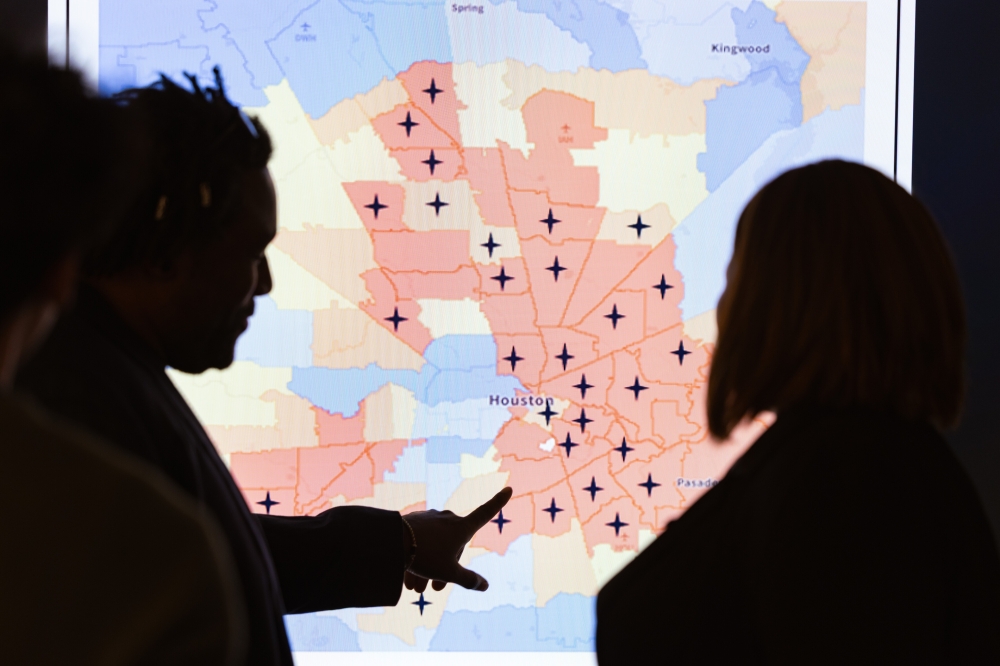
The study, published Oct. 15, found that even neighboring ZIP codes may have sharp differences in accessibility to mental health resources, as areas with lower education levels and higher poverty rates had fewer—sometimes zero—licensed mental health professionals.
“Prosperity should not be the deciding factor on whether a population, a community, is mentally healthy and has access to mental health [care],” UH researcher Chakema Carmack said.
About the study
Carmack and co-author Damien Kelly coined the term “mental health deserts” after deciding to compare the availability of mental health resources in Houston using the concept of food deserts.
The pair told Community Impact their findings closely aligned with their hypothesis: communities in ZIP codes with higher incomes and more development had greater mental health care options.
Kelly and Carmack said they mapped resources using data from Psychology Today’s registry of licensed mental health professionals and the U.S. Census Bureau’s Distressed Communities Index, or DCI.
The DCI rates ZIP codes as “distressed,” “at risk,” “mid-tier,” “comfortable” and “prosperous” based on poverty, job growth, education level and other factors, per the study.
The local impact
Locally, the Sugar Land area ranks consistently “prosperous”—with only ZIP code 77498 considered “comfortable”—on the distressed communities index.
Meanwhile, Missouri City has three ZIP codes in the “prosperous” or “comfortable” range, while ZIP code 77071—which consists of Fondren Park and the east side of Brays Oaks—is considered “distressed.”
Additionally, Stafford ZIP code 77477 sits at “mid-tier” distress, according to the map
The big picture
Of the 96 ZIP codes mapped, 43% were considered “distressed”—averaging only 1.9 licensed mental health professionals, with 39 having none at all, per the report.
“The same thing that comes with food deserts often happens with mental health deserts as well, meaning you don’t have access to transportation [and] there’s economic disinvestment in these neighborhoods,” Kelly said.
The action taken
In a continuation of their work, Kelly and Carmack said they’re partnering with Harris County Precinct 4 to explore potential policy solutions. The duo said they’re expecting to release a follow-up report in spring 2026.
Potential policy recommendations from the Oct. 15 report included:
- Incentives or stipends for professionals to practice in underserved areas
- Programs to promote mental health awareness and normalize seeking help
- Insurance reforms to cover travel for care or telehealth services