



"The district has an active debt management program, and that has allowed us to maintain a low tax rate while saving taxpayers money,” he said at the board of trustees' Dec. 1 meeting.
The district’s debt management strategies are governed by state statutes and board-approved parameters on an annual basis to limit the amount of debt issued and how it is managed, combining expertise from staff, financial advisors Hilltop Securities, and the district’s bond counsel, Bracewell LLP, Guinn said.
The basics
The district’s bonds, which cover capital projects related to growth or facility renovations, are loans issued by the district and paid back from the I&S portion of the property tax rate collection, currently set at 27 cents per $100 in taxable property.
This is separate from the maintenance and operations portion of the tax rate—currently set at nearly 79 cents—used to cover salaries and operating costs, Community Impact reported. While the board approved a temporary tax increase to the M&O rate to cover staff raises, it has not touched the I&S portion since 2023, Guinn said.
The strategy
The district employs a mix of tools to reduce borrowing costs on the 75% of debt that is callable—or has the ability to be refinanced when interest rates are lower—including:
- Refunding opportunities when new bonds are issued to pay higher interest bonds
- Variable rates for up to 25% of total debt
- Commercial paper program, which was implemented in 2016 and saves over $30 million by providing temporary cash flow from the general fund for capital projects to avoid taking out loans and paying interest rates
While the district can use up to $5 million of general funds at a given time from the commercial paper program, the largest amount they took out last year was $944,000, reimbursed in 40 days.
The comparison
The district maintains an AA+ bond rating from both Fitch Ratings and S&P Global credit agencies, indicating “strong” financial management, Guinn said. He said that ratings agencies focus on governance practices and adherence to board-adopted policies—not just financial balances.
Rating agencies also evaluate debt through ratios such as debt per pupil and debt as a percentage of property value, Guinn said. Compared to neighboring districts, FBISD has the lowest ratios, with the exception of Alief ISD, due to its “fully grown out" status, meaning most of the debt that they issue is related to maintaining their existing facilities.
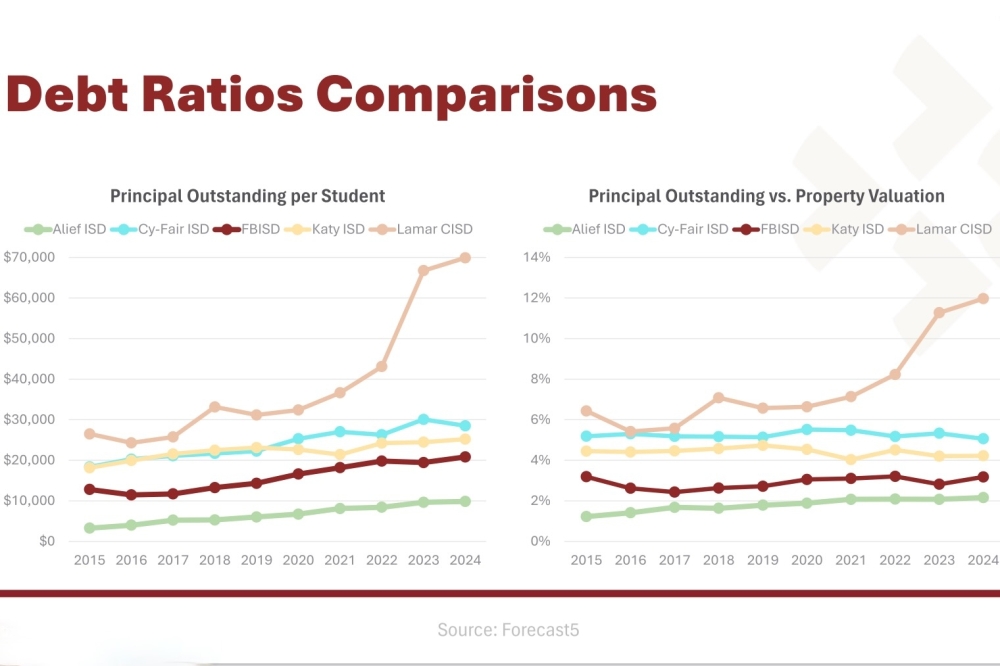
In line with the annual approval cycle, administrators are proposing new parameters for board approval that allow staff the flexibility to issue up to $200 million in new debt and to refinance up to $50 million in commercial paper, using either fixed or variable interest rates based on market conditions.
The new parameters also let staff handle refinancing the debt that comes due in 2026 and allow the temporary use of general funds to cover short-term cash needs for bond projects so the city can avoid paying extra interest.
The board-approved flexibility will only last through the calendar year 2026, and administrators will return in late 2026 for approval of 2027 parameters. The board will vote on the proposals at the Dec. 15 meeting, per board documents.
Looking ahead
With $868 million in authorized but unissued debt remaining, Guinn said he expects the increase will be needed in the future.