Harris County workers will now have a seat at the table in discussions about workplace regulations, grievances and salaries after commissioners approved a new policy allowing labor organizations to advocate on behalf of county employees—a first for a Texas county.
Commissioners Court passed the Harris County Consultation Policy on March 19 in a 3-1 vote, with Precinct 3 Commissioner Tom Ramsey as the only dissenting voice. Judge Lina Hidalgo was absent.
“We see Band-Aid fixes to problems that need real results simply because the people making the decisions do not talk to the people operating the machines,” said Leonard Washington, a Harris County road and bridge foreman. “This consultation policy is a formal way to bring issues and observation to the table so management can do their job better.”
How it works
Harris County employees will have the option to select a labor union organization to serve as a “consultation agent” on their behalf. Organizations must receive signatures from 20% of eligible county workers to serve as an agent, County Attorney Jonathan Fombonne said.
State law bans political subdivisions from entering collective bargaining contracts with labor organizations. Chapter 617 of the Texas Government Code also states the county may not “recognize a labor organization as a bargaining agent for a group of public employees.”
However, officials from the county attorney’s office told Community Impact the policy does not violate the statute because it creates a consulting framework, not bargaining rights. Commissioners still retain ultimate discretion over county policies included in the consultation process.
Precinct 1 Commissioner Rodney Ellis said consultation teams will be composed of eight employee representatives selected by the agent and eight management representatives from county leadership and court offices. The team will then meet regularly to discuss workforce issues and proposed changes to county personnel policies, he said.
While Harris County is the first county in Texas to adopt such a policy, several other local government entities, including the city of Austin, city of San Antonio, Austin ISD and San Antonio ISD, have implemented similar procedures, Ellis said.
What they’re saying
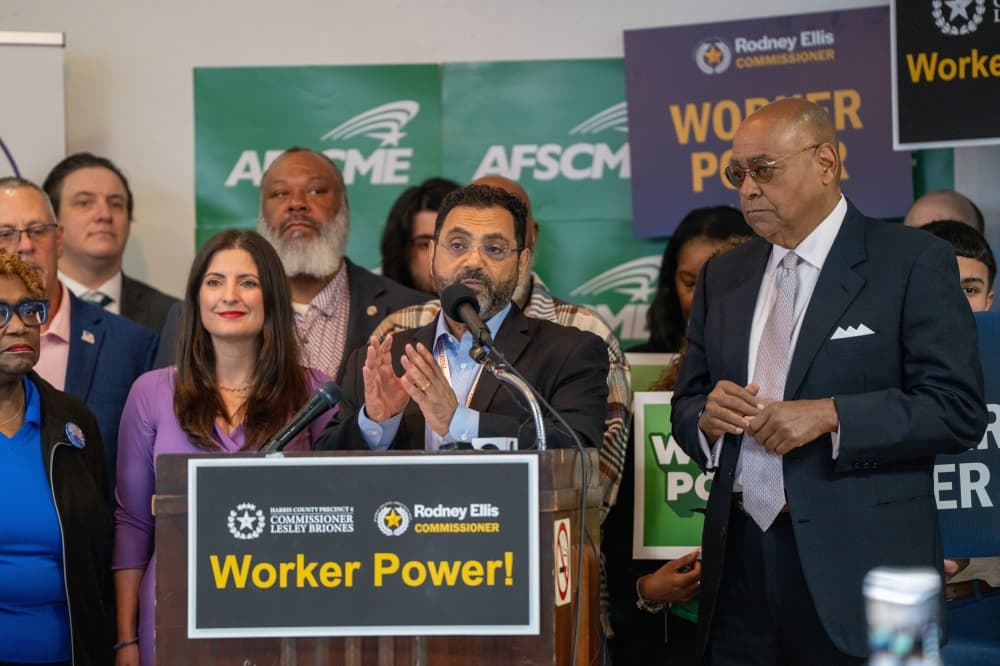
Ellis' office spearheaded the policy with support from Precinct 4 Commissioner Lesley Briones. The pair announced preliminary details during a March 18 news conference in collaboration with local labor organizations, including the Texas Gulf Coast Area Labor Federation, Houston Federation of Teachers and the culinary workers union.
“[The policy] brings Harris County workers to the table with county management, giving them a voice to advocate for good jobs, wages and benefits, working conditions and other needs that they think are important,” Ellis said.
Briones said the consultant plan builds off several other worker-focused initiatives adopted in the past year, including a standardized worksite safety policy, increased minimum wage and an Apprenticeship Advantage Program for job training.
“This is another step in our deep commitment to making sure that we are being fair, that we are being inclusive, respectful and honoring the dignity of workers,” Briones said.
Guillermo Vazquez with the American Federation of State, County and Municipal Employees—a public sector union that intends to serve as a consulting agent—said the workers will be able to provide more effective input based on on-the-ground experiences, such as dealing with inclement weather or career training ideas.
"Building trust and strong relationships always works to get the job done," he said.
Precinct 2 Commissioner Adrian Garcia commended the initiative during the March 19 meeting and called on county staff to ensure there are "no hiccups" in the policy.
"I want to make sure it works well and it's a real system that employees can depend on," he said.
Another viewpoint
Ramsey said he would have liked to know the exact costs associated with the initiative before taking a vote. He also called the proposal "a solution looking for a problem," saying it too closely resembles collective bargaining practices.
"I am very concerned that you get to a third party who may not understand what the county job is, who may not understand what the responsibilities are, who may not understand any part of it other than they're getting paid as an advocate to deal with it," Ramsey said before the vote.
What happens next?
Vazquez told Community Impact that AFSCME will hit the ground running in collaboration with the county to communicate details to employees. He said the biggest challenge will be visiting work sites and collecting contact information to reach everyone eligible to work with an agent.
The consultation framework specifically pertains to approximately 5,200 workers in departments that fall under the purview of commissioners, such as road and bridge crews, parks employees and trash collectors, Vazquez said.
The policy will take effect Oct. 1. County officials said they plan to hire liaisons for the consultation process, but do not expect a large cost associated with the initiative.
An exact fiscal note is expected to be presented to Commissioners Court during budget workshop sessions in the summer.
"I hope that other counties and other jurisdictions will follow suit because at the end of the day, we're only as good as the people on our team," Briones said.