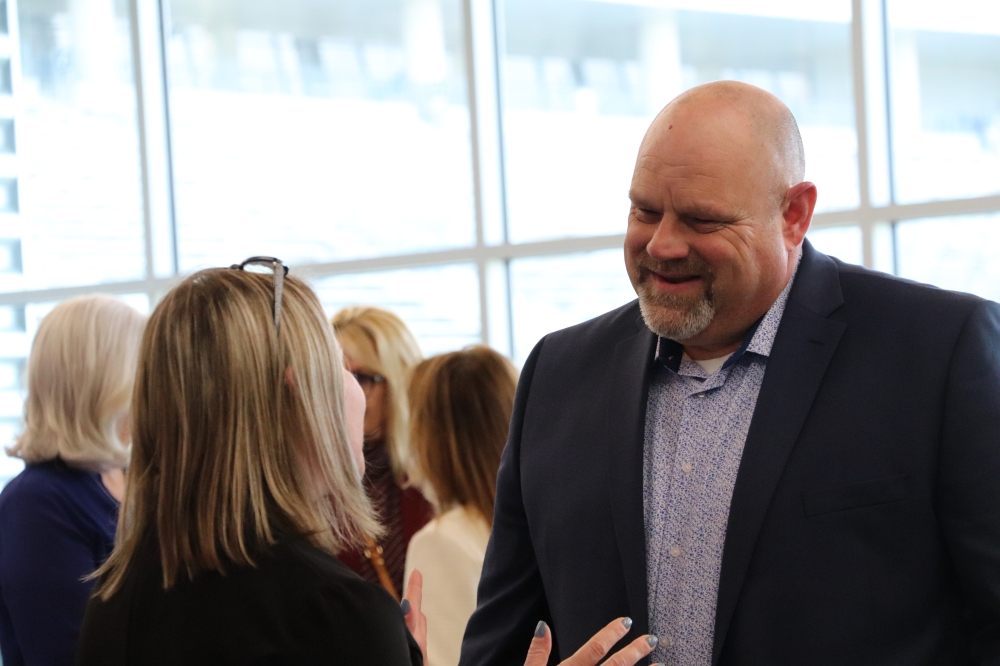


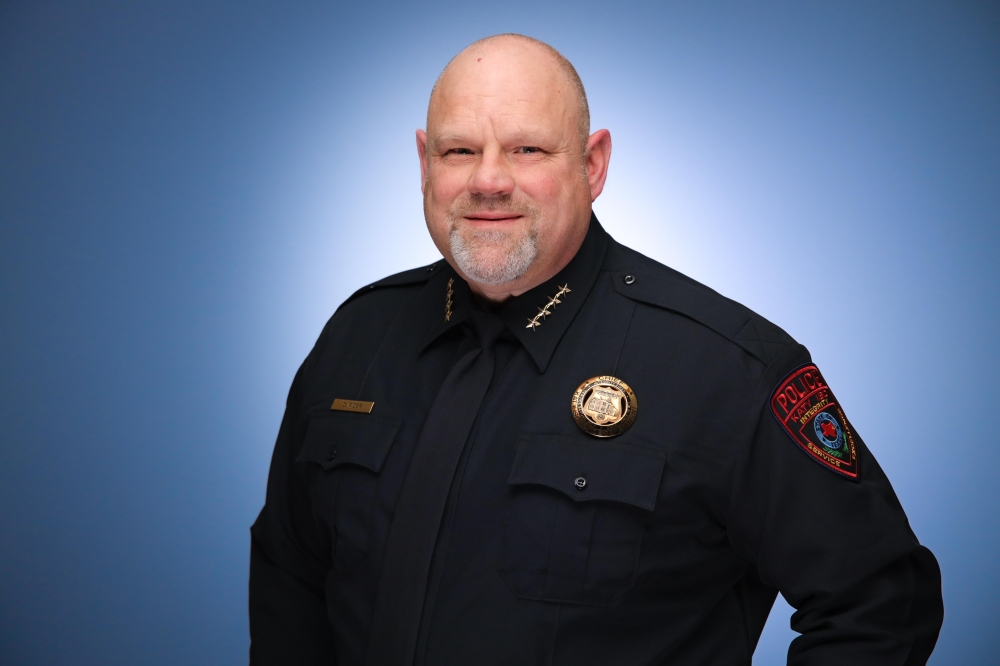
In February, he stepped into his newest chapter as Katy ISD’s police chief after 15 years at neighboring Fort Bend ISD. Drawn by the district’s reputation and its proximity to his previous department, he said he saw both as strengths to build on and opportunities to expand safety initiatives districtwide.
In this conversation, Rider discusses his career path, his goals for trust-building across the community and the lesser-known but essential work happening behind the scenes at Katy ISD Police Department—from 24/7 camera monitoring to a gift-giving program supporting hundreds of students.
What is your educational and employment background?
I earned a bachelor's degree in psychology from Texas A and I University, now Texas A&M University in Kingsville, and then I got my master's degree in criminal justice management from Sam Houston. I've been in law enforcement for 35 years now. I worked over six years with the city of Kingsville, and then I transitioned to school-based policing. I went to Austin ISD Police in 1997 as a school resource officer at a middle school, and over the next 12 and a half years, I worked my way up to assistant chief in the department. Then, I had an opportunity to transition to Fort Bend ISD, and where I was hired as the chief in 2010. I spent 15 years in FBISD as their chief, and then this past February, I had the opportunity to transition over to KISD PD, and so I've been here for about 10 months or so.
What led you to apply to the police chief position for Katy ISD?
The chief's job opened here, and I was trying to help them find a good chief knowing that I would be working alongside them being in FBISD. But as the process went on, I just felt a calling to come over to KISD. I was familiar with the department because of our close proximity to each other, and I knew that there were some great things going on here, but there were also some opportunities to really bolster the department and really help service the entire KISD community. After a lot of prayer, I just felt like it was the right thing to do for me and my family, and it's been amazing ever since I got here.
What’s different about your role in KISD compared to previous roles?
During the COVID years, I was elevated to be on the executive team [at FBISD], which is equivalent to the cabinet at KISD. And so in addition to operating and running the whole police department, I was now working very closely with all the other district leaders. That gave me a really good perspective and insight on how other departments within the district operate and the inner workings of being very close to board members and things like that that I normally wouldn't have had that opportunity. I'm not on the cabinet [at KISD], but that experience that I had has helped me work with cabinet members here and board members here in a way that I wouldn't have been able to do before. So my role as a chief, things that we focus on, things that we are invested in from a police department, that really doesn't change much, but my ability to understand how all the other high level operations of the district work I believe is very unique to what I'm doing here.
What are you most proud of accomplishing since becoming KISD police chief?
As I evaluated my transition, I knew there were multiple priorities that I wanted to focus on, and the top priority was getting KISD PD to be an accredited police agency from the Texas Police Chiefs Association. This accreditation process is voluntary. It is not something that we're required to do. To be accredited, we follow 174 best practices in Texas law enforcement. When we follow those best practices, it reduces risk to the district and the department. It ensures that we're protecting individual rights. It ensures that we are reviewing all the things that we're doing on a regular basis, and it just makes us a more professional police department, and that's something that we're proud to be able to tell our community about.
When I was with Austin ISD as the assistant chief of police, we went through this accreditation process, and we became the first school district police department in the state to achieve this accreditation. When I went to [FBISD], I thought it was a goal of mine as well and so in 2016, FBISD became an accredited police department due to Texas Police Accreditation. We were only the seventh school district police department at the time to obtain that accreditation, and we entered into a four-year cycle, so we were reaccredited in 2020 and [again] for the third time in 2024. So when I talked to [Superintendent Ken] Gregorski as I was thinking about transitioning over here, that was something that [said] he wanted us to obtain, and it's definitely a goal in mind. In order to do that, we've had to really kind of rewrite some of our foundational things, get back to the basics here at the PD.
We've done a complete rewrite of our general orders manual, which is our policies and procedures. We've done a complete revamp of our field training manual and our field training program, where we train new officers when they come into the department. We've done some restructuring in the department to help us run more efficiently and effectively. We've added some processes and procedures that allow us to review our work and our activities to ensure that we're in compliance with those best practices. So it's really an opportunity for us to take a look at ourselves internally, and then have the [TPCA] come in and look at us from an external view and just verify that we're doing everything that we're supposed to be doing. So in the end, when we become accredited—which we will—we will be able to tell our community that we are the absolute most professional police department that we can be for our community.
KISD has always been a leader in that area, but over the last six years or so, we've had a lot of legislative mandates that are required that come down and not all of them are completely funded. One example would be House Bill 3, in the [2023 legislative] session where they required that every campus in Texas has an armed officer on the campus. And if you can't put an armed officer there because you don't have the funding or you don't have the financial means to hire officers, then you can do a good cause exception. KISD went to the board before I got here and [filed] a good cause exception, and KISD did something that most districts have not done—they hired their own Level 3 armed security guards. These folks are KISD employees, they work under us here at the police department and they are responsible for providing that safety and security—that first line of defense for the elementary schools. Most other agencies either contract out with other law enforcement [employees] on their days off, or they hire some private security to come in and cover campuses. Some agencies are just using roving officers to go around, [patrol] each elementary school, and I don't believe that's the intent of the law. So KISD is ahead of the game in that aspect, or we've had our own Level 3 security guards. Because they work for us, we're able to train them in the things that we want them to be proficient in. We know exactly what kind of training they're getting, and it's also a pathway for them to eventually become a police officer with us if they choose to do so. So that's been a good program for us.
What specific practices do you believe should be implemented for campus safety?
There are a number of safety programs and protocols out there. We are constantly evaluating those. Running through all the different safety protocols that we have in place from all the exterior doors with electronic locks and keypad access, window film on the windows, fencing around, portables and at elementaries. We've got Fliploks now, all of our classroom doors stay locked during instructional day. We've got security cameras all over the district. We have so many measures in place. I think we're in a really good shape. What I want to focus on is just making sure that we're maintaining all those because that's a huge task. We have 80 campuses that need to be maintained and cleaned and make sure they're all working. Because we were so far ahead in KISD with implementing safety procedures and protocols and systems, now it's a matter of being able to maintain all those. And so that's really one of our challenges, is making sure that we have the people and the budgets and the staff, the ability to make sure that all of those systems are well-maintained.
How do you plan to build trust and engage with students, families and the broader community?
I believe that we are educators first. That sounds funny coming from a police officer, but we work in an educational environment. The vast majority of our time interacting with students and staff is education, it's not law enforcement. We spend most of our time talking to students, interacting with them in the hallway, and when I talk about being an educator first, it doesn't mean that we have to be in a classroom. We educate kids every single day. By the way we walk down the hall, the way we talk to them, the way we interact with them, we're teaching them if it's okay to talk to an officer or not, and there certainly is a bad publicity out there about police officers that we don't want to exacerbate that. We want to make sure that they know that we're the good guys. We are here to protect them, and we're here for them. And so when I talk to our officers, and I tell them that we're educators first, that means that we need to be building relationships every day.
One of the things that I say is, if I said the word "swoosh," you know exactly what company I'm talking about because Nike has spent a lot of time investing in their brand. Well, our brand is our patch and our badge, and so every day we have the opportunity to increase the value of our brand, and that's not just KISD police, that's every law enforcement officer in the country. If one does something bad, it ruins it for all of us. But specifically here in KISD, our officers have the ability to increase the value of our brand every day. A lot of times I'll ask them, what have you done today to increase the value of our brand? Well, I held the door open for somebody or I helped carry something in or I helped [someone] do something. That's not law enforcement, that’s just being a human. That's what we want to focus on is being visible on campus and engaging in discussion with various student groups on a regular basis. We sponsor community education classes. Tonight, we're doing a CRASE class, the acronym for Civilian Response to Active Shooter Events. We are at the police department and our Office of Emergency Management, our OEM unit, and 50 people have signed up. We did Halloween safe trick or treat for the first time ever, where we invited elementary kids from across the district to come here on Halloween and trick or treat in our lobby, and we had candy for them and took pictures with them. We're doing a Santa Claus program right now as we speak. Our department sponsors 740 kids from elementary schools across the district, and [officers] pick up the wish list for them. They go buy presents for them, wrap them, collect them here, and then we contact the families, and then they come and pick them up at a specific time. Those are all the kinds of things that we do to be a part of our community, when we're not just law enforcement.
Outside of your role, what do you like to do in your free time?
My professional life takes up a lot of my time and it has over the last 35 years, so I'm learning now to enjoy spending more time with my family. Early in my career, some of that suffered because you're always very focused on, you know, working a lot. But I've been married for over 32 years, and we have a daughter who recently graduated from Texas A&M and a sophomore in Texas A&M on a Navy scholarship. We spend a lot of time in College Station nowadays, and that's not a bad thing. I just really enjoy spending time with family and just making memories, it's really important. And so the other thing that, you know, as I realized that from the chief perspective, I try to encourage our younger employees to have a good work-life balance so this job is not all there is. You have to maintain those relationships that you have with your friends and family, and to do that, you can't be at work all day, every day. And so I think that's really important from my perspective that I've passed that down to them.
What else would you like readers to know about your role and priorities?
I think people are really surprised at what our department does and what we're responsible for. We employ 80 full-time school police officers and 61 Level 3 armed security guards. We have 140 folks that are armed, that are out on campuses every day. We also have over 50 unarmed Level 2 security guards that help support high schools. They don't carry guns, but they're eyes and ears on the campus, and that's really kind of what people see. But they don't see is that we also have an Office of Emergency Management that's part of our PD that ensures compliance with all of the Texas school safety standards, which includes our district emergency operation plans, our safety audits, that we're required to do in the district, all of our safety initiatives, as well as make sure that all of our required emergency drills are being completed. There are 80 campuses that have emergency drills annually to be done, some every single month. And so our department of our OEM ensures that all of those drills are being conducted, properly, and when they're supposed to. But we also employ dispatchers and support folks. We have a dispatch center that's operated 24 hours a day, seven days a week. It never closes, there’s always somebody in there. Somebody can always answer the phone here at the police department. We also have what we call Safety and Security Analysis Center, or SSAC. They're also in there 24 hours a day, seven days a week, and what they're doing, they're monitoring all 7,000 cameras in our district, the intrusion alarms and the fire alarms. They're monitoring all the doors, so if the door opens, they know it. If somebody sets off a Raptor alert, or some type of alert to lock the school down, they instantly get that notification, and they're pulling up the camera to see what's going on in that school. So we have instant visibility on each one of our campuses the moment an alarm is triggered here at the police department, and those folks work 24 hours a day, seven days a week. Those two places are never without somebody else. And that is very unique in our world of [public school] policing.