
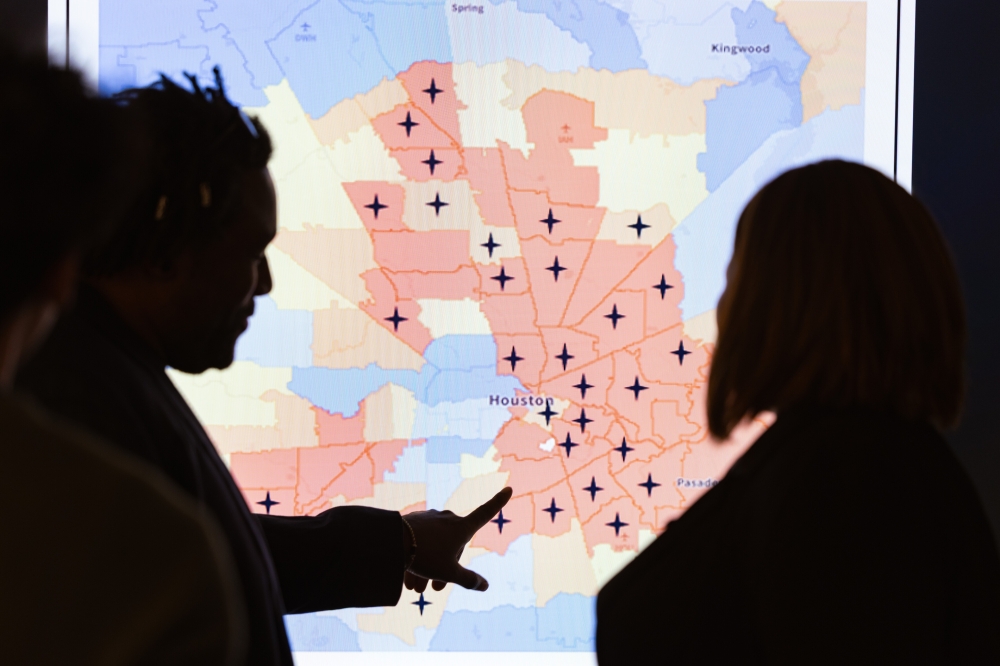
The study, published Oct. 15, found that even neighboring ZIP codes may have sharp differences in accessibility to mental health resources, as areas with lower education levels and higher poverty rates had fewer—sometimes zero—licensed mental health professionals.
To address the gap, counselors, psychologists and policymakers in the Northwest Houston region are aiming to diversify options and fight barriers, such as cost and stigma.
“Prosperity should not be the deciding factor on whether a population, a community, is mentally healthy and has access to mental health [care],” UH researcher Chakema Carmack said.
About the study
Carmack and co-author Damien Kelly coined the term “mental health deserts” after deciding to compare the availability of mental health resources in Houston using the concept of food deserts.
The pair told Community Impact their findings closely aligned with their hypothesis: communities in ZIP codes with higher incomes and more development had greater mental health care options.
Kelly and Carmack said they mapped resources using data from Psychology Today’s registry of licensed mental health professionals and the U.S. Census Bureau’s Distressed Communities Index, or DCI.
The DCI rates ZIP codes as “distressed,” “at risk,” “mid-tier,” “comfortable” and “prosperous” based on poverty, job growth, education level and other factors, per the study.
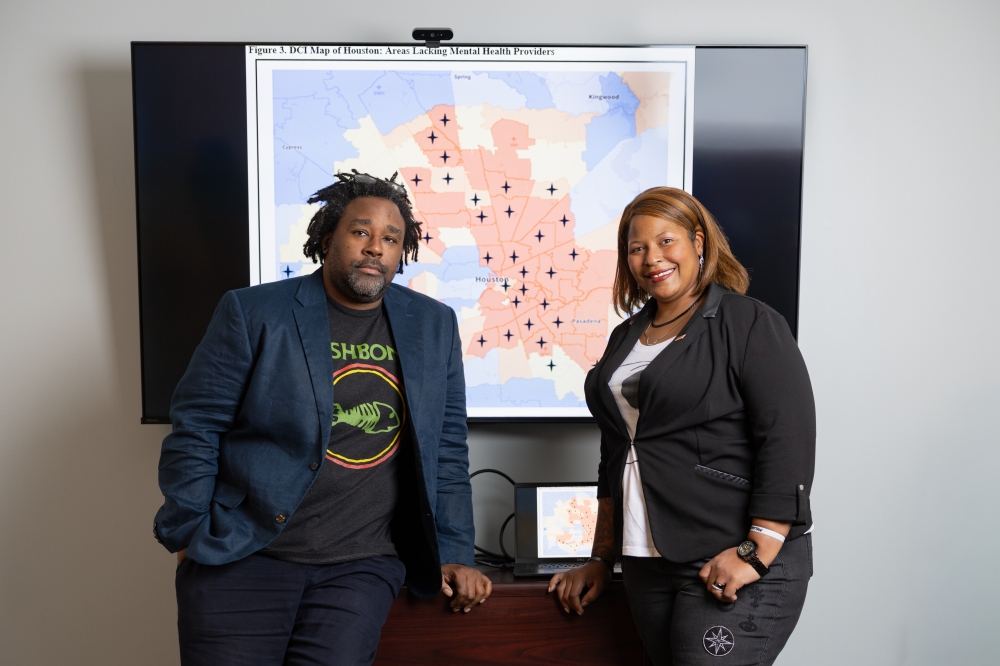
Several ZIP codes in the Cypress, Cy-Fair and Spring-Klein areas are ranked “prosperous” on the DCI, which was last updated with 2023 Census Bureau data, according to the map.
However, some ZIP codes—particularly near Hwy. 249 and Jersey Village—came up as “mid-tier” and “at risk,” with fewer mental health professionals than their “prosperous” counterparts.
Kristin Henshaw, clinical director of local mental health center Cy-Hope Counseling, said the Cypress and Cy-Fair regions lacked affordable mental health clinics when the counseling center opened in 2013. She said while there are now many clinics open in the area, Cy-Hope Counseling is still one of the few to offer free and reduced-cost services.
The counseling center serves children, teenagers and adults, and uses a sliding scale to help clients find a rate they’re comfortable with, all without a waitlist for services, Henshaw said.
“We’re not here to make a ton of money,” Henshaw told Community Impact. “We’re here to serve and provide mental health care, so we don’t want to create any sort of barriers of something like documentation or an application process.”
In addition to the cost of care, which isn’t covered by all health insurance plans, Henshaw said time and transportation create challenges for consistent treatment. She said Cy-Hope Counseling opened a second center in 2024 in Waller, an area with a large transportation disparity.
Similarly, psychiatrist Arianne Suarez told Community Impact she opened her clinic, Spring Psychiatry, in November to fill a service gap in the area. She said she was inspired to start her own clinic in northwest Houston because she struggled to find proper care for her son, who has autism spectrum disorder, without having to drive downtown.
Suarez said creating more diverse and holistic mental health options can help people connect with sustainable and accessible care in their own communities.
“[Trauma] can get to a point that is really debilitating us and our ability to work, to do the things that we need to do as a social being,” she said. “It’s important to address that whenever we can so that it doesn’t translate into something more chronic.”
Zooming out
Of the 96 ZIP codes mapped in the UH study, 43% were considered “distressed” on the DQI, most of which are located in northeast and southeast Houston neighborhoods, per the report.
“Distressed” ZIP codes had on average only 1.9 licensed mental health professionals, and 39 ZIP codes had none at all, the study found.
“The same thing that comes with food deserts often happens with mental health deserts as well, meaning you don’t have access to transportation [and] there’s economic disinvestment in these neighborhoods,” Kelly said.
Jennifer Boswell, director of adult mental health services at the Harris Center for Mental Health and IDD, said the center has seen an increased demand for services across its Houston clinics. As of Nov. 30, she said the Harris Center served more than 22,000 residents in 2025.
As the designated Local Mental Health Authority for Harris County, the Harris Center focuses provides low-cost services without a waitlist and does not deny services based on ability to pay, Boswell told Community Impact.
"Our care coordinators, who provide case management services, and our therapists can go out into the field, into the community, and provide those services as well," she said. "We really strive to meet the individual where they're at."
The action taken
In a continuation of their work, Kelly and Carmack said they’re partnering with Harris County Precinct 4 to explore potential policy solutions. The duo said they’re expecting to release a follow-up report in spring 2026.
Potential policy recommendations from the Oct. 15 report included:
- Incentives or stipends for professionals to practice in underserved areas
- Programs to promote mental health awareness and normalize seeking help
- Insurance reforms to cover travel for care or telehealth services
She said Precinct 4 worked earlier this year to connect residents with free mental health resources in the area, including appointments with a social worker.
“The partnership with UH is going to be so helpful to give us an understanding of the mental health ecosystem and further build on an equitable, coordinated system to meet residents where they are,” Sung said.