Growth is coming to Bryan-College Station, and to keep up with it, officials believe a bigger highway is needed.
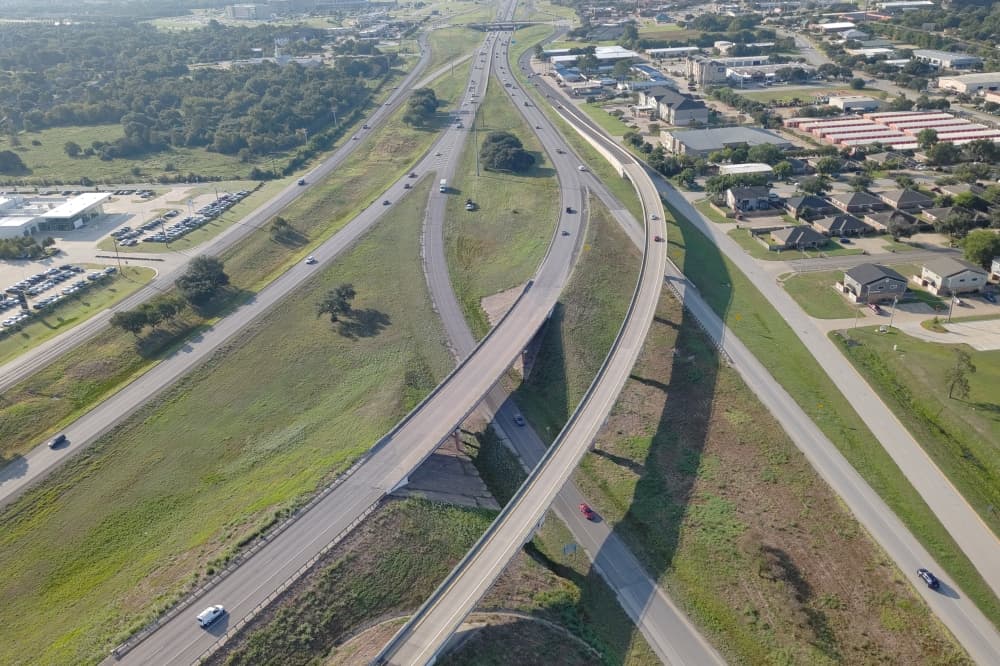
As a result, work began in December on an 11.5-mile stretch of State Hwy. 6—titled the SH 6 Central BCS Expansion, or better known as the Big 6—that will see the highway expanded to three lanes on each side.
What you need to know
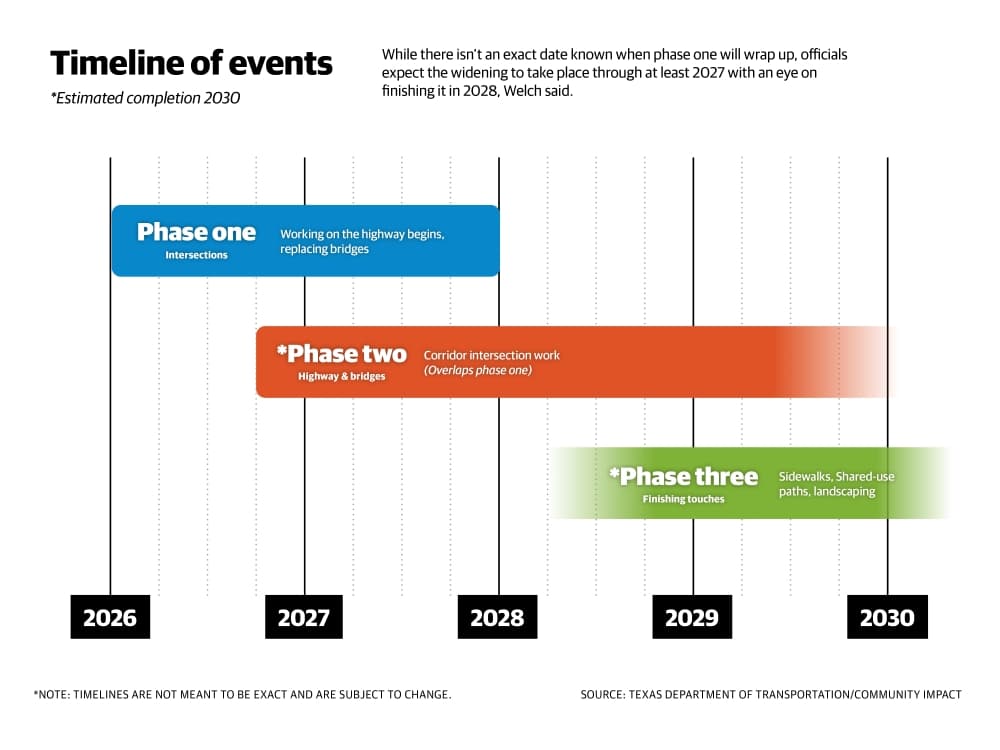
Work began in December and is expected to run through 2030 across all three phases, said Dan Rudge, executive director of the Bryan-College Station Metropolitan Planning Organization, which oversees a variety of transportation projects in the area.
Paired with the expansion, improvements at several intersections, frontage roads and shared path upgrades along the corridor are also planned, according to documents from the Texas Department of Transportation, which is leading the project.
Brazos County Judge Duane Peters said in a statement to Community Impact that the construction and closures will have an impact, but added the expansion is a way for the area to “make sure we’re looking to the future.”
“Anyone who has lived in Brazos County for a while knows we are growing and traffic on Hwy. 6 has increased,” Peters said. “The Big 6 expansion project will help alleviate the congestion.”
The highway currently consists of two lanes in each direction, which officials said is no longer enough to sustain the flow of traffic due to ongoing population growth in recent years.
While the expansion and various upgrades will help accommodate traffic flow for what Rudge estimates could be more than two decades, it will come at a cost of north of $670 million, documents show.
Zooming in
In addition to expanding the highway from two lanes on each side to three, several adjustments and improvements are planned at various intersections, exits and frontage roads along the corridor.
The project will consist of elements such as new turnarounds at a handful of intersections, bridge and overpass widenings, new turn lanes and a shared-use path throughout the project’s boundaries.
Some of the roads getting the most attention include both University Drive and William J. Bryan Parkway, which will each receive new turnaround lanes, turn lanes and a widening at their bridges, according to TxDOT documents.
University Drive will see some unique upgrades in addition to those changes, including a new diverging diamond interchange, which officials note will make the intersection safer and help traffic flow.
Another major change is coming to Harvey Road, which will see its southbound ramp moved further north and connected to a new bridge over University Drive, documents show.
Lastly, the exit to Texas Avenue will no longer connect to Hwy. 6 but instead will connect to the frontage road, which drivers will be able to access by exiting right before Rock Prairie Road.
The cost
TxDOT awarded a $671 million contract to global engineering firm Fluor Heavy Civil LLC in March last year.
In 2016, the BCSMPO put together a list of its top unfunded projects and placed Hwy. 6 at the top. Teaming up with TxDOT, the organization put aside $190 million. After funding from the Texas Transportation Commission—an additional $480 million—made them whole in 2022, the project was able to move forward.
Documents from both TxDOT and the BCSMPO show the project was expected to cost around $592 million. But Fluor bid the project out at $671 million, which TxDOT spokesperson Kendra Welch said necessitated more statewide funding due to the project’s regional significance.
“If a project is not fully funded, it cannot be awarded to the contractor,” Welch said. “This additional funding allowed the project to be fully funded based on the contractor’s bid, and the project was able to be awarded.”
Bidding went out for the project last March. Bid documents from TxDOT show some of the biggest differences in TxDOT’s estimation and Fluor’s bid cost included:
- An item for mobilization, which was $23 million more than TxDOT’s estimation
- Barricades, which were roughly $670,000 more
- Irrigation, which came in at more than $600,000 in additional costs
- Temporary traffic signals, which were around $150,000 more
Despite this, Fluor came in as the lowest of four bidders, according to TxDOT documents.
How we got here
Momentum for the project began in 2018 when officials began gathering data and information on the current roadway. Officials held the first meeting in 2019 and a second in May 2021.
The need for the project was spurred by the growth coming into the area, Rudge said. As of 2024, Brazos County had a population of about 242,000, which is an increase of 20% since 2014, according to the 2024 annual community survey data from the U.S. Census Bureau.
That growth has resulted in traffic counts along the highway’s project boundaries increasing. Areas within the 11-mile stretch are seeing north of 80,000 vehicles per day as of 2024, according to TxDOT traffic count data.
One of the busiest sections of the highway—near Rock Prairie Road—had a daily traffic count of 84,000 in 2024, data shows. This is up by almost 22% since 2021 and has more than doubled since 2010.
“[The highway section] has traffic counts that are higher than some six-lane highways in Houston, Dallas and Austin,” Rudge said. “So that was really the nexus for what we thought was an important project.”
Stay tuned
Work has begun on the project, along with regular closures, according to TxDOT’s website for the construction.
To see daily updates and lane closures, click here.
In the long term, the project will be carried out in three separate phases, with each phase having its own steps.
Phase 1 will consist of work on the highway itself, which Welch said is the biggest part of the project.
While officials said they don’t know when Phase 1 will wrap up, they expect the widening to take place through at least 2027, with an eye on finishing it in 2028, Welch said.
Some work within Phase 1 includes replacing bridges, which will be done during the summer and must wrap up before school starts.
Phase 2 will focus on intersection work along the corridor, while Phase 3 will consist of sidewalks, shared-use paths and landscaping, among other items tied to completing the project.
The phases should overlap with each other, as intersection work could begin in late 2026.
Ultimately, work on the project is expected to be ongoing until 2030, Welch said.
“Highway infrastructure and traffic congestion is always an issue,” College Station Mayor John Nichols said in a December interview with Community Impact. “We are blessed to have the Texas Department of Transportation roads all the way through the city.”