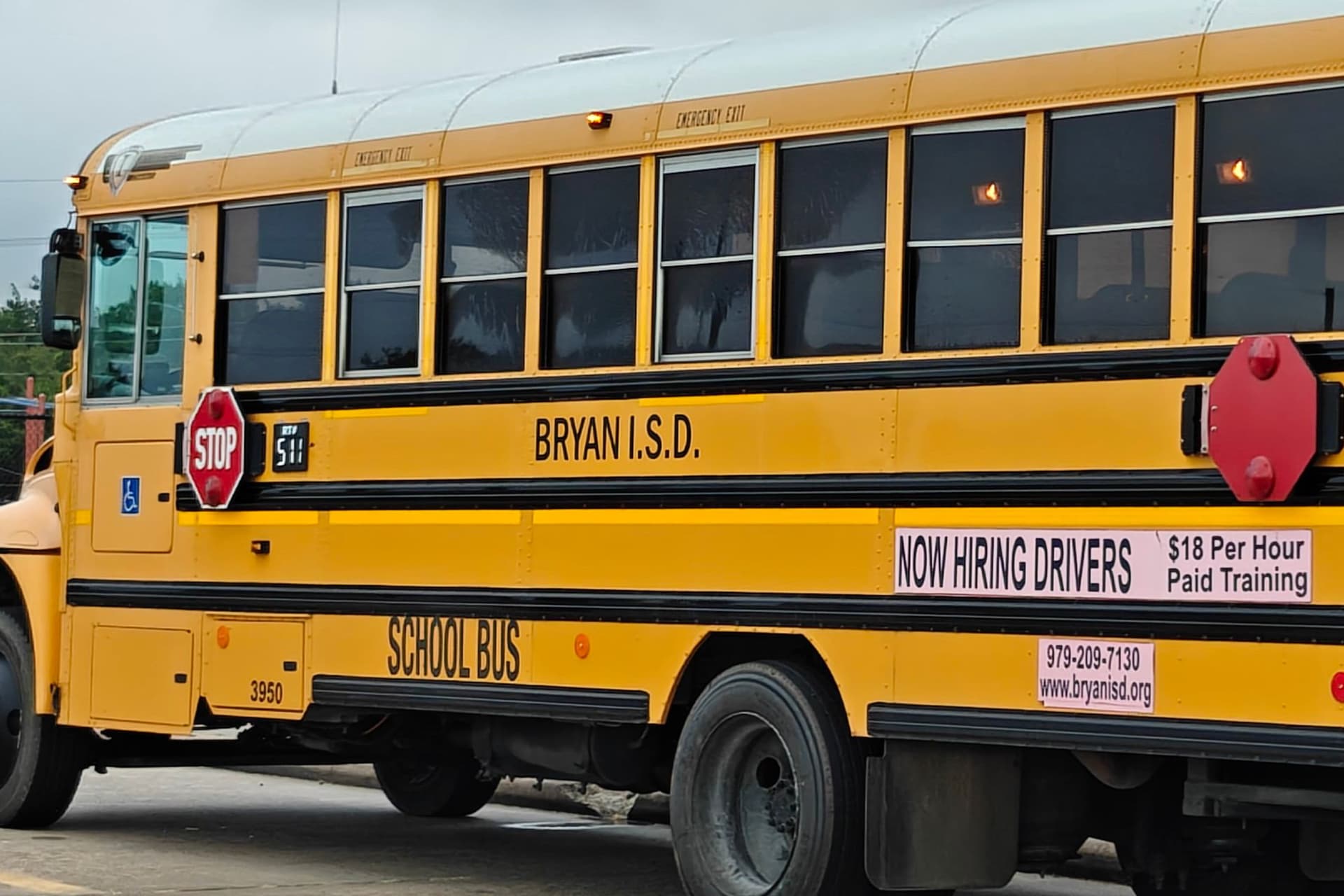
Bryan ISD faces a projected $3.1 million deficit after losing more than 300 students since last school year. (Karley Cross/Community Impact) (Karley Cross/ Community Impact)
After months of financial workshops and planning discussions, Bryan ISD leaders are preparing next year’s budget amid declining student enrollment, limited growth in state funding and rising operational costs.
In a one-on-one conversation with Community Impact, Bryan ISD Chief Financial Officer Norma Friddle said the upcoming budget year is expected to include a projected deficit, but emphasized how the district is working to avoid long-term financial imbalance through staffing adjustments, attendance improvements and spending reviews.
What you need to know
Friddle has spent months walking trustees, staff and community members through school finance realities as revenue growth slows. She said the district’s financial challenges stem largely from enrollment drops and the funding tied to it.
She said the district has lost more than 300 students from the 2024-25 to the 2025-26 school year. Each student represents about $10,000 in annual funding, based on weighted funding, resulting in a roughly a $3 million revenue loss.
“Any loss of children is a loss of money,” Friddle said, “and we feel it across our entire budget.”
Texas school districts are funded primarily by average daily attendance, not enrollment totals or local tax rates. That means fewer students showing up each day directly reduces district revenue.
However, Friddle said leadership does not view the situation as a long-term crisis.
“Every school district hopes to have a balanced budget every year,” she said. “I don’t think that it is [a long-term issue].”
By the numbers
The district was facing a projected $6.7 million deficit, but after submitting a one-time property value to the state, the estimated deficit for the 2025-26 school is now $3.1 million. The district's total general fund was about $184.66 million.
Several financial indicators are shaping Bryan ISD’s budget outlook:
85% of district spending goes toward payroll and employee benefits.
A 2% increase in attendance would significantly improve revenue projections.
The district maintains about $41 million in fund balance reserves.
Officials consider around three months of operating expenses—about $47 million—a fully comfortable reserve level.
Friddle said declining attendance following the COVID-19 pandemic remains a statewide challenge and a trend districts across Texas continue to analyze.
“I just call it the ‘post-COVID phenomenon,'" she said. "You know, it’s like, ‘where did our kids go?’”
Demographic changes, including lower birth rates and housing turnover, also play a role in enrollment declines.
Budget explained
One of the biggest misunderstandings that Friddle said she encounters is the belief that rising property tax bills automatically mean school districts receive more money.
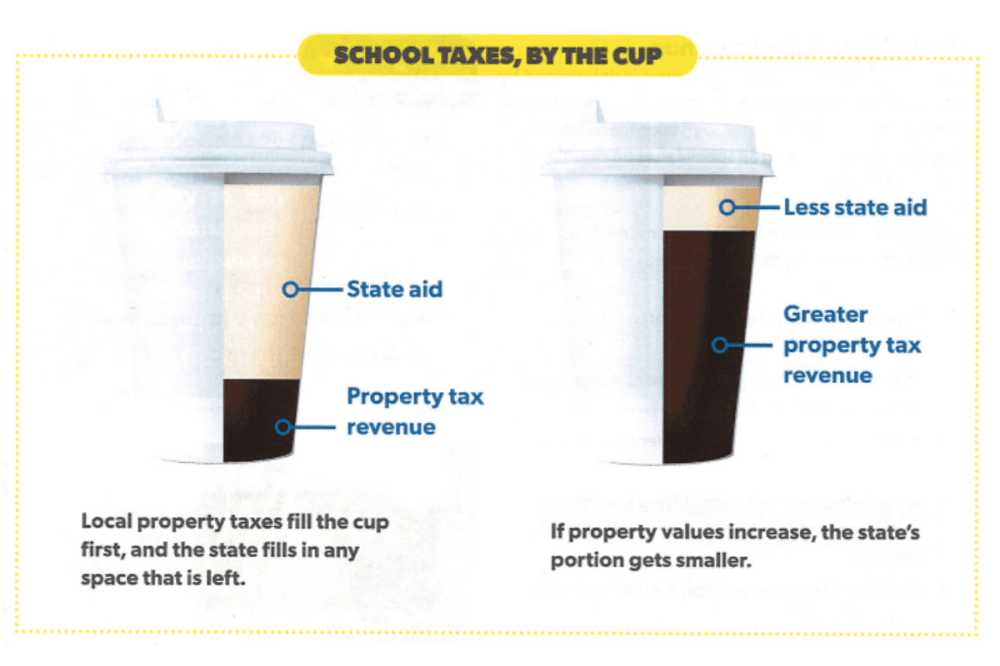
She said that is not how Texas school finance works. Instead, higher property values increase local collections and, as local revenue rises, state funding decreases. School districts often see little or no net funding gain. Friddle called it an optics issue, explaining how a stronger local economy doesn’t necessarily mean more dollars for schools, and when local tax collections increase, state funding decreases.
One of the biggest misunderstandings the district said it encounters is the belief that rising property tax bills automatically mean school districts receive more money. (Courtesy TASB via Bryan ISD)
“People see apartment complexes being built, they see development all around them ... We may be collecting more locally, but that just means that the state is contributing less,” she said.
Because funding is driven primarily by attendance formulas set by the state legislature, local districts have limited control over revenue growth.
About the programs
Despite financial pressure, Friddle said layoffs have not been used and are not planned. Instead, the district is relying on attrition and internal reassignment. Attrition is when an employee leaves their position and their duties are distributed out to other employees.
When enrollment declines cause a reduction in staffing needs at a campus, positions may move to an “excess” list. Employees are reassigned to existing vacancies and outside hiring is reduced when possible.
Friddle said administrators have visited campuses in a districtwide “roadshow” to explain budget realities and gather feedback from staff.
Communicating a complicated process, such as attrition and district budgets, to campus staff is “not easy work,” she said.
The district also continues offering programs that exceed state requirements, including:
Friddle said these programs are worth it for the students as some families have moved into the district just to put their student in the IB program.
“We choose to keep [these programs] because our kids deserve it,” she said.
Transportation, for example, is required by the state for certain students in special education and Section 504 programs who require specialized services, per the Texas Education Agency's Transportation Allotment Handbook. For other programs, districts may choose to charge a fee to families living within a 2-mile walking distance from campus who are ineligible for the free program. Yet, Bryan ISD continues broader service to its students.
The discussion
Trustees and administrators are also evaluating long-term revenue options, including a possible voter-approval tax rate election, or VATRE, that would allow the district to increase its maintenance and operations tax rate, which funds daily operations and employee pay.
“The bond was about our buildings, and now we're talking about our people,” Superintendent Ginger Carrabine said at a May 11 budget workshop.
Breaking it down
Bryan ISD’s total property tax rate is made up of two separate parts, each serving a different purpose.
Maintenance & operations: The M&O tax rate pays for the day-to-day operation of the district, including:
Teacher and staff salaries
Utilities and transportation
Classroom materials and programs
Campus operations
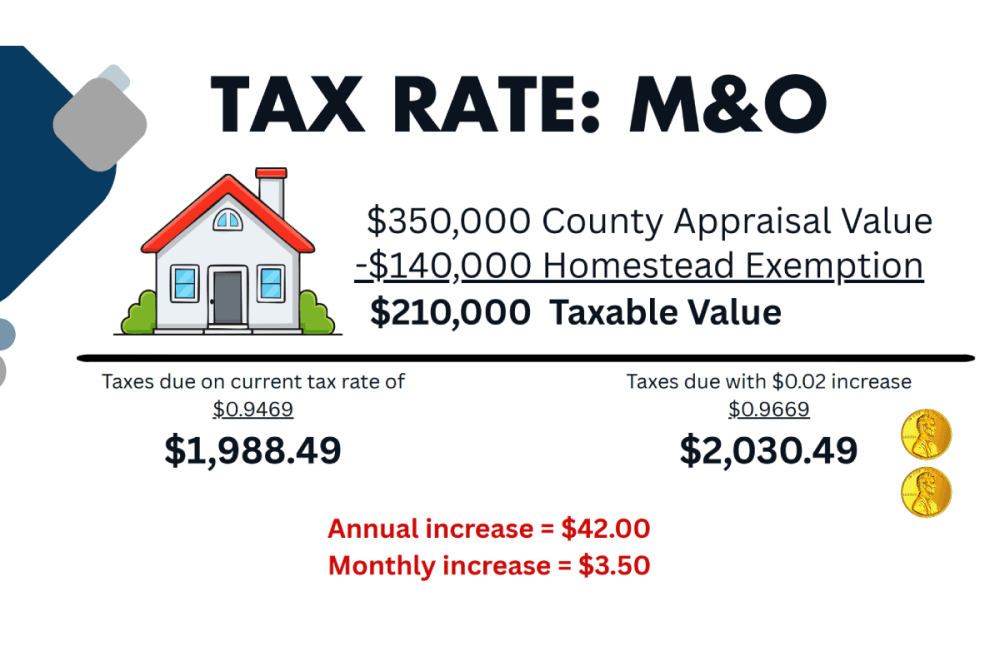
A VATRE affects only the M&O portion of the tax rate. If voters approve a VATRE, the additional revenue can be used primarily for operational expenses such as employee pay.
Interest & sinking: The I&S tax rate is used strictly to repay debt from voter-approved bonds.
Bond funding typically pays for:
New schools
Major renovations
Safety upgrades
Facilities and infrastructure projects
State law restricts I&S funds so they cannot be used for salaries or daily operations.
Bryan ISD’s current tax rate is:
M&O: $0.6769 per $100 of property value
I&S: $0.2700 per $100 of property value
Total rate: $0.9469 per $100 valuation
A VATRE affects only the M&O portion of the tax rate. If voters approve a VATRE, the additional revenue can be used primarily for operational expenses such as employee pay. (Courtesy Bryan ISD)
Friddle said many residents assume rising property values automatically increase school funding, but there are several factors to consider. Property values may rise, but state formulas can reduce state aid, meaning local tax growth does not always equal new district revenue.
She said the district’s strategic planning committee has begun discussing the possibility of a VATRE, though no final decision has been made as of press time.
Key factors under review include:
Cutting expenditures where possible
Improving attendance
Evaluating staffing efficiencies
Community feedback
To build public trust, Bryan ISD is pursuing a voluntary efficiency audit conducted by an outside firm, which is an extra step not required by law.
The audit is intended to show how the district is operating efficiently before considering asking voters for additional revenue. Friddle said the district wants to show the community that it is working within its means and not asking taxpayers for additional funding unnecessarily.
Results of this audit have not yet been made available. The board of trustees approved the district to conduct the voluntary audit at its May 18 meeting.
Why it matters
For families and taxpayers, district budget decisions influence:
Teacher and staff pay competitiveness
Class sizes
Program availability
Student services and transportation
Long-term financial stability
A common topic at this year’s board meetings includes inflation and unfunded/underfunded state mandates, as well as targeted funding programs that cover only certain employees. Friddle said these points have added pressure to local budgets.
Districts increasingly face difficult decisions because state funding formulas have not kept pace with rising costs.
“We’re going into the deficit because we chose to give [staff] a raise,” she said, adding how discretionary funding isn’t keeping up with “double-digit inflation.”
College Station ISD leaders said their district is also managing enrollment declines and flat state funding, but currently projects a small budget deficit after implementing zero-based budgeting and staffing adjustments through attrition.
Unlike Bryan ISD, College Station ISD officials said they are not currently considering a VATRE, and instead will be focusing on attracting out-of-district transfer students and maintaining attendance rates near 96% to stabilize revenue.
Administrators in both districts emphasized similar concerns, including:
Funding tied to attendance rather than enrollment
Rising operational costs and inflation
Expiration of federal pandemic relief funding
Uncertainty surrounding future state legislation
Together, the two districts illustrate a broader trend across Texas public schools as systems shift from years of enrollment growth toward long-term financial sustainability planning.
What’s next
Bryan ISD trustees will continue budget discussions throughout the summer ahead of formal budget adoption.
Upcoming milestones include:
Presentation of the efficiency audit
Continued budget workshops
Possible discussion of a VATRE election
Final adoption of the district’s annual budget
Residents can attend school board meetings or provide public comment as financial decisions move forward.
Aug. 17 is the Bryan ISD board of trustees' deadline to order a VATRE on the November ballot.
College Station ISD proposes admin taking on substitute teaching tasks