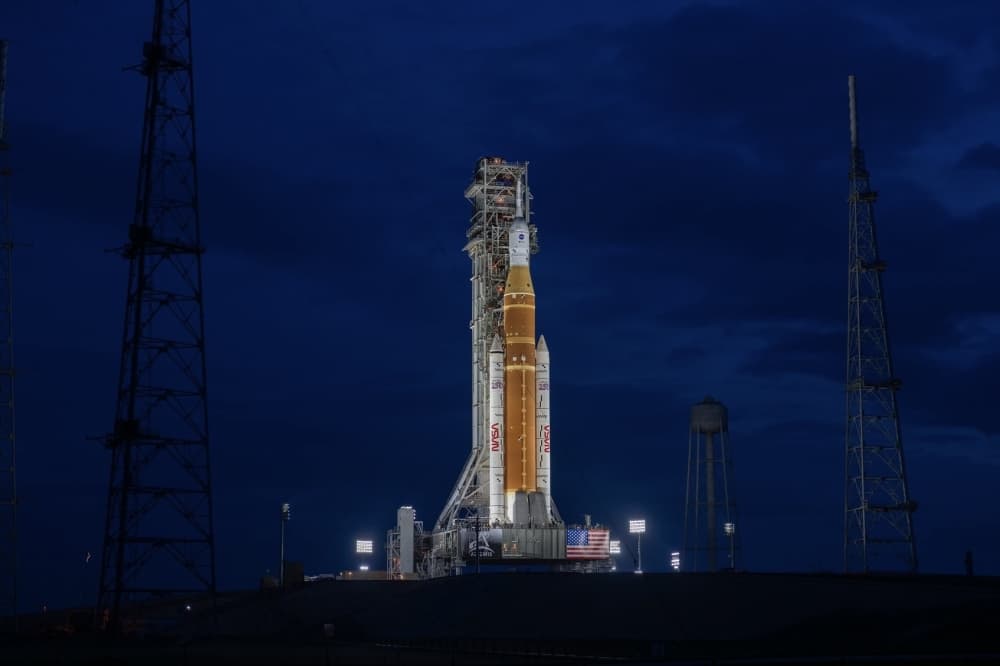
NASA is now targeting March to launch the Artemis II lunar mission after problems were discovered during a pre-launch test, according to a Feb. 3 news release from NASA.
What happened?
NASA had hoped to launch the mission as early as Feb. 8. However, during a Feb. 3 pre-launch test, known as a wet dress rehearsal, engineers discovered a liquid hydrogen leak in an interface used to route the cryogenic propellant into the rocket’s core stage, according to the release.
The discovery pushed the expected launch date to March, so the agency can further analyze the first test and conduct a second wet dress rehearsal. The next earliest launch opportunities are March 6, 7, 8, 9 or 11, according to NASA’s website.
What they’re saying
“The wet dress rehearsal we had last night was a critical milestone on the way to Artemis II,” NASA Associate Administrator Amit Kshatriya said at a Feb. 3 press briefing. “... It allowed our teams to test all the systems required and the all-up configuration. I think it’s clear based on what we saw in real-time that we’re now targeting no earlier than March for the Artemis II launch.”
Following the wet dress rehearsal, the astronauts were released from quarantine, Kshatriya said. Crew quarantine will resume two weeks before the next launch date, which has not yet been determined.
Officials emphasized that the rehearsal is intended to identify issues prior to launch and that data from the first test will be used to determine corrections and plan for another wet dress rehearsal before the expected March launch.
“We got a chance for the rocket to talk to us, and it did just that,” John Honeycutt, the chair of the Artemis II Mission Management Team, said at the briefing. “The test gave us exactly what we needed.”
Before you go
Artemis II will send NASA astronauts Reid Wiseman, Victor Glover and Christina Koch and Canadian Space Agency astronaut Jeremy Hansen on a 10-day mission around the moon, according to NASA’s website.
While the astronauts won’t land on the moon’s surface, they will orbit it. The astronauts will be the first people to leave low-Earth orbit since the Apollo 17 moon mission in 1972.
The four astronauts will be able to view the moon from a higher altitude, about 4,000-6,000 miles above the moon's surface, than the Apollo missions, which flew at an altitude of about 70 miles above the moon’s surface, according to NASA’s website.
As a result, the astronauts will see the entire disk of the moon, including areas near the north and south poles. At closest approach, the Moon will appear to the Artemis II crew to be about the size of a basketball held at arm’s length.