As NASA’s Artemis program advances following its first crewed mission to the moon April 10, former astronaut Bonnie Dunbar sees it as the latest step in a long legacy of human spaceflight that includes Apollo, the space shuttle program and the International Space Station.
The historic Artemis 2 mission sent astronauts Reid Wiseman, Victor Glover, Christina Koch and Canadian Space Agency astronaut Jeremy Hansen on a lunar flyby, making them the first humans since Apollo 17 in 1972 to travel beyond low earth orbit.
The nearly 10-day mission marked NASA’s first crewed journey to the moon in over 50 years, as previously reported by Community Impact.
“We wouldn’t be there without the space shuttle program. We wouldn’t have the [ISS] without the shuttle,” Dunbar said.
Career history
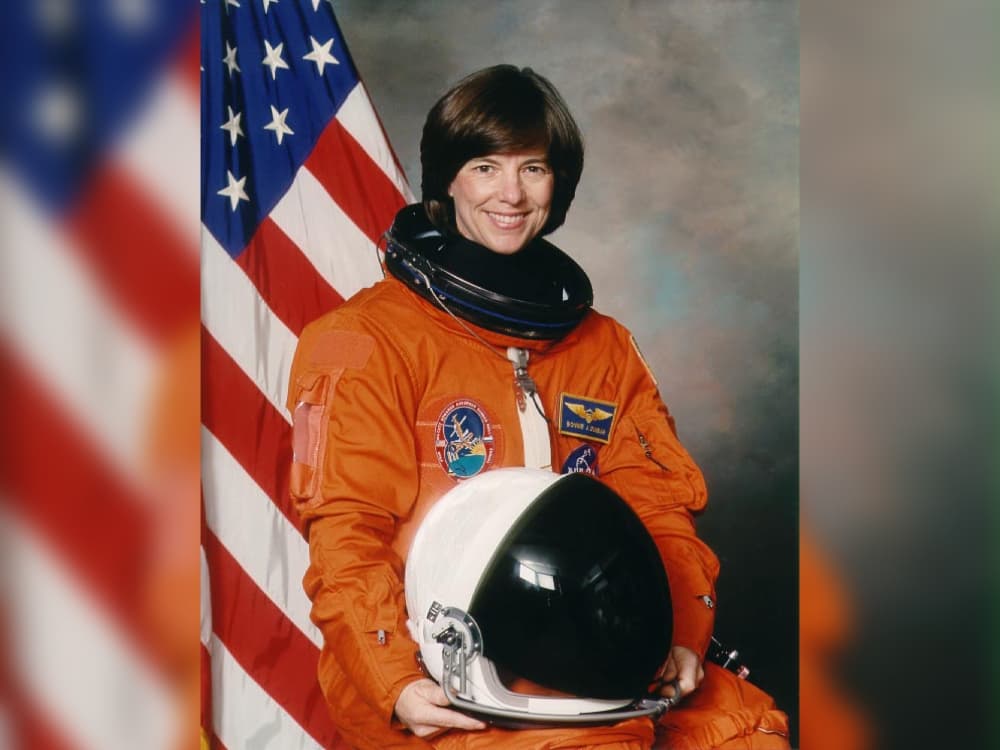
Dunbar began her 27-year long career at NASA in 1978 as a payload officer and flight controller at the Johnson Space Center, just as the space shuttle program was preparing for its first flight in 1981.
She was part of the mission control team supporting early orbital systems work, including Skylab reentry tracking, Dunbar said.
Dunbar was selected in the 1980 astronaut class and became a mission specialist on five space shuttle flights, including STS-61A, STS-32, STS-50, STS-71 and STS-89. Across her career, she logged more than 1,200 hours, or 50 days, in space, according to NASA.
Before joining NASA, Dunbar was already working on shuttle-related research as an undergraduate and later at Rockwell International, where she contributed to shuttle development, including thermal protection systems.
“As an undergraduate, I had the opportunity to work on this brand new set of materials that would cover the outside of the space shuttle to protect it from the high heat of reentry,” Dunbar said. “Artemis had a combination of materials we'd used in Apollo and for the shuttle. They were ceramic fiber tiles that could be reused for up to 100 missions.”
She earned her bachelor's and master’s degrees in ceramic engineering from the University of Washington in 1971 and 1975 and a doctorate in mechanical and biomedical engineering from the University of Houston in 1983. She is currently a professor of aerospace engineering at Texas A&M University.
How we got here
The space shuttle program, officially the Space Transportation System, or STS, was the first reusable spacecraft system designed to carry astronauts and equipment into low earth orbit and return them for reuse, according to NASA.
Shuttle missions were not only transportation flights, but also scientific laboratories that helped develop much of the research now used aboard the International Space Station, including work in fundamental physics, fluids, combustion, crystal growth, human physiology and plant biology, Dunbar said.
That legacy continues today through both hardware and engineering standards carried into Artemis systems, Dunbar said.
“If you look at the components of the Artemis, there are parts that were actually built for the space shuttle and are being repurposed,” she said. “What we learned about life support systems on the shuttle was an essential part of training the engineers and the students to be able to do Artemis.”
However, the two programs differ significantly in mission design and engineering approach, Dunbar said.
“The shuttle was designed to stay in low earth orbit, and it was totally reusable. With the shuttle, you launched like a rocket and landed like an airplane,” she said. “Artemis has a lot more thrust, and it has to escape Earth's gravity. The only part that really gets to the moon is the capsule that's at the top. The rest of the rocket is not able to be used again.”
Dunbar also highlighted differences in reentry conditions and crew experience between shuttle and Artemis missions.
“Because [the shuttle] came back a little bit slower, the peak reentry heat on the bottom of the shuttle on those tiles is only about 2,300 degrees Fahrenheit.” Dunbar said. “Artemis is coming back faster, so it's going to be a little bit hotter and the crew is going to feel more acceleration on the body.”
What’s next
Dunbar sees the Artemis 2 mission as a stepping stone toward long-term lunar exploration and eventual Mars missions, particularly through the moon’s south pole.
“What a better way to study the Earth ... because we know the moon used to be part of the Earth,” she said. “We think that there's water ice at the bottom of some very large impact craters that would support a research station and you could actually make some fuel out of it.”
As the Artemis program opens a new era of human spaceflight, Dunbar pointed to the preparation she believes future astronauts will need most.
“Be serious. Always be prepared.” Dunbar said. “Take as much math, science and literature and humanities and languages that you can. You have this opportunity to learn so much, so use it.”