The Artemis 2 astronauts safely returned to Earth on April 10, splashing down off the coast of San Diego at 7:07 CDT, according to NASA’s website.
The successful landing concluded the nearly 10-day mission that marked NASA’s first crewed journey to the moon in over 50 years.
In case you missed it
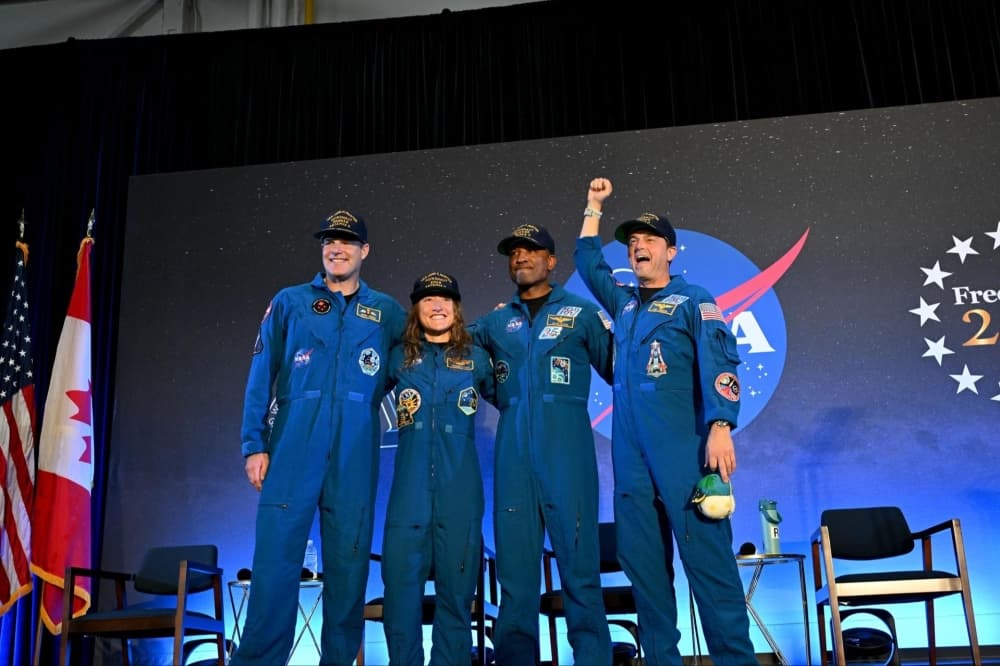
The mission sent NASA astronauts Reid Wiseman, Victor Glover and Christina Koch and Canadian Space Agency astronaut Jeremy Hansen on a lunar flyby, making them the first humans since the Apollo 17 mission in 1972 to go beyond low-Earth orbit, as previously reported by Community Impact.
The crew included Friendswood residents Wiseman and Hansen, along with Pilot Glover, who is a parent within Clear Creek ISD.
Launching April 1 from NASA’s Kennedy Space Center in Florida, the crew traveled as far as 252,756 miles from Earth, surpassing the distance record previously set during the Apollo 13 mission, according to NASA’s website.
During the mission, the astronauts conducted studies to support future exploration, including research on how human tissue responds to microgravity and deep space radiation, along with additional human performance experiments designed to prepare astronauts for long missions, according to NASA’s website.
More details
The Orion spacecraft, nicknamed “Integrity” by the crew, reentered Earth’s atmosphere April 10 at speeds of up to 25,000 mph—about 35 times the speed of sound—before pilot Glover safely landed the spacecraft in the Pacific Ocean.
Following splashdown and recovery, the crew returned to Houston and began the process of postflight reconditioning, medical evaluations and lunar science debriefs, according to NASA’s website.
What’s next
Artemis 2 is the first in a series of planned missions that aim to send astronauts on increasingly complex journeys to explore the moon, paving the way for a sustained lunar presence and future crewed missions to Mars, according to NASA’s website.
“Artemis is an opportunity to recapture that national sense of discovery and to remind the public that exploration fuels innovation far beyond NASA’s launch pads,” said Bonnie Dunbar, Texas A&M professor and former NASA astronaut, in an April 1 Texas A&M University news release.