As protests continue across the country over the death of George Floyd and others in police custody, journalists are dealing with the complexity of covering a civil rights movement in the age of social media as to where to draw the lines.
Community Impact Newspaper spoke with journalism educators Kathleen McElroy, professor and director of the School of Journalism at The University of Texas, and Kym Fox, a journalism professor at the School of Journalism and Mass Communication at Texas State University, on the subject.
Below are their comments, lightly edited for clarity.
How do black journalists or allies cover protests such as Black Lives Matter when they may be reluctant to voice their opinions as journalists?
McElroy: One of the things that I like to talk about is that the concept of objectivity as it's been pushed in newsrooms for a very long time is maybe outdated and obsolete. And a lot of times, objectivity was used as a weapon against people who were women [and] for journalists of color. If you're a Jewish reporter, you can't cover Israel. If you're African American, you can't cover the O.J. [Simpson] trial. When in fact, instead of thinking about it as "I'm going to be completely objective"—because who is?—I like to talk about being accurate, fair, fully dimensional and empathetic. With those at the forefront of your mind, even if you feel greatly about a wrong in this country—and a lot of us get into journalism because we want to right the wrongs that are in this country—it's not so much you should have no feelings about these things because a lot of times those feelings are what get you through the process.
As long as you are fair, accurate, fully dimensional and empathetic than you're still doing your job as a reporter.
Fox: Black journalists are journalists. Most journalists I know don’t focus on their personal opinions and seldom share their personal opinions when they are out reporting. Journalists have opinions just like everyone else, but the power of journalism is not in the one individual opinion. The power of journalism is in telling the story and telling it well. Real change can come when a journalist shines a light on injustice. I hope black journalists are voicing their opinions in their newsrooms, where they can help guide coverage and help colleagues understand what it is like to be black in America. Most newsrooms are not very diverse. We still do not have enough journalists of color. As an industry, we have to keep working on this. As a journalism professor, I have an obligation to keep working on this.
How does coverage of protests hurt or help the movement?
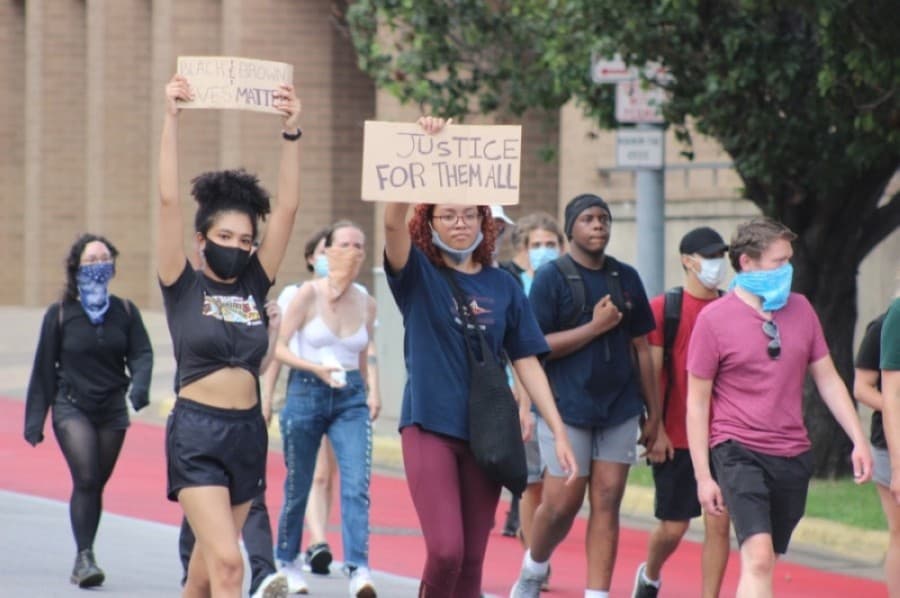
McElroy: Protests are a strategic communication in one sense; you have a cause, and you think the best way for your cause to get attention is to protest. Now, there were towns in the deep South that did not hose African Americans who were peacefully protesting, [but] we don't really have those images embedded in our brains. We have the images that journalists took. Sheriffs putting snarling dogs and hosing the protesters. So, if we think about things that have come out recently, this police officer doing this to x protester, that is because of either journalists being there or a citizen with communication tools. To use "help or not help a movement?" Yes, [they help]. But, I guess you're talking about movements we would all say are doing something for the common good. Right? Because there are a lot of movements in this world that are not for the common good. Should journalists be covering those? There are a lot of tricky answers to that question.
Fox: A core tenet of journalism is to act independently, so journalists shouldn’t make decisions about news coverage based on whether they think the coverage will help or harm a movement. Journalists need to be fair, to gather multiple perspectives, particularly those of people who often go unheard. Black voices have traditionally gone unheard in many communities, in many circumstances. Journalists have always had an obligation to seek out those voices, though we are not always good at doing that.
3. What kind of coverage beyond protesting could be important?
McElroy: It is important to understand that the protest is often the last straw that the protest comes from other means not being effective or not gaining attention. A classic case is that a lot of media will cover labor strikes and protests as just protests without looking at the reason behind them. Police had to keep a protest peaceful, as opposed to why that protest was held in the first place. We're at a moment in America in which so many elements can be so many things that are going on society can be traced to any quality can be traced to racism. I think it's important that there is an understanding of why people take to the streets or why people approach us as much as the protests itself.
Fox: I go back to what I said before. Journalists need to tell the stories of injustice. Journalists have an obligation to hold government accountable for how all people are treated, but particularly for how people of color are treated. The disproportionate use of force by police on people of color, particularly on black people, is not new. I’ve written about it as a journalist. I was a journalist for more than 20 years and have been teaching college journalism for almost as long. I cannot believe we still have to have this conversation, but we do. We must. Journalists have an obligation to tell the stories of black people, of other communities of color, in every realm – in business, in the arts, in government, schools, in neighborhoods.
4. How has the perception of journalism changed, and what erodes the trust factor?
McElroy: Trust in journalism has been eroding for decades. This is not new, the actual attack on journalism, which has been taking place since the '80s. As you know, to that there are alternate forms of information that are often called journalism. People have access to information that seems like journalism is in it, and it isn't. That journalism itself has been politicized. There was a time, no matter what your politics, you read certain media and all of this media, just like politics itself was within a framework of democracy and trying to be dimensional democracy. People are trying to make journalism polarized, [but] journalism itself is not polarized.
Fox: When government officials call reputable journalism outlets “fake news,” it’s dangerous. We cannot have a healthy democracy without independent journalists. Press freedom is set out in the First Amendment because it is one of the core principles of this country. Cutting newsroom budgets, downsizing newsrooms is bad for democracy. Fewer journalists covering communities is bad for democracy and bad for those communities. If journalists don’t hold government accountable, who will?
5. Why is good journalism more important than ever?
McElroy: Good journalism is always important. It's maybe more important than ever because so many people have access to information that's not necessarily journalism, so good journalism is doing double duty: It's not just informing people; it's informing people with information that's gathered. Again, it's accurate; it's fair; it's fully dimensional; it's all those things. I want to help people understand why this protest is taking place and get these individual stories and put them all together, and it's a very powerful story. That is a perfectly good piece of journalism that maybe has a heart, but it's still gathered in all the ways that we find not just acceptable in good journalism, but a part of the journalism.
Fox: I could go on a long rant here, but I won’t. I think I answered this in the question above, but here’s one more thing. Government should be transparent, but it often isn’t—in fact it is less and less transparent all the time. Journalists are the ones who push back. Journalists fight for transparency; they push for the answers. If journalists don’t ask the tough questions, who will?
6. Any advice for journalists covering protests or social injustices right now? What are some dos and don’ts?
McElroy: There are things that my generation did that seemed good at the time, which are now probably wrong. So I'm not wanting to say anything people are doing now. I just like anyone who's covering a protest and in this age of COVID[-19] and often brutality, protect yourself. Protect yourself emotionally and physically.
Fox: Covering a protest can be daunting and dangerous, but we need their eyes and ears documenting the protests and what happens at the protests. Hundreds of journalists have been targeted by police, injured or arrested—just for doing their job. So journalists must be careful, but they can’t stop covering injustice. As a practical matter, it is better if they don’t work alone, but that’s hard. Too many news outlets don’t have the resources to send journalists and photographers out together. Too many work as one-man bands, doing the work of the reporter and photographer. The network news outlets hire security officers for their crews, but few local media outlets can afford that.