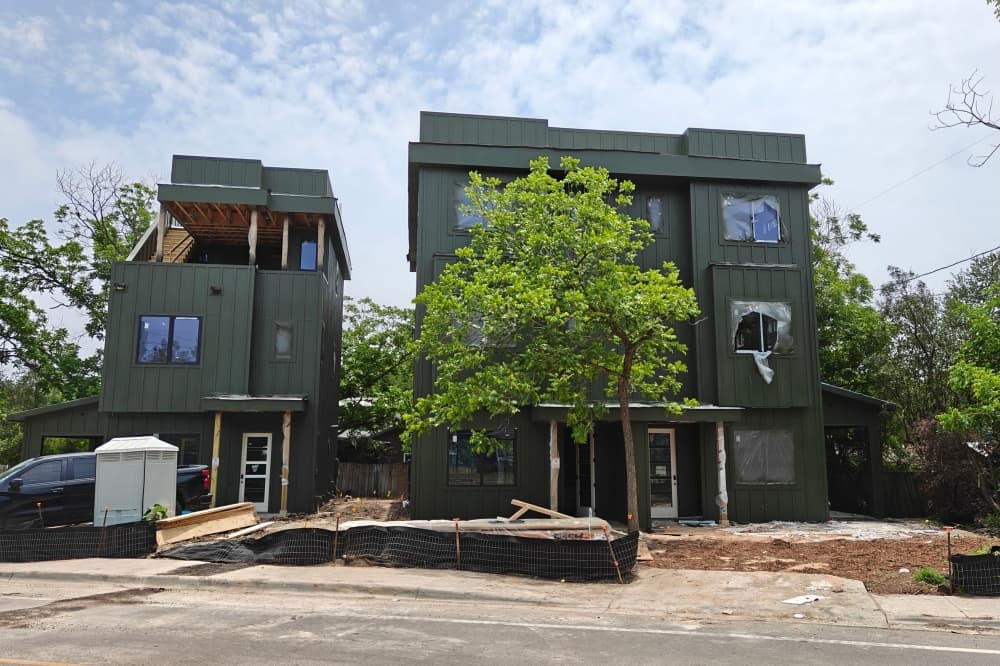
Austin officials asked to revise new development rules enacted under the Home Ownership for Middle-income Empowerment, or HOME, initiative, more than two years after the residential housing policy first went into effect.
“HOME is working, and we owe it to our city to enable it to do the most efficient and effective work possible to bring affordability and consistency in our policies to our entire city," said council member Krista Laine, who sponsored the update.
The overview
HOME's two phases, approved in 2023 and 2024, generally permitted up to three units of housing on most of Austin's residential lots and reduced the amount of land needed to build a house by more than two-thirds. City Council majorities advanced the land development code changes with the stated goal of creating more varied housing options that could be accessible at lower price points.
More than 600 applications for projects that'd add more than 1,200 new housing units were approved by the city under HOME Phase 1 as of this May, according to Austin Development Services. Phase 2 has generated less activity; about 40 small-lot buildings and half a dozen property subdivisions advancing as of this spring.
Zooming in
Laine said edits to the development code are now needed to improve its "clarity and predictability" after some residents, homebuilders and city staff reported issues with the process. She and some Austinites who testified on her resolution said aspects of HOME development rules have resulted in complex city reviews and even lawsuits, adding time and cost to new construction.
The resolution calls to reduce lot width and side yard requirements, simplify requirements for features like porches and garages, clarify that two homes are allowed on 3,600-square-foot lots—twice the HOME Phase 2 minimum—and improve the subdivision process for larger lots.
Specific issues with the policies so far weren't identified by Austin Development Services, which will be involved in the requested update.
"The transition from prior regulations to HOME has gone smoothly. However, as with most significant changes to the Land Development Code, staff and applicants have encountered some challenges," development services spokesperson Stephanie Sánchez said in an email. "We look forward to City Council’s guidance and will continue working with stakeholders to support HOME’s implementation."
By the numbers
Council's vote followed the Austin Board of Realtors release of a new HOME affordability report. That analysis was compiled months after the city released its first formal findings on HOME.
ABoR found HOME projects' sales prices and sizes were roughly half that of traditional single-family homes—although HOME units still cost well above levels considered to be affordable by federal standards. Of 57 HOME units built and sold in 2025, ABoR reported a median sales price of $750,000. That came in well below the $1.58 million median sales price of 115 non-HOME residences in the same period.
“The data speaks pretty clearly for itself that the home initiative is working," Taylor Smith, ABoR deputy director of government affairs, said in an interview.
While HOME is producing smaller and less expensive units, many residents said a $750,000 price point remains out of reach for working-class Austinites. ABoR estimated households of working medics or teachers can now likely afford homes up to $380,000.
Smith and some city residents said the HOME price gap represents a positive trend away from past policy that could become more impactful. ABoR projected a "filtering effect" of new supply that'll meet demand from higher-income households and leave existing housing for others over time.
“Today’s $750,000 builds will be next generation’s more affordable housing, in the same way that my house wouldn’t have been the price it was if it was built yesterday," said resident Riley Patterson, who owns an older small-lot home.
ABoR also forwarded proposals to further reduce construction costs, including some of the "technical corrections" addressed in council's May resolution. It also recommended simplifying HOME Phase 2 subdivisions and reducing limits on impervious cover, or land covered by buildings and driveways that can't absorb rainwater.
Put in perspective
Laine's resolution passed 9-1, with only council member Marc Duchen against, and a majority of resident commentary was in favor of the proposal. However, dozens of people also registered against the measure and Duchen laid out extensive concerns about policy impacts before council's vote.
In a presentation to his colleagues, Duchen outlined multiple cases of HOME resulting in more expensive projects that often replaced lower-cost existing homes.
“We need housing, we need incremental density. But what we’re seeing in cases is this expansion of luxury housing in the market that is displacing low- and mid-income Austinites," he said. "I’m uncomfortable cloaking everything we do under the cloak of ‘lowercase affordability’ when we’re seeing ... instances where that’s clearly not happening, where it’s clearly being used for a different purpose."
He and several residents also raised concerns with the May resolution's potential expansion of HOME beyond standard single-family areas into more specialized zones. For example, city development staff will now explore adding HOME allowances into the Lake Austin overlay, which restricts some development near the waterway, and several Neighborhood Conservation Combining Districts, or NCCDs, established to protect older parts of town.
North University resident Peter Journeay-Kaler said that area's NCCD already led to denser, smaller-scale housing and shouldn't be affected.
“These are housing types and overlays that should be studied for their successes. They are not failures of the city that need to be replaced," he said.
Pushing back on some of those worries, council member José Velásquez noted HOME is resulting in city-backed affordable housing and should be applied to neighborhoods he said were traditionally "insulated from opportunity."
"Exclusivity has consequences, and for decades it has helped push displacement and gentrification onto the Eastern Crescent while parts of this city have remained closed off from growth, affordability and a shared responsibility," he said.
What's next
Revisions requested in Laine's resolution will be presented to council by early December. City staff will also begin flagging other potential issues with HOME policies to the Planning Commission on a regular basis starting this year.
Austin's next comprehensive report on HOME's effects will cover emerging trends in the housing market, Sanchez said, although a timeline isn't determined. The first report was released nearly a year late, and Austin Development Services is not completing an interim report requested in council's adopted HOME ordinance due to a staff recommendation to collect another full year of data.
"Allowing more time would provide a more complete understanding of HOME’s effects as more projects move through both phases," Sanchez said.