CSL Plasma operates several plasma donation centers across Dallas-Fort Worth, with locations in McKinney, Grand Prairie, northeast Fort Worth and Dallas. CSL operates over 350 locations in the United States and Europe, according to the company website. Community Impact contacted the company to learn more about plasma donation, and got responses from Wlenyeno Elliott-Browne, the company’s global head of plasma quality. Answers have been edited for clarity and style.
Who can donate plasma? Are there any age, weight or health restrictions?
Generally, anyone in good health, between the ages of 18 and 74, who weighs at least 110 pounds, and meets eligibility and screening requirements can donate plasma. Prior to donating, every donor must complete a medical questionnaire, which is reviewed by a CSL staff member.
How often can people donate?
Based on U.S. FDA regulations, eligible donors can donate plasma twice in a seven-day period if there are two days in between. Additionally, the Cross Donation Check System, or CDCS, is used by the plasma industry to ensure people do not donate more frequently than FDA regulations allow.
Does CSL Plasma pay their donors? If so, why?
Plasma donors are rewarded because their efforts allow us to create life-saving therapies for people who rely on them. Payments are based on various factors on the day of donation, including a donor’s targeted collection amount, center location, and local incentives that may be in effect.
Is donation painful?
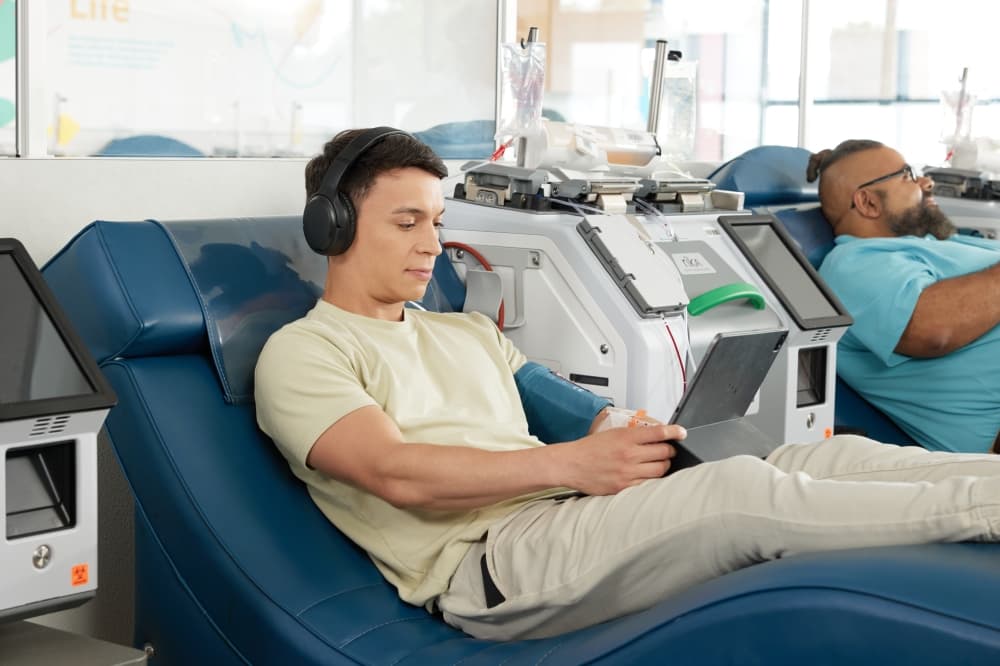
In general, people may experience mild discomfort when donating plasma, similar to when donating blood or having blood drawn. Donors often compare the feeling of the needle to a slight pinch or bee sting.
How long do donations take?
It usually takes 2-2½ hours for the first plasma donation, including a health assessment. Subsequent donation visits last 1-1½ hours on average.
What happens to the plasma after it’s donated? What is the plasma used for?
Donated plasma undergoes rigorous safety testing. After plasma is collected at a donation center, a sample of each donation is sent to a CSL laboratory to undergo multiple tests. Plasma is frozen and held for 60 days, per FDA requirements, before being shipped to manufacturing where plasma units are pooled for further testing and processing. During the manufacturing process, plasma proteins are separated and purified to develop a range of plasma-derived therapies for people living with rare and serious diseases and other acute medical concerns.
What's the need for plasma donations?
It can take hundreds to thousands of individual donations to treat one patient for a year. Each donation is a lifeline for people who rely on plasma-derived therapies.
What conditions does plasma treat?
Plasma-derived therapies are used not only for rare diseases, such as primary immunodeficiency, hereditary angioedema, and chronic inflammatory demyelinating
polyneuropathy, or CIDP, but also for acute and emergency conditions, including trauma, burns, shock, and certain maternal health complications.
Are there synthetic substitutes for plasma?
While CSL and others offer recombinant products, the plasma-derived therapies developed from the plasma we collect are the only option for many people.