


“I remember driving through Prosper, and there were horses being ridden up and down Preston [Road],” Ross said. “We just don’t see that anymore.”
Concerns about multifamily and density have continued to be points of conversation for Prosper officials over the last several years. This has resulted in some projects, such as Prosper Oaks, being tabled, while others, like additional housing at the Gates of Prosper, have drawn careful review.
Most recently, the Bella Prosper development was first presented in November and tabled to 2026 over those same concerns.
The gist
Development Services Director David Hoover said the town favors planned development districts, which is a zoning tool that allows officials more time to negotiate project details and standards with developers.
Drawing on Prosper’s comprehensive plan, Hoover said the town uses a soft cap of 7,000 multifamily units, a level the town is currently hovering around.
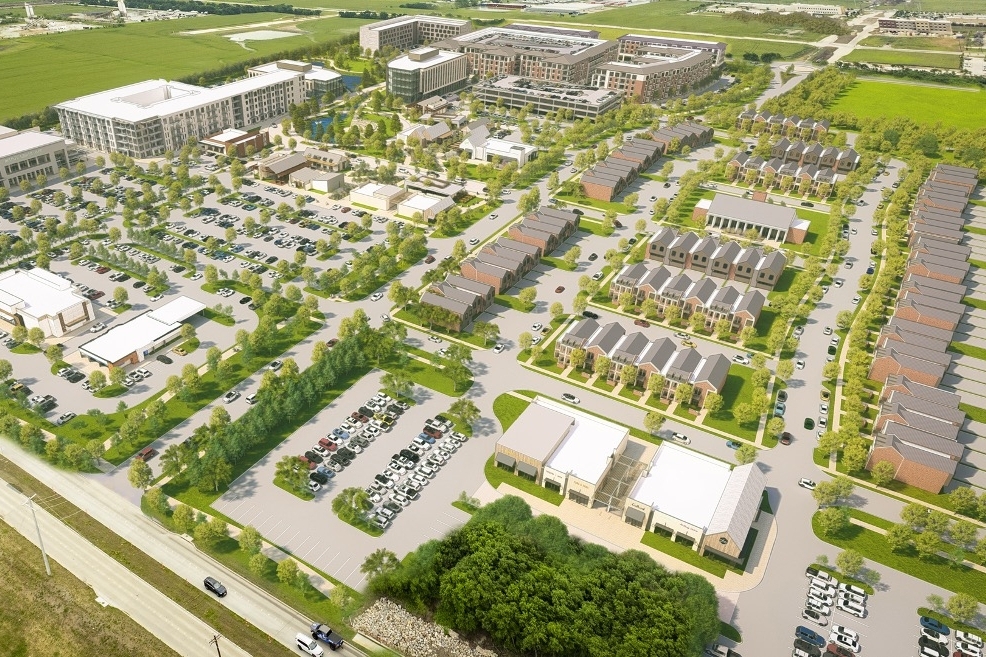
Prosper Oaks, a 775-home development off Parvin Road, was approved in October after being tabled several times. Meanwhile Bella Prosper, a proposed 62-acre mixed-use development off First Street, was tabled in November for the second time to February due to concerns about multifamily and project phasing.
Additional multifamily housing, replacing previously planned office space at the Gates of Prosper, was approved 5-2 by Town Council in August despite a unanimous denial recommendation from the Planning and Zoning Commission.
Council members raised concerns about the Gates’ apartment density, quality and alignment with Prosper’s 2024 multifamily development standards.
Deputy Mayor Pro Tem Chris Kern voted against the added units and said the increased density doesn’t fit with Prosper’s long-term vision.
The new units would have about 18 units per acre, while several existing Prosper apartments are closer to 15 units per acre, according to town data.
As multifamily development continues, Mayor David Bristol said council’s philosophy is to only approve additional multifamily along Dallas North Tollway, which was reinforced by the new standards.
“A developer has to bring us something that the council will see is special, unique [and] something of value to our community that would [warrant us] to go past that [cap],” Bristol said. “It’s the measuring ... stick that we’re using for all multifamily development.”
On the other hand
Scott Shipp, director of engineering for Blue Star Land, said during the Gates of Prosper discussions that the need for a variety of housing types is necessary to compete with similar mixed-use developments in the North Texas area.
“They have to have a multifamily component, or they’re not being built,” Shipp said.
Shipp and Bristol said attracting high-end retail clients, which they said many residents want, often depends on nearby housing density. Bristol noted development can help relieve the property tax burden on residents.
Kelly Underwood, multifamily industry professional for over 12 years, said mixed-use development offers a diverse, vibrant space and a variety of housing options.
“[Mixed-use] works really harmoniously if it’s planned and developed correctly,” Underwood said. “Thoughtfully planned communities that reflect the way a city wants to balance their homes ... are headed in the right direction.”
Cullum Clark, director of the George W. Bush Institute’s Economic Growth Initiative, said the housing density debate is a common issue in North Texas as the region’s population booms.
“Developers are going to want to build in Prosper, ... and local government is going to see benefits from allowing further growth,” Clark said.
What they’re saying
Ross said Prosper’s growth began to feel like “too much” after the Gates of Prosper opened, bringing more apartments and pulling Prosper from its small town roots.
“There’s no community left,” Ross said. “It’s a completely different town.”
Prosper resident Britney Stephens said she is “concerned about how Prosper is going to build out” because she lives off the tollway where more mixed-use development is starting to take shape.
“I’m concerned that Prosper is spending more time worried about their tax revenue ... [than] what this looks [like] for Prosper in the long run,” Stephens said. “The original Prosper feeling was ... small town, big heart, and that’s why we moved here.”
Looking ahead
Hoover said town officials are working to manage the “density equation” and mitigate its impact.
“So many people are moving [north], and they’ve got to go somewhere,” Hoover said. “You can’t stop growth and progress because people don’t want any place to change.”
Hoover said the town’s standard is that each new development is expected to be “better than the last.”
Bristol said the council is looking for high-quality developments that add value to the town when considering proposed projects.
“We only have three miles of tollway,” Bristol said. “If we get it wrong, now we’re going to be stuck with it for 50 to 75 years, and the council very much wants to get it right.”