Community Impact spoke with four computer science and artificial intelligence experts from the University of North Texas to discuss how data centers and AI function, and why Denton is attracting the technology.
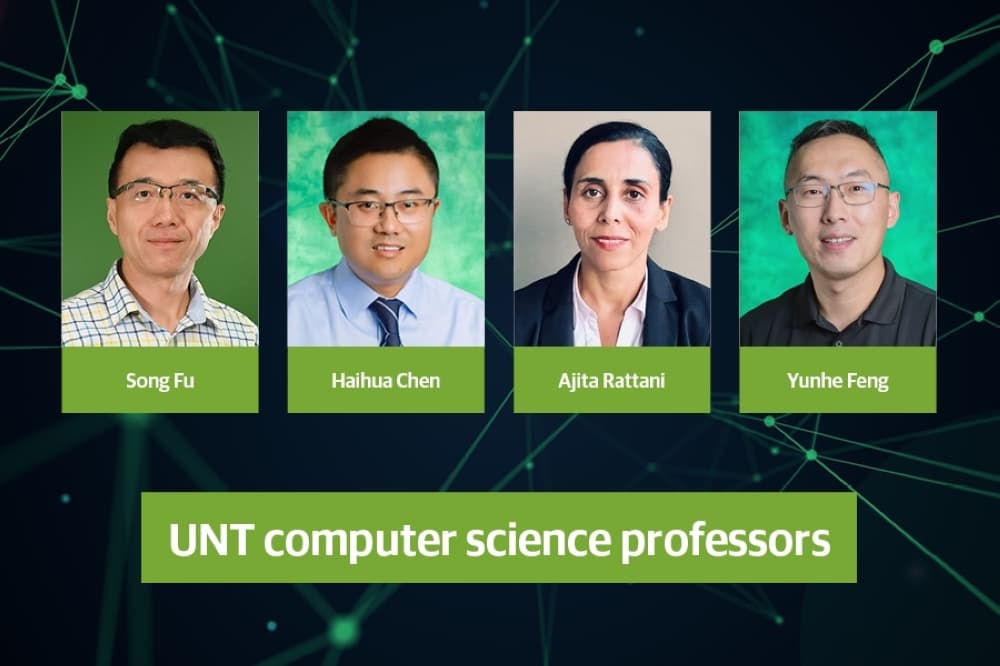
Community Impact spoke with:
- Song Fu, a professor of computer science and engineering and the director of the Applied Artificial Intelligence and Data Science Institute
- Haihua Chen, a professor of data science
- Ajita Rattani, a professor of computer science and engineering
- Yunhe Feng, a professor of computer science and engineering
Responses have been edited for length, clarity and style.
Can you explain in the simplest terms how large-language AI models like ChatGPT work?
Feng: The model learns from test data to recognize patterns. We can put in articles and papers and the language model can learn patterns from it to train. Then when we query it, it predicts the words to the answer based on the patterns it recognized when we put in the data.
Rattani: The [large language models] keep on adapting to new queries whenever users interact. They can learn with text as well as images, audio, all that. They can learn richer context and they can do far more sophisticated things.
Fu: I did a quick search on ChatGPT to ask how much data was used to train you, and for the GPT 3 model, it’s used about 400 billion tokens of text, so that’s millions of books. For the new model, like GPT 4 and 5, the number of tokens reaches about 10 trillion tokens. That’s probably 10,000 times larger.
What is a token?
Feng: You can look at tokens as the smallest unit of measurement, like a word count. For example the word “strawberry” can be split into multiple tokens instead of one token. Maybe “straw” is one token and “berry” is another token. For English tokens, one token is equivalent to roughly 0.75 words.
How do data centers factor into AI? Why do we need them for AI?
Rattani: AI models are very large scale, which means they can have up to trillions of parameters which we adjust or optimize by using the training data. The number of data points requires large computing resources, large networking, everything. This is why data centers are coming into play.
Chen: I think data centers provide a high-performance [Graphics Processing Unit] like computing resource and accelerators that can specialize in AI computing. We need massive storage to save the data set to train the model. Also, the data center provides reliable power and cooling infrastructure that can enable the training to run continuously.
Fu: To train the model, it will process a huge amount of data, try to find the pattern and then to optimize the millions of parameters. That will use a lot of computation power, so that's why we need data centers.
What is the attraction of AI training and development in North Texas, specifically the Denton area?
Fu: To build the data centers, we need the power and space. For Denton, [the city has] a power plant next to the data centers to provide a power supply. It’s close to the community airport in Denton and there’s a lot of open space around there. I think for both the power and space, Denton is well positioned for both.
Another thing is North Texas is becoming a technology corridor. A lot of big [information technology] companies are moving specifically to North Texas, and UNT has a lot of people with expertise in AI, data science and high-performance computing. I think this is a good combination of both resources and intelligence.