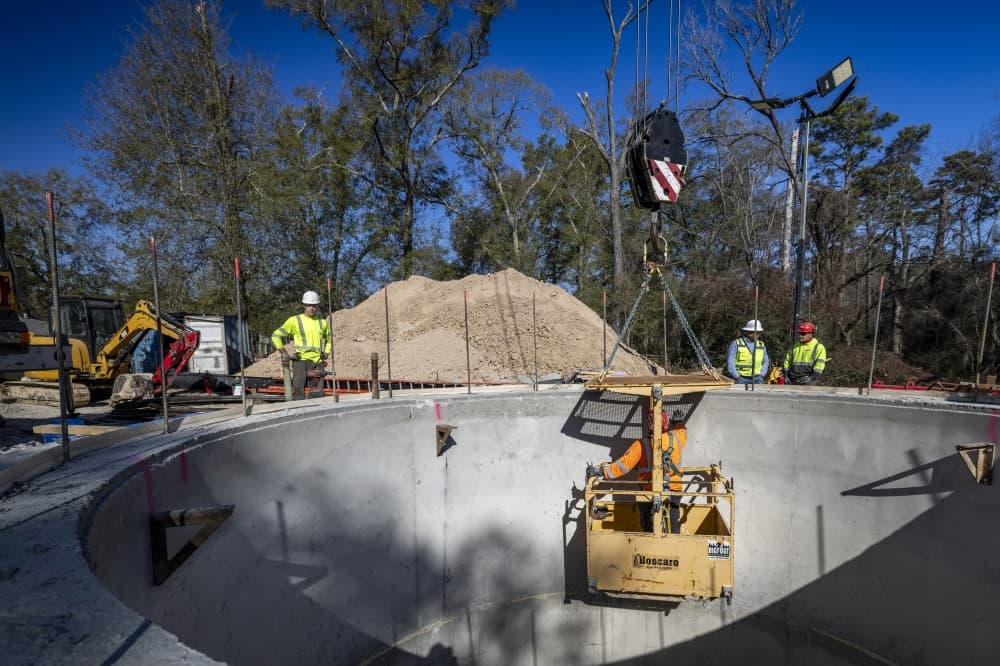
Construction crews work at a launch shaft in Cypress Feb. 24 on a project connecting local water receiving facilities to surface water sources. (Daniel Arizpe/Community Impact)
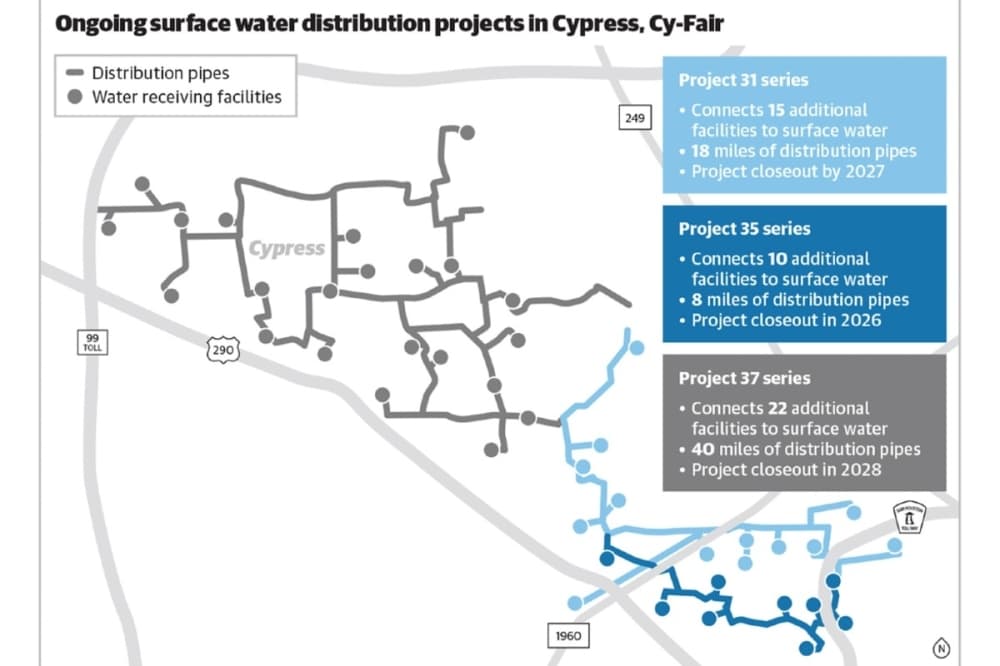
The North Harris County Regional Water Authority has approximately $406 million worth of construction projects planned for 2026—with several in the Cypress and Cy-Fair areas—as part of its decades-long effort to keep up with a state-mandated groundwater reduction plan.
The big picture
The NHCRWA is responsible for carrying out surface water conversion projects across northwest Harris County as mandated by the Harris-Galveston Subsidence District, or HGSD. The HGSD’s regulatory plan aims to reduce groundwater pumping to combat subsidence, or land sinking, by requiring entities to gradually increase their surface water supplies.
Entities within HGSD’s jurisdiction were supposed to have at least 60% of their water supplies sourced from surface water, such as Lake Houston and the Brazos River, by the end of 2025.
However, the NHCRWA has only achieved about 35% conversion to surface water, officials said, citing challenges related to COVID-19, supply shortages and easement delays. Program Manager Amber Batson said the 60% benchmark is a roughly $2 billion initiative that likely won’t be completed before 2031.
Additionally, NHCRWA District 3 Director Melissa Rowell said the total conversion requirement, 80% surface water sources by 2035, could cost nearly $10 billion in capital improvement projects.
"The surface water conversion is happening,” said Rowell, who represents parts of Cy-Fair and Jersey Village on the five-member board of directors. “The real policy question is whether the financing structure is fair to existing homeowners.”
NHCRWA surface water conversion projects also extend into the Spring area east of I-45 and could reach Tomball in the future, according to the authority's 2026 Capital Improvement Plan. (Community Impact staff)
Diving in deeper
As a non-taxing entity, the NHCRWA collects revenue through water fees typically billed through municipal utility districts. Despite the growing debt projection, the NHCRWA board has reduced water rates three times since 2022.
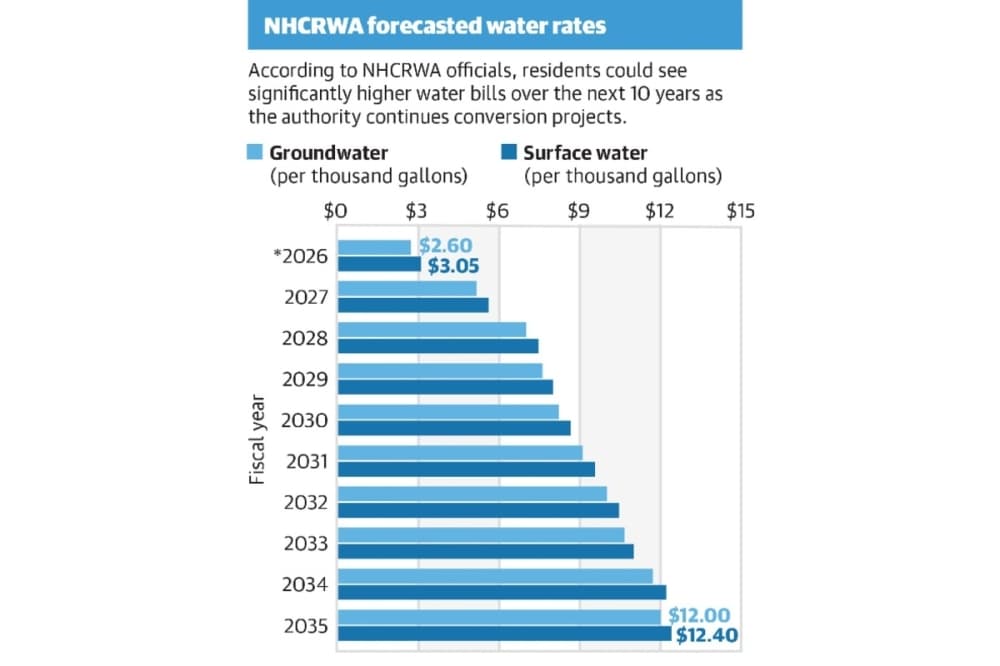
However, Rowell said rates must inevitably increase to pay off the debt—likely tripling within the next 10 years. She expressed frustration with the fact that local authorities are responsible for financing the conversion, which ultimately trickles down to water customers. Rowell voted in favor of the three rate cuts.
HGSD General Manager Mike Turco said the state established the district to mitigate subsidence through groundwater regulation, and HGSD is prohibited from buying or selling water. Water authorities were then created to carry out related infrastructure projects.
“We have continued to impress upon them the tools within the regulatory plan if they’re having a delay or an issue with the timeline,” Turco told Community Impact.
The NHCRWA board of directors set the fiscal year 2026 water rates during its Jan. 5 regular meeting. (Community Impact staff)
The HGSD offers two options to avoid a disincentive fee of $12.52 per thousand gallons for failing to meet the required conversion timeline.
Water authorities can earn Over Conversion Credits by using less groundwater than what’s mandated in the regulatory plan, Turco said. The NHCRWA has accumulated OCCs over time but could deplete its balance within the next one to three years, officials from the authority said.
Secondly, Turco said authorities can earn credits by sponsoring the HGSD’s Water Conservation Program, such as purchasing education kits for schools. The NHCRWA is the only local authority that does not participate in the education credit opportunity, he said.
Rowell said the conservation credits are not enough to address a five-year construction lag.
“We need to make sure existing homeowners are not being asked to bankroll infrastructure that will primarily serve future growth,” she told Community Impact.
A quick note
A majority of the NHCRWA’s capital projects are funded by the State Water Implementation Fund for Texas, or SWIFT bonds, which provides financing for projects in the state water plan. About $396 million SWIFT dollars were allocated to NHCRWA projects for 2026, according to a five-year capital improvement plan approved Feb. 2.
The NHCRWA spent approximately $500 million to hit 30% conversion, which the authority achieved by 2010 as required by the HGSD, per the CIP. The authority will need to submit another application for SWIFT funds in 2027, the plan shows.
HGSD's regulatory plan includes three benchmarks for local water authorities to reduce groundwater reliance:
2010: No more than 70% total water demand met by groundwater
2025: No more than 40% total water demand met by groundwater
2035: No more than 20% total water demand met by groundwater
Why it matters
Turco said subsidence is “slower than other natural disasters,” which is why it isn’t always a top-of-mind concern when thinking about water supply. He said because the region is generally flat, a small amount of elevation change could increase flood risks, even in non-coastal regions like northwest Harris County.
“Once it occurs, it’s irreversible,” Turco said. “That’s why we have to get in front of it, and we have to prevent it as we’re moving along.”
The HGSD board has approved approximately 34,000 groundwater well permits over the last five years, but only about 2% of those were new wells, he said. All permits in the district’s jurisdiction must be renewed annually.
To track sinking, the HGSD established a subsidence monitoring network of GPS stations that can measure land surface deformation. Additionally, Turco said the district recently implemented satellite technology called InSAR that can measure millimeter-scale elevation changes.
Subsidence rates measured a local monitoring stations include:
Ault Elementary School: 10.8 cm vertical displacement since 2015
Cypress Falls High School: 12.5 cm vertical displacement since 2015
Jersey Village High School: 8 cm vertical displacement since 2015
Ash Green Drive: 20.7 cm vertical displacement since 2011
Between FM 1960 and Windfern Road: 61.2 cm vertical displacement since 1999
Kirk Elementary School: 10.4 cm vertical displacement since 2015
What's next?
The HGSD will hold a public hearing April 30 in Friendswood to present the 2025 Annual Groundwater Report, which includes updated information about measured subsidence, groundwater use, groundwater levels and climatic conditions in its regulatory areas.
Community members can review past groundwater reports and register to watch the hearing virtually on the district’s website. Public testimony must be given in person or emailed to [email protected] before May 8.
Residents can also hear local project updates at NHCRWA board meetings, held the first Monday of the month at 3648 Cypress Creek Parkway, Ste. 110, Houston. The next regular board meeting is scheduled for 6 p.m. May 4.
“We have tools within the regulatory plan to be able to deal with these short-term timeline issues, and we look forward to working with everybody that needs to discuss those things,” Turco said.