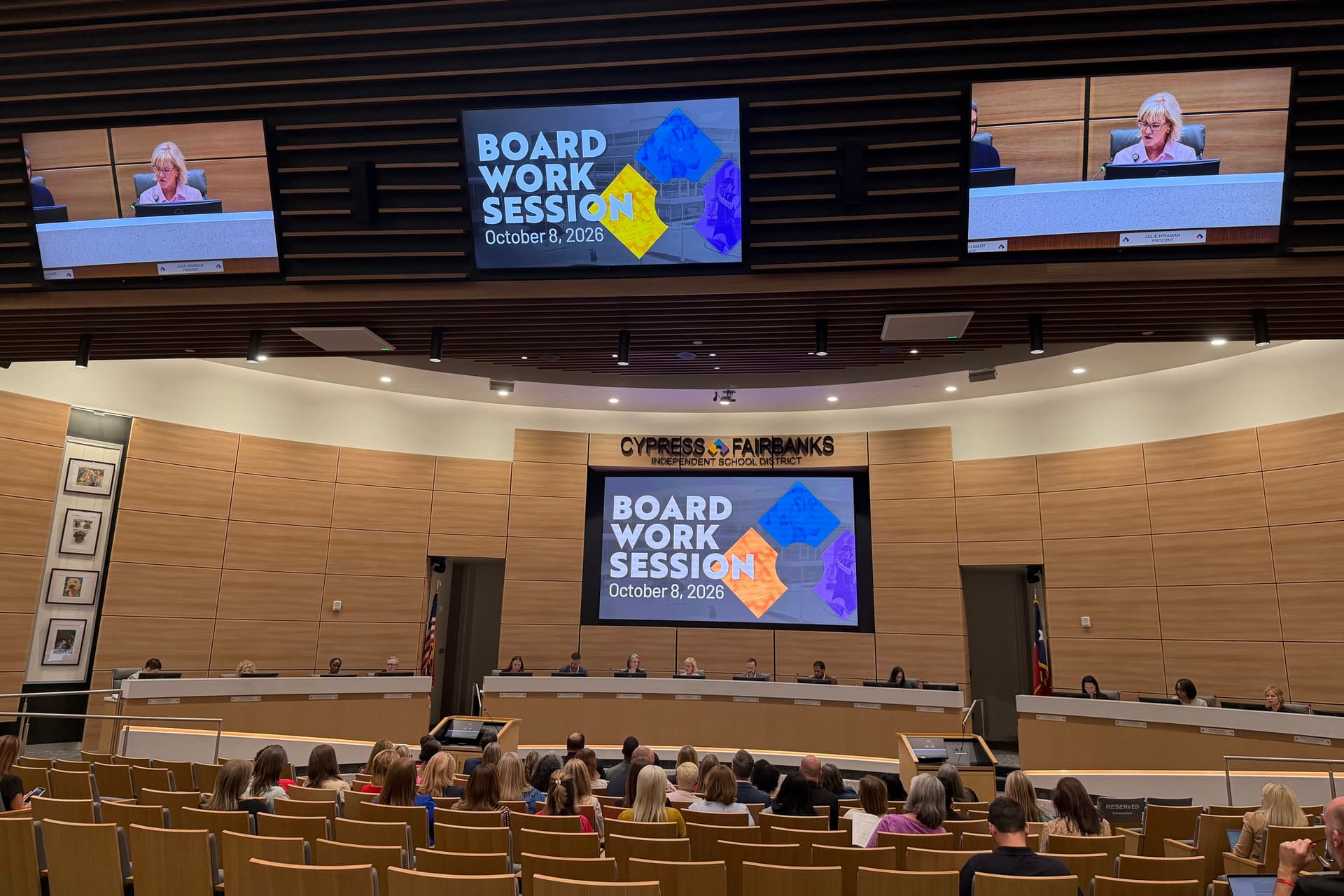
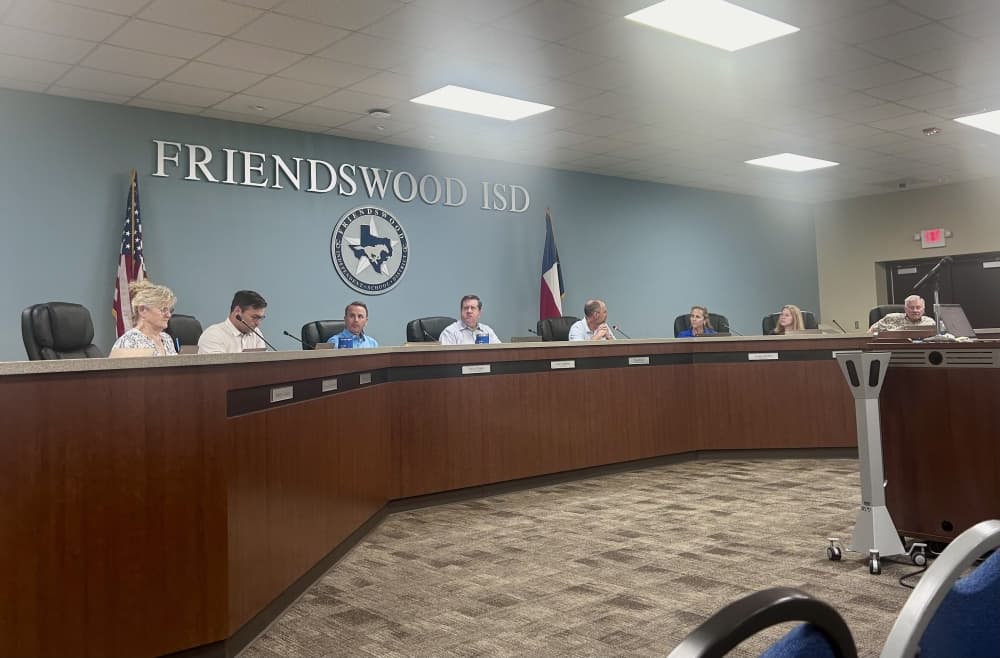
The Cy-Fair ISD board of trustees called a four proposition bond, and voter-approval tax rate election for November during the Aug. 10 regular meeting. (Courtesy Cy-Fair ISD)
The Cy-Fair ISD board of trustees called for a 12-cent voter-approval tax rate election, or VATRE, on Aug. 10 for the Nov. 3 general election in a 6-1 vote, with trustee Christine Kalmbach opposed.
The fiscal year 2026-27 budget with an estimated $80.9 million shortfall and a projected ending fund balance of $437 million was approved June 22 in a 6-1 vote, with Kalmbach opposed.
What we know
Superintendent Doug Killian said the district’s financial issues are a result of a lack of revenue—not overspending.
The average funding per student from maintenance and operations, or M&O, taxes for school districts in the Houston area with over 10,000 students was $11,165 for FY 2025-26, while CFISD receives $9,798 per student. Chief Financial Officer Karen Smith said this gap in funding has been present for many years, and that the 20% local homestead exemption offered by CFISD is a primary factor, along with other statewide issues.
The district misses out on $72 million in M&O revenue from the exemption as state funding formulas do not account for it, Smith said. Texas law restricts reduction of the exemption until Jan. 1, 2028, and Smith said CFISD has offered the exemption since 1983.
“While CFISD believes in this benefit to homeowners, it directly reduces revenue the district can collect locally,” Smith said.
Smith said with the anticipated shortfall, administration and board members began discussing the possibility of holding a VATRE in April.
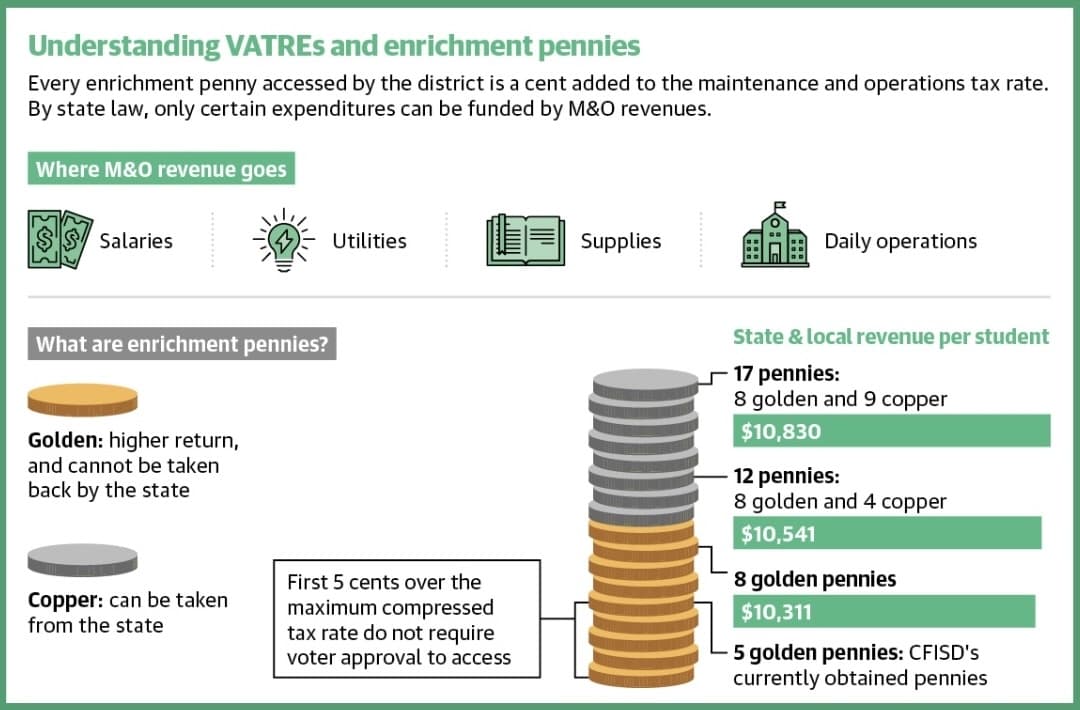
Texas school districts have the ability to raise their M&O tax rate by 17 cents over the maximum compressed tax rate, or MCR, as determined by the Texas Education Agency. State law allows districts to access five pennies without voter approval, which CFISD has already done, and the district must turn to voters to access the other 12.
During the May 7 work session, Killian originally discussed a 7-cent increase but later recommended the full 12-cent increase June 18. Per the election notice draft, the increase would bring an additional $102 million in revenue to the district. CFISD’s board of trustees adopted the FY 2026-27 budget with two one-time contingency stipends for full-time hourly, paraprofessional and full-time employees, dependent on a successful 12-cent VATRE in November.
“If the VATRE passes, it will help the district eliminate the deficit, remain competitive with neighboring districts, strengthen recruitment and retention and sustain existing programs,” Smith said
If the VATRE fails, Smith said the district will immediately implement zero-based budgeting and examine necessary reductions to preserve the district’s financial position.
State & local revenue per students are estimations for FY 2026-27 (Source Cy-Fair ISD/Community Impact)
Zooming out
Texas school districts faced various financial challenges recently, such as increasing inflation, declining student enrollment and underfunded state mandates.
Smith said state inflation increased 24% from September 2019 through August 2025, and state funding per average daily attendance needed to increase $1,200 to match the purchasing power of 2019. It has increased by $55 in that time.
“While businesses can pass on cost increases to the consumer, school districts do not have that option and must absorb the costs under existing funding formulas, which have not been adjusted for inflation,” Smith said.
According to a Texas 2036 enrollment trend report, the state saw 76,000 fewer public school students in the 2025-26 school year. Smith said CFISD lost most than 3,200 students in the 2025-26 school year, and demographers project a further loss for 2026-27.
House Bill 3 requires an armed officer be assigned at every public school. Smith said anticipated expenditures to meet this requirement are expected to exceed the anticipated state funding.
“When this happens, school districts are forced to pull money out of their existing operating budgets to meet these legal requirements,” Smith said.
CFISD has also experienced financial effects from several statewide issues:
$5.3 million: in anticipated HB 3 funding with an expected $16.5 million cost
$17 million: decrease in state funding from enrollment decline in FY 2025-26
$20 million: drop in revenue from SHARS reimbursements
In case you missed it
In FY 2024-25, CFISD cut staff and bus routes due to budgeting concerns, but the board approved reinstating bus routes for the 2025-26 school year following parental backlash, according to previous Community Impact reporting.
During the June 18 work session, board President Julie Hinaman said the district is spending $60 million on transportation, while the state offers $8 million in funding.
“That’s another reason why we’re talking about coming to the community and asking for help and assistance,” Hinaman said. “That if that’s something you value, we need help to cover those costs, because we can’t do it all.”
The board of trustees considered reinstating librarian positions in the FY 2026-27 budget as well, but did not reach a majority decision.
How we got here
May 21: projected shortfall: $67.4 million
Killian recommends 7-cent VATRE
Board majority adds $500 one-time stipend and increased health insurance contributions to proposed budget, totaling $13.5 million
June 18: projected shortfall: $80.9 million
Killian recommends 12-cent VATRE and discusses adding contingency stipend to proposed budget
June 22: projected shortfall: $80.9 million
FY 2026-27 budget is adopted in 6-1 vote, adds two one-time contingency stipends dependent on a successful 12-cent VATRE
The board unanimously approves an efficiency auditor
July 3: efficiency auditor selection deadline
Aug. 6: planned board work session
Aug. 10: planned regular board meeting
Recommendations for a 12-cent VATRE and a $1.63 billion bond referendum placed on the agenda
Aug. 17: deadline to call VATRE and bond election for November 2026 general election
Also of note
The board of trustees approved a $1.63 billion bond referendum for the Nov. 3 ballot on Aug. 10 in a 6-1 vote, with Kalmbach opposed.
Smith said the district formed a Long-Range Planning Committee intended to evaluate and assess the district’s current and future needs. The committee, composed of parents and community members, presented a bond recommendation to the board of trustees earlier in the year after evaluating district infrastructure and program needs, per previous Community Impact reporting.
The committee recommend the board of trustees address:
Current and future program needs
Transportation and police vehicle fleet
Technology infrastructure and instructional technology