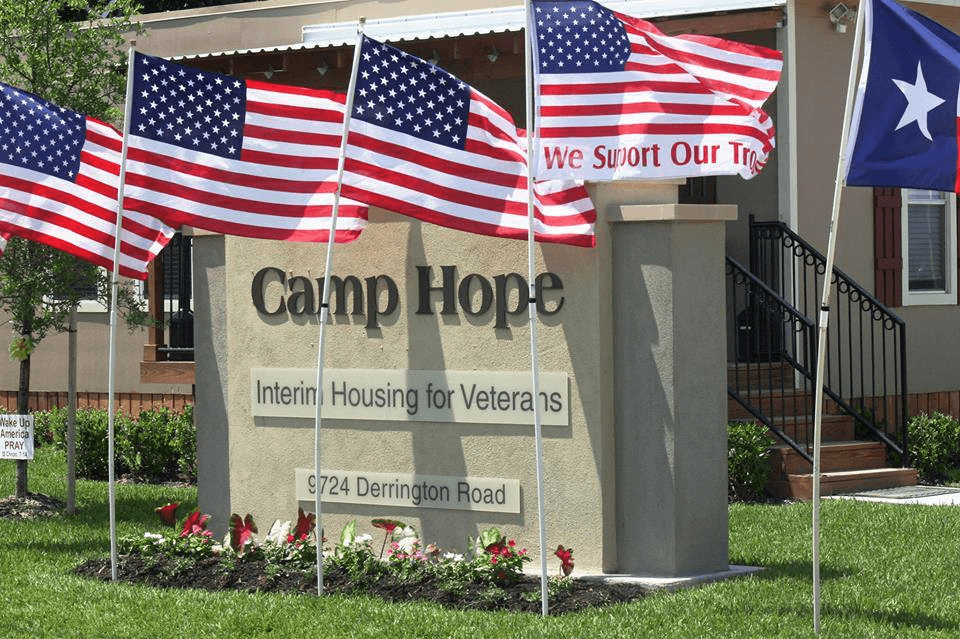
PTSD Foundation of America extends its programs to veterans, establishing interim housing in a healing community. (Courtesy PTSD Foundation of America/Camp Hope)
With the goal of protecting veterans, enriching their lives and encouraging healing, the PTSD Foundation of America continues its mission through Camp Hope, a local healing community and interim housing program.
To date, 2,700 veterans have attended the program at Camp Hope. Including $1.5 million in in-kind donations in addition to private grants, Camp Hope costs nearly $7 million annually to operate. Receiving no federal funding doesn't stop this Christ-centered organization from helping as many veterans as it can and setting its eyes on expanding.
How it happened
The PTSD Foundation was founded in 2005 as IMPACT 21 by Gene Birdwell, a former Air Force Civil Engineer. The organization was created to serve veterans suffering from the effects of combat-related trauma, which can lead to homelessness, suicide or chemical dependence.
Birdwell renamed the organization the PTSD Foundation of America in 2008. By 2012, Camp Hope was established to provide a sustainable approach to veteran support.
Today, Camp Hope offers interim housing as well as peer-led trauma recovery for combat veterans in Houston. With Christ at the center of its mission, this organization continues to instill hope and provide healing to veterans as they reintegrate into the society they risked their lives protecting.
“No one teaches them how to reintegrate back into society … the biggest thing is the loss of identity,” said Chris Knight, president and CEO of the PTSD Foundation of America, as well as a retired U.S. Army Sergeant Major.
The details
Camp Hope houses up to 108 veterans at a time, at no cost to them. With 52 employees currently on campus, and another 53 employees across its corporate office and five outreach locations, the program intends to deliberately expand to reach higher and further than before.
According to Knight, 70% of veterans who come to Camp Hope struggle with unaddressed childhood trauma. Meanwhile, at the time of intake, 55-60% of veterans are homeless and 90% struggle with chemical dependency.
Camp Hope doesn’t only serve veterans from Texas; 45% of veterans who find Camp Hope are from out of state and found their way through word of mouth or referrals.
With the goal of protecting veterans, enriching their lives and encouraging healing, the PTSD Foundation of America continues its mission through Camp Hope. Courtesy Camp Hope/PTSD Foundation of America
About the program
Veterans come to Camp Hope and participate in this 6-9 month program voluntarily. They can leave at will, and if they do, Camp Hope provides referrals to programs that might be a better fit for them, Knight said. As it stands, strong support from local businesses, community members and in-kind giving maintains the resources veterans of this program so desperately need.
Camp Hope also acts as a bridge between veterans and their families. Through family support groups and coordinators, the program offers family counseling as needed to help members understand behavioral changes and give them resources to better support themselves and the veteran member they love.
Transition support services provided include:
Peer counseling
Identification of resources and community support
Network development support
PTSD, substance abuse dependency and co-dependency education resources
Family empowerment
Money management education
These services are listed on the organization's website.
Veterans also have access to on-site psychotherapy with licensed mental health clinicians as well as medical care when needed and chaplaincy, which speaks to the spiritual needs of each veteran and the heart of what Birdwell established in 2008.
Some context
Over the past 13 years, more than 16,000 combat veterans from all branches and their families have found healing through the foundation's outreach programs and Camp Hope, according to the organization’s website.
The lack of federal funding was a direct trade-off for formalizing its Christ-centered curriculum and values nearly two years ago. Funding for the program relies on organic, mission-aligned support. However, while the program faces a funding challenge, every dollar it raises goes directly toward the veterans in need.
Knight attributes the success of this program to not only the staff and volunteers who run the housing and peer-mentorship on site, but also the clinicians who give their services, and the surrounding community that supports this essential life-saving initiative.
“I don’t think it would be what it is today without Houston, Texas,” said Knight.
Looking ahead
The program’s biggest needs are awareness, donations and volunteers.
As Camp Hope continues its deliberate expansion, Knight said the program hopes to offer a women’s program, Camp Faith, as well as peer-mentor certification courses that allow mentors to reach their full potential by expanding into rural locations and national regions.
Knight encourages community members to tour Camp Hope, inquire about volunteer opportunities and attend fundraising events.
“People don’t understand the true impact until you come [to] see Camp Hope,” said Knight.
The Foundation currently operates chapters in five states and six major metropolitan areas, including Houston, San Antonio, Dallas, Atlanta and Tampa, according to the website.
Get involved
Community members can review the list of urgent needs, such as clothing, toiletries, pillows, blankets and sheets here. Information about volunteering opportunities and upcoming events is here, and donations can be made directly on the website.