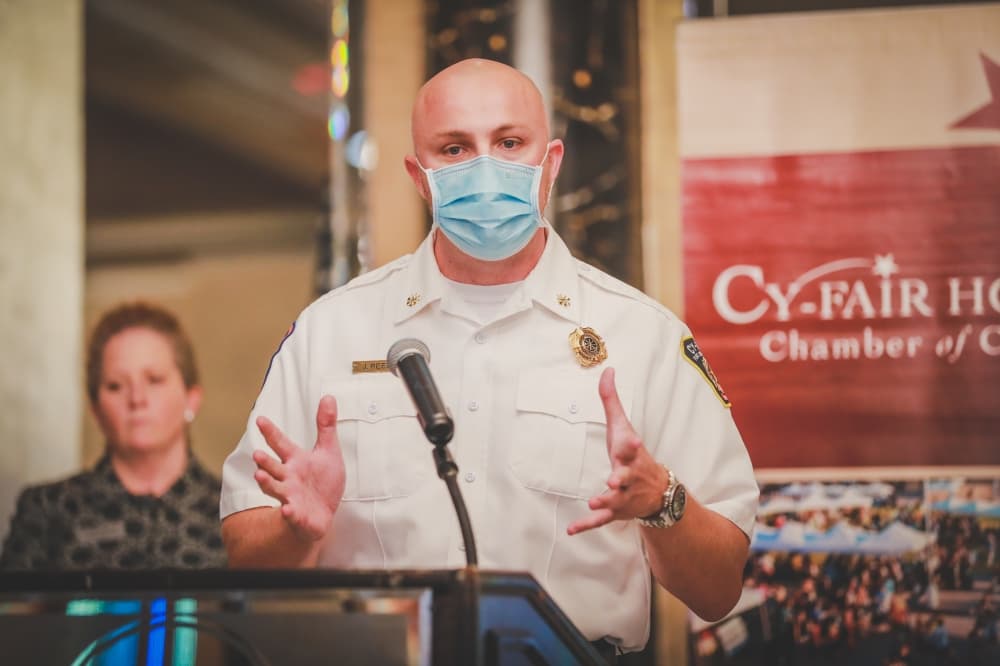
Justin Reed has 15 years of experience as a paramedic in Harris County and currently serves as the assistant chief of EMS for the Cy-Fair Fire Department. He said the most recent COVID-19 case surge has consistently overwhelmed the local health care system at unprecedented levels since the beginning of August.
“Hands down, the worst I’ve ever seen in my career, and I just can’t fathom seeing it [get worse]. To get worse than what it is right now is a complete failure,” Reed said in an Aug. 19 interview with Community Impact Newspaper. “We’re managing, but anything worse than this—that’s that tipping point, that’s that breaking point where we start having massive failures.”
As of Aug. 17, there were 39,901 active cases of COVID-19 in Harris County. This includes 6,158 across the 10 ZIP codes that fall within Cy-Fair ISD’s boundaries. More than 450 Cy-Fair residents have died with COVID-19 since the start of the pandemic, and at least 100 of those deaths have occurred in the past three months, according to data from Harris County Public Health.
But patients who do not even have the virus are dying due to a lack of resources because the local health care system is inundated as officials manage the most recent wave of COVID-19, Reed said.
“The problem is the surge and the overload on the current health care system—from the EMS providers in the field to the [emergency departments] to the actual ICUs,” he said. “It’s so overwhelmed that a typical patient who comes in from a car accident who may need a massive resuscitation—that in normal times would be just business as usual and they would be absolutely fine—right now the resources just aren't available to give them every chance that we know that we can give them.”
For instance, paramedics typically aim to get a heart attack patient to the cardiac catheterization lab in under 40 minutes, and Reed said getting them in even 10 minutes sooner can make all the difference in that patient’s recovery.
Today, Reed said he cannot guarantee patients will get into that lab within 60 or even 90 minutes. The process takes longer, not because of a shortage of hospitals or of EMS equipment but because of staff shortages, capacity limitations and increased 911 calls.
“Right now, when we take a patient to a hospital, our time on task has increased from an hour from when the 911 call is made until that truck is ready to respond to another call. Now we’re seeing seven hours—seven hours from when you call 911 until your loved one is in a bed in acceptable care, and that ambulance is now available,” he said.
Reed said his department is seeing an uptick in 911 calls from individuals who cannot access routine health care from their regular physician or telemedicine appointments because the health care system is so overwhelmed.