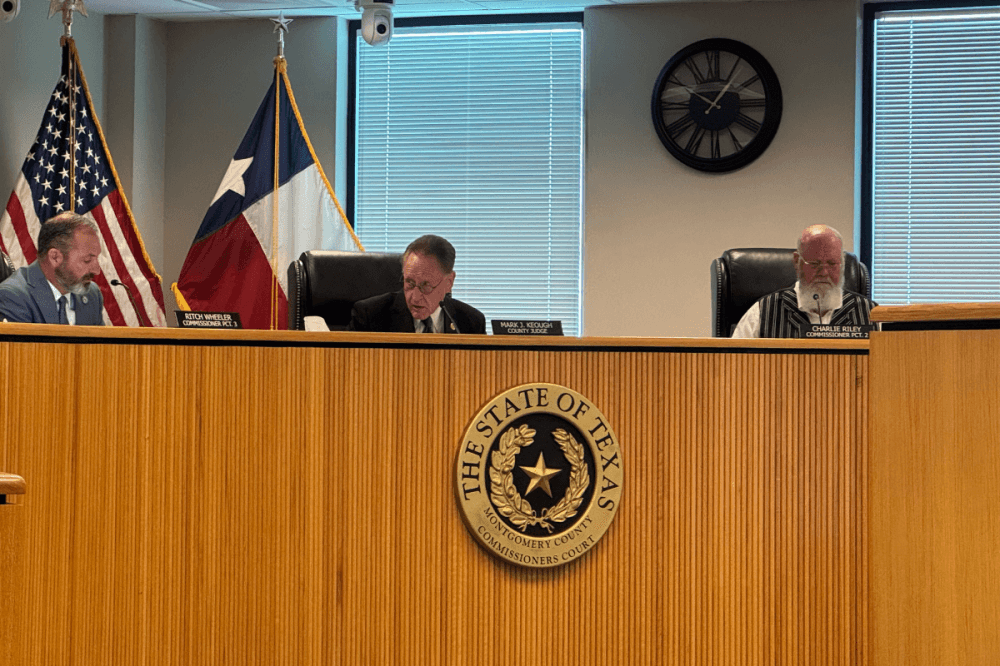
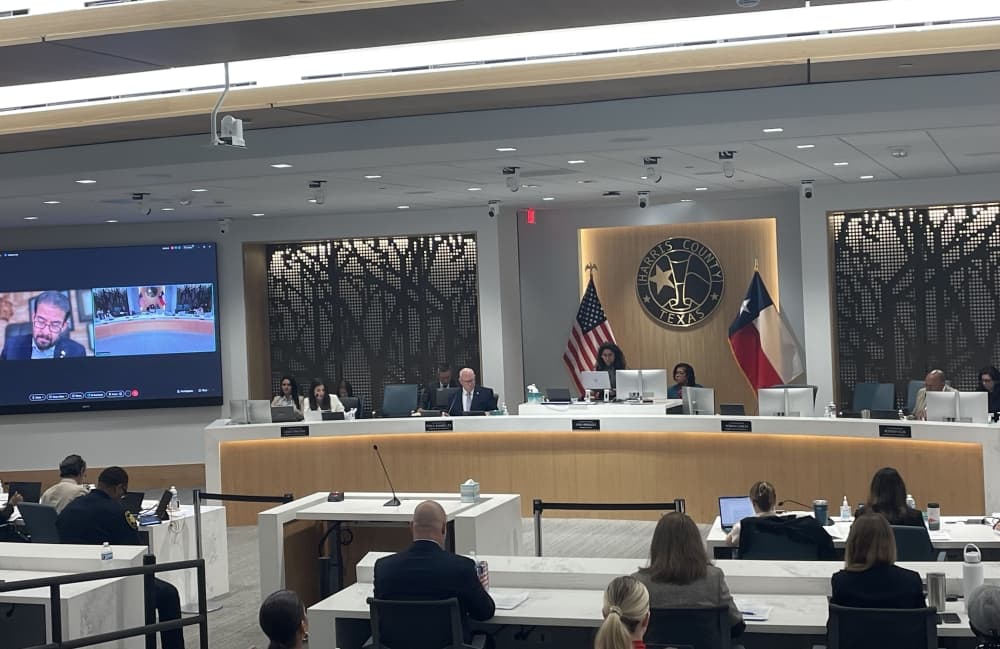
Montgomery County commissioners stopped short of calling a November bond election for a proposed justice center Aug. 6, with members of the court saying too many questions remain about the building’s size, cost and long-term capacity.
The court had been scheduled to consider an order calling a Nov. 3 bond election and to discuss potential funding scenarios. After more than 45 minutes of discussion, a motion tied to the bond was rescinded and commissioners took no action on either item.
Instead, commissioners discussed holding additional workshops on the justice center after the county finishes its upcoming budget process, tentatively planning a workshop after Sept. 1. The deadline for counties to order a measure for the Nov. 3 election is Aug. 17, according to the Texas Secretary of State.
What happened
Brinkley Sargent Wiginton Architects presented several options for the proposed downtown Conroe justice center, including a 10-floor concept with a basement. One option shown to commissioners totaled about 316,000 square feet and included a 777-space parking garage.
That option carried an estimated total project cost of about $342.3 million in January 2029 dollars, which architects rounded to about $350 million. The presentation included two unfinished shell floors for future expansion and assumed 21 courts.
But commissioners quickly questioned whether even that plan would provide enough space.
Judge Kristin Bays, who presides over 284th District Court, told the court during the Aug. 6 meeting that the county currently has 23 judges operating with 17 courtrooms. She said the county could need 27 courtrooms if four additional courts previously supported by commissioners are ultimately approved by the Texas Legislature.
The architects also recommended placing three courtrooms per floor rather than four because of the number of people who would move through each level. The site previously selected by commissioners limits the building footprint, which means additional courtrooms would largely have to be added vertically.
What they’re saying
Precinct 2 Commissioner Charlie Riley, who has supported addressing the county’s courthouse needs, said the compressed timeline was his main concern.
“It’s too fast to do this for November,” Riley said. “We need to put this off to May or November next year.”
County Judge Mark Keough also said the latest numbers did not match what commissioners had previously been working from.
“Here we are sitting here, and we’re still confused about this,” Keough said. “I don’t think we’re ready to move forward on this at all.”
Precinct 3 Commissioner Ritch Wheeler said he wanted more input from the people who would actually use the building before locking in a plan.
“We need their input. We need the tax assessor’s input. We need the clerk’s input,” Wheeler said. “We need a committee.”
Precinct 4 Commissioner Matt Gray raised similar concerns about asking voters to authorize hundreds of millions of dollars before the county has a long-term plan.
“I refuse to be a part of something that’s not sustainable and doesn’t plan through 2050 or ’60,” Gray said.
Precinct 1 Commissioner Robert Walker questioned whether the county should reconsider the site itself, saying a larger piece of property could allow the county to build outward instead of continuing to add floors.
“I think we need a bigger footprint,” Walker said. “That way we can spread out and ... not start talking about 10 stories.”
How we got here
Commissioners voted 4-1 in March to seek architectural services for a new justice center at a site adjacent to the Alan B. Sadler Commissioners Court Building. Wheeler cast the dissenting vote at the time, questioning the proposed location.
Earlier estimates ranged from about $250 million for a courthouse alone to as much as $700 million under broader courthouse and jail scenarios.
On July 9, commissioners unanimously selected BSW Architects to begin refining the previous facility study and developing a firmer project estimate as the possibility of a November bond remained in play, as previously reported.
At that point, officials said a cost estimate would need to be developed quickly enough for commissioners to make a decision before the August election deadline.
What’s next
For now, the justice center will head back into discussions rather than onto the November ballot.
Commissioners said they want the architects, judges and county departments involved in developing a more complete plan before the court decides how large the facility should be—and how much voters could ultimately be asked to approve.
As Riley put it during the discussion, the concern is building something that is “too little” almost as soon as the county moves into it.